
TL;DR:
- Effective onboarding in small firms emphasizes role-specific training that builds competence and improves retention. Structured training with clear milestones, mentorship, and real tasks accelerates early productivity and reduces turnover costs. Technology tools like onboarding platforms support consistency and tracking, especially for remote teams, enhancing overall training effectiveness.
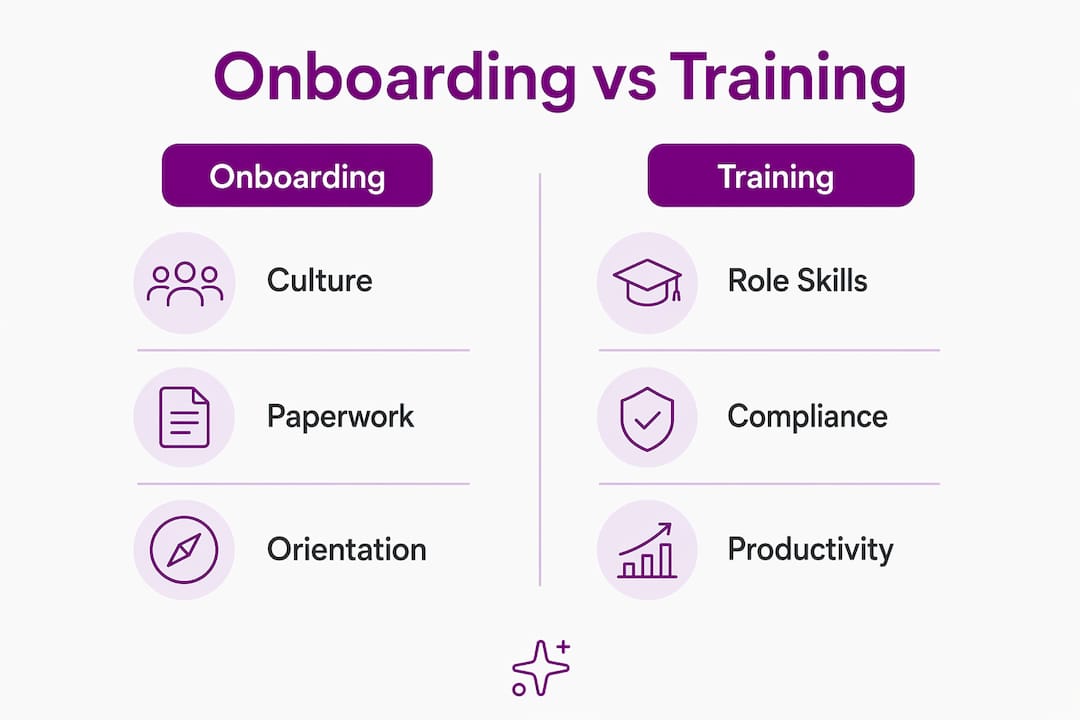
Training in small business onboarding is defined as the structured, role-specific skill-building process that equips new hires to perform their job from day one. It is distinct from general orientation, which covers culture, policies, and paperwork. The industry term for this combined process is "structured onboarding," and training is its most productive component. Research from Korn Ferry shows that structured onboarding with training improves new-hire retention by up to 82%. That number reflects a direct business outcome: firms that invest in role-specific training keep the people they hire. For small professional service firms in law, accounting, consulting, or medical practice, where every seat matters, that is not a minor detail.
What is small business onboarding and how does training fit into it?
Small business onboarding is the full process of integrating a new employee into the firm. It covers paperwork, system access, policy acknowledgment, culture introduction, and role-specific skill development. Training is the component that addresses the last item on that list, and it is the one most firms handle poorly.

The distinction matters because orientation and training serve different purposes. Orientation tells a new hire what the firm does and how it operates. Training teaches them how to do their specific job within that context. According to JoinHomebase's employee training guide, training is the hands-on, job-specific skill-building that follows orientation, covering procedures like client intake protocols, billing software use, or customer service scripts starting on day one.
In a small accounting firm, for example, orientation might cover the firm's values and introduce the team. Training then covers how to set up a new client file in the practice management system, how to handle a client call about a missed deadline, and what the review process looks like before a return goes out. These are not the same thing, and conflating them is one of the most common small business onboarding mistakes.
Compliance training sits at the intersection of both. It is required by policy or regulation, so it belongs in onboarding. But it also builds specific knowledge, so it functions as training. For professional service firms, compliance training covering areas like data privacy, conflict-of-interest disclosures, or HIPAA procedures should be scheduled and tracked as part of a formal onboarding program, not handed over as a PDF on day one and forgotten.
The components of a complete small business employee onboarding program include:
- Administrative setup: tax forms, benefits enrollment, system credentials
- Orientation: firm culture, team introductions, communication norms
- Compliance training: required policy acknowledgments and regulatory modules
- Role-specific training: job procedures, tools, client interaction standards
- Performance milestones: clear output expectations at 30, 60, and 90 days
Training occupies the bottom two tiers of that list. Without them, you have processed a new hire through paperwork. You have not prepared them to do the job.
Why does training drive retention and early productivity?
The business case for embedding training in onboarding is direct. Korn Ferry research shows that companies with structured onboarding see a 70% increase in new hire productivity. That increase does not come from orientation. It comes from training that connects new employees to real work quickly and gives them the competence to execute it.
Competence is the mechanism. A new paralegal who understands the firm's document management system and client communication protocols on day five is not just more productive. She is less likely to leave. Employees who feel capable in their role within the first 30 days are significantly more likely to stay past 90 days. The inverse is also true: confusion and lack of direction in the first weeks are primary drivers of early turnover.
"The hidden power of onboarding is in engaging employees by building competence quickly enough so they feel connected and capable, not just processed through paperwork." — Korn Ferry Institute
Replacing an hourly employee after early turnover costs $3,500 to $5,000 when you account for recruiting, lost productivity, and manager time. For a small consulting firm billing at $150 per hour, that cost is immediate and visible. Training is not a soft investment in culture. It is a direct hedge against a measurable financial loss.
One practical approach that accelerates early productivity is the "first contribution" model. Research from AZ Big Media shows that pre-assigning small but real tasks within the first week builds role clarity and confidence faster than any classroom-style training session. In a consulting firm, that might mean asking a new analyst to draft a section of a client briefing document by day four, with a senior reviewer assigned to give feedback within 24 hours. The task is real, the stakes are low, and the feedback loop is fast.
How to design training that actually works during onboarding
Effective training during onboarding requires a documented plan, not improvisation. The plan should specify what skills the new hire needs to demonstrate by day 30, day 60, and day 90. Korn Ferry's research confirms that output-based role training with clear deliverables and standards is the defining feature of onboarding programs that produce competent, retained employees in professional service firms.
Here is a practical sequence for a small professional service firm:
- Days 1 to 5: Complete administrative setup and orientation. Assign one compliance training module per day. Introduce the buddy or mentor who will supervise hands-on training.
- Days 6 to 14: Begin role-specific training with the mentor present. Cover the firm's primary tools, client communication standards, and core procedures. Assign the first real task with a defined output.
- Days 15 to 30: Increase task complexity. Hold a structured check-in at day 30 to review output quality against the stated standard. Identify gaps and adjust the training plan.
- Days 31 to 60: Shift from supervised practice to independent work with periodic review. Introduce secondary procedures and edge-case scenarios.
- Days 61 to 90: Evaluate against the full role competency checklist. Confirm readiness for unsupervised client-facing work.
The mentor or buddy system is not optional in this model. Research from JoinHomebase confirms that structured training shifts with mentoring reduce costly errors and improve retention. Squeezing training into gaps between other tasks produces inconsistent results and frustrated new hires.
Pro Tip: Build your training checklist before the hire starts. A one-page document listing the ten skills a new hire must demonstrate by day 30, with a named reviewer for each, takes 30 minutes to create and saves hours of confusion during the first month.
For small firms without a dedicated HR team, a new hire training management guide can provide the documented framework that replaces what larger firms have built into their HR systems.
Common small business onboarding and training mistakes
Most small business onboarding failures trace back to a short list of predictable errors. Recognizing them is the first step to avoiding them.
- Treating training as a one-time event. A single orientation day that includes a policy walkthrough and a software demo is not training. It is an introduction. Real skill-building requires repetition, feedback, and time.
- Information overload in week one. Presenting 40 pages of policy documents, six software logins, and a firm history presentation in the first two days does not prepare a new hire. It overwhelms them. Sequence information delivery across the first 30 days.
- No defined day-one or day-30 goals. If you cannot state what a new hire should be able to do independently by the end of their first month, you do not have a training plan. You have a schedule.
- Skipping the mentor assignment. Telling a new hire to "ask anyone if you have questions" is not a support structure. Assigning a specific mentor with scheduled check-ins is.
- Ignoring role-specific output standards. Generic policy review does not prepare a new hire to handle a client escalation, produce a deliverable, or operate a specialized tool. Training must be tied to the actual outputs the role requires.
- No documentation or consistency. If training depends entirely on who happens to be available that day, the quality varies with every hire. Documented checklists and scheduled training shifts create consistency.
The deeper problem in professional service firms is that onboarding is often treated as an administrative task rather than a performance investment. A law firm that spends three weeks carefully vetting a new associate and then hands them a staff handbook on day one has misallocated its attention entirely.
Pro Tip: Review your HR onboarding best practices against your current process once per year. A 30-minute audit of what your last three new hires actually experienced will surface gaps faster than any planning exercise.
How does technology support training in small business onboarding?
Digital tools change what is possible for small firms without dedicated HR staff. Automated onboarding software improves training consistency, reduces delays in task assignment, and gives managers a clear view of where each new hire stands in the process. That visibility matters when the owner is also the trainer.
The table below compares what a manual onboarding process looks like against a technology-supported one for a 10-person consulting firm.
| Process area | Manual approach | Technology-supported approach |
|---|---|---|
| Training task assignment | Verbal or email, easy to miss | Assigned in platform, tracked to completion |
| Compliance acknowledgment | PDF sent by email, filed in a folder | Signed in portal, logged with timestamp |
| Mentor check-in scheduling | Calendar invite sent ad hoc | Built into onboarding milestone timeline |
| Progress visibility | Manager asks the new hire | Dashboard shows completion status by task |
| Role-specific content delivery | Printed manual or shared drive folder | Assigned by role, accessible in one link |
OnboardingGenie is built specifically for this gap. The platform consolidates training task assignment, compliance tracking, document signing, and checklist management into a single portal. For a small firm where the principal is also managing client work, that consolidation removes the administrative overhead that causes training to slip. Automation handles reminders and deadline tracking. The owner retains full control over what training content is assigned and when.
For remote or hybrid teams, the difference is even more pronounced. A new hire working from a different city cannot shadow a colleague in the traditional sense. A platform that delivers role-specific training content, tracks completion, and flags overdue tasks replaces the informal proximity that in-office training relies on.
Key takeaways
Training embedded in structured onboarding is the single most effective lever small professional service firms have for improving new-hire retention and accelerating time to contribution.
| Point | Details |
|---|---|
| Training is distinct from orientation | Orientation covers culture and policy; training builds the job-specific skills needed to perform the role. |
| Retention impact is measurable | Structured onboarding with training improves retention by up to 82%, according to Korn Ferry research. |
| First-contribution tasks accelerate ramp-up | Assigning real, low-stakes tasks in week one builds competence and confidence faster than passive learning. |
| 30/60/90-day output goals are required | Training without defined deliverables at each milestone produces inconsistent results and missed gaps. |
| Technology removes the execution barrier | Platforms like OnboardingGenie give small firms the tracking and consistency that manual processes cannot sustain. |
What I've learned about training and onboarding in small firms
I built OnboardingGenie because I kept seeing the same pattern: small firms invest real effort in hiring and almost none in what happens after the offer is accepted. The onboarding process gets treated as a checklist of forms, and training gets squeezed into whatever time is left over. Then the owner wonders why the new hire seems lost at week six.
The firms that get this right share one habit. They treat the first 30 days as a structured performance period, not a grace period. They assign real work early, with a named reviewer and a clear standard. They do not wait for the new hire to ask for feedback. They build the feedback loop into the schedule.
What surprises most owners is how little time this actually requires. A documented training checklist, a mentor assignment, and two scheduled check-ins in the first month are not a significant time investment. They are a 90-minute setup that pays back in reduced confusion, fewer errors, and a new hire who feels prepared rather than abandoned.
The technology question comes up often. My honest view is that tools matter less than structure. A well-designed checklist in a spreadsheet beats a poorly configured onboarding platform every time. But when a firm reaches the point where the owner cannot personally supervise every new hire's first 30 days, a platform that tracks progress and sends reminders becomes the structure. That is what OnboardingGenie is designed to do: give you the structure without requiring you to build it from scratch.
The role of training in consultant onboarding is particularly underestimated. Consultants are expected to be client-ready fast. The firms that achieve that invest in training that is tied to actual client deliverables from week two onward, not generic policy review.
— Chris
How OnboardingGenie handles training and compliance for small firms
Small firms that want structured onboarding without building it from scratch use OnboardingGenie to manage the entire process in one place.
The platform assigns training tasks by role, tracks completion against your milestone timeline, and manages compliance acknowledgments with timestamped records. There is no separate tool for document signing, no shared drive for training materials, and no manual follow-up to confirm a new hire has completed a required module. Everything lives in a single branded portal that you control. If your firm needs tighter compliance tracking alongside training management, the compliance management tools built into OnboardingGenie handle both without adding administrative overhead. You can also review the full platform overview to see how training task assignment and checklist management work in practice.
FAQ
What is the difference between onboarding and training?
Onboarding covers the full integration process: paperwork, culture, system access, and policy orientation. Training is the role-specific skill-building component within onboarding that teaches new hires how to perform their actual job tasks.
How long should training last during onboarding?
Training should extend through the full 90-day onboarding period, not just the first week. Korn Ferry research recommends setting output-based milestones at 30, 60, and 90 days to track competency development progressively.
What does poor onboarding training cost a small business?
Replacing an employee who leaves due to poor onboarding costs between $3,500 and $5,000 per hire, including recruiting and lost productivity. That figure makes structured training a direct cost-control measure, not a soft benefit.
What is the best way to train a new hire in a small professional service firm?
Assign a named mentor, schedule dedicated training shifts rather than fitting training around other tasks, and give the new hire a real deliverable to complete by the end of week one. Embedding training in real work with rapid feedback reduces confusion and shortens time to full contribution.
Do small businesses need onboarding software to run effective training?
No, but software helps when the owner cannot personally supervise every new hire's progress. Platforms that track task completion, send deadline reminders, and consolidate training materials remove the execution gaps that cause manual training programs to break down.