
TL;DR:
- Many small professional firms believe they handle employee onboarding well, but they usually confuse orientation with structured training. Effective new hire training management is a multi-month, organized system that ensures compliance, role clarity, cultural immersion, and confidence, leading to better retention. Using digital tools streamlines onboarding, reduces errors, and enhances the new hire experience, which is vital for small firms' success.
Most small professional firms believe they're handling new employee training just fine. They run a half-day orientation, hand over a policy binder, and assume the rest will sort itself out. What they've actually done is confuse orientation with new hire training management, and that gap costs them. What is new hire training management, exactly, and how does it differ from what most firms actually practice? It is a structured, multi-month system for developing skills, tracking compliance, and integrating new people into their roles with consistency. This guide breaks it down in practical terms built for HR managers and firm owners who want results, not theory.
Table of Contents
- What is new hire training management and why it matters
- Core components of an effective new hire training program
- How digital tools streamline onboarding and training management
- Common pitfalls and expert tips for new hire training management
- Applying effective new hire training management in your small professional firm
- A small firm owner's perspective: why training management is your best investment
- How OnboardingGenie simplifies new hire training management for small firms
- Frequently asked questions
Key Takeaways
| Point | Details |
|---|---|
| New hire training management | It is a structured, multi-month process beyond orientation that develops skills, compliance, and engagement. |
| Manager accountability | Active manager involvement with clear expectations and regular check-ins drives onboarding success. |
| Digital onboarding tools | These streamline training workflows, improve compliance, and reduce manual administrative work. |
| Common pitfalls | Treating onboarding as one-day orientation and manual processes increase turnover risk and errors. |
| Application steps | Small firms should implement phased plans, assign buddies, use checklists, and leverage automation. |
What is new hire training management and why it matters
New hire training management is the deliberate planning, delivery, and tracking of everything a new employee needs to learn, complete, and absorb from their first contact with your firm through their first 90 days. It is not a checklist. It is not a single onboarding meeting. It is a structured system that touches compliance requirements, role clarity, cultural immersion, peer relationships, and the new hire's growing confidence on the job.
The distinction matters because most small firms treat the employee onboarding process as a one-time event rather than a sustained program. Orientation covers the administrative basics. New hire training management covers everything that follows. You can think of it this way: orientation is the handshake; training management is the relationship that develops afterward.
Understanding this correctly has real consequences. Onboarding scholar Talya Bauer identifies five dimensions that successful onboarding must address:
- Compliance: legal forms, required certifications, and documented policies
- Clarification: clear understanding of job responsibilities and expectations
- Culture: absorbing the firm's values, norms, and working style
- Connection: building relationships with managers, peers, and mentors
- Confidence: developing the self-assurance to perform and contribute
When your new hire training management program ignores any one of these, the ripple effects show up quickly, usually as disengagement, confusion, or early resignation. For small professional firms where losing one person can derail a client engagement, this is not an abstract risk. It is a direct business problem.
Explore training management basics to see how small firms are rethinking their approach to new employee training from the ground up.
Core components of an effective new hire training program
Knowing what new hire training management is and building a program that actually delivers it are two different things. Here is what an effective program looks like in practice, organized by phase.
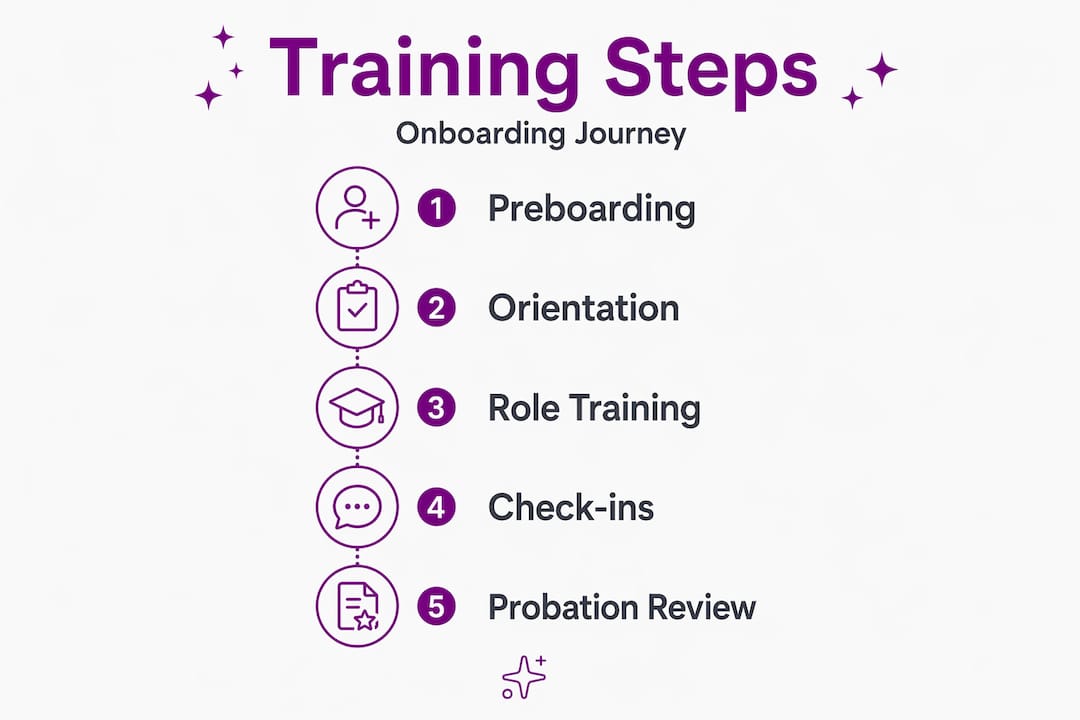
- Preboarding (before day one): Send the welcome kit, upload required documents, assign equipment, and confirm IT access. The goal is to remove all logistical friction so day one is about people, not paperwork.
- First week: Focus on orientation, compliance form completion, team introductions, and buddy assignment. The first week should balance information with engagement, avoiding the temptation to dump every policy document on the new hire at once.
- Days 8 to 30: Role-specific training begins in earnest. This includes shadowing experienced team members, attending client meetings or internal reviews, and completing scheduled one-on-one sessions with their manager.
- Days 31 to 90: Feedback check-ins, goal-setting sessions, and early performance reviews. This phase is where the new hire transitions from learning mode to contributing mode.
Compliance documentation is not a phase. It runs across all four stages, and tracking it requires active management, not passive hope that forms got signed.
Two supporting roles are critical throughout: the manager and the buddy. The manager owns role clarity, performance feedback, and escalation support. The buddy provides day-to-day guidance, answers the small questions the new hire may feel embarrassed to ask their manager, and accelerates cultural assimilation. Structured plans with manager involvement and buddy systems measurably improve training velocity and 90-day retention.
For a practical breakdown of how to structure each module, see this resource on training program components for small and mid-sized businesses.
How digital tools streamline onboarding and training management
If you are managing new hire training through a combination of email threads, PDF forms, shared drives, and spreadsheet trackers, you already know how fragile that system is. One missed step, one unsigned form, one forgotten introduction email can create compliance exposure or a poor first impression that is hard to recover from.

Digital platforms save 6 to 12 hours per new hire in manual work, and the global market for digital onboarding tools is growing rapidly for good reason. The efficiency gains are real. So is the compliance improvement.
Here is what a training management system does that manual processes simply cannot match consistently:
- Centralizes all tasks, documents, and training modules in one place
- Sends automated reminders when deadlines approach for form completions or training milestones
- Gives managers a real-time view of each new hire's progress without requiring a status update email
- Tracks compliance documentation with timestamped records that hold up to audits
- Removes the manager from repetitive task reminders so they can focus on actual mentorship
A single continuous workflow reduces the compliance errors that occur when people bounce between email, spreadsheets, and portals. That fragmentation is where things fall through the cracks.
| Task | Manual process | Digital training management system |
|---|---|---|
| Compliance form tracking | Spreadsheet, prone to gaps | Automated, timestamped records |
| Training progress visibility | Email check-ins | Real-time dashboard |
| Reminder delivery | Ad hoc email | Automated deadline-aware nudges |
| Document access | Shared drives, version risk | Centralized, version-controlled |
| Onboarding time per hire | 8-14 hours admin work | 2-4 hours admin work |
Pro Tip: When evaluating training management software, look for platforms that allow you to configure workflows for different roles or departments without requiring separate tools for each. A single-portal approach keeps the new hire experience consistent and your team's workload manageable.
For more on how HR workflow automation is reshaping onboarding efficiency, the research is worth reviewing alongside your own process audit. Also explore how digital onboarding tools can unify compliance and training in one place.
Common pitfalls and expert tips for new hire training management
Even firms that understand the importance of employee training fall into the same traps. Here are the most common mistakes and how to sidestep them.
Poor onboarding can cost 50 to 75 percent of an employee's annual salary through turnover and lost productivity. That is a number worth pausing on. For a professional services firm billing by the hour, the cost of a new hire leaving at month two is not just replacement cost. It is lost client time, disrupted team workflow, and institutional knowledge that walks out the door.
The most common pitfalls are:
- Treating onboarding as one day. Conflating orientation with onboarding leaves new hires feeling lost after their first morning. A structured multi-week process prevents this.
- Disconnected tools. When signatures live in one system, training in another, and task tracking in a spreadsheet, someone always misses something.
- No manager accountability. If training is left entirely to HR with no defined manager role, it loses relevance. Managers must own role-specific development.
- Information overload on day one. Overwhelming new hires with policies, handbooks, and system logins in one sitting guarantees poor retention and anxiety.
The firms that lose new hires in the first 60 days almost always share one trait: they built their onboarding around what HR needed to complete, not what the new hire needed to succeed.
Pro Tip: Assign a buddy before the new hire's first day and brief them on their role. A good buddy answers the questions a new hire would never ask their manager, which dramatically accelerates comfort and contribution.
Early check-ins at the end of week one and the end of month one catch alignment problems before they become performance problems. Build these into your calendar as non-negotiables.
Avoid the common onboarding pitfalls that come from thinking a digital signature tool is the same as a complete onboarding system.
Applying effective new hire training management in your small professional firm
Knowing the theory is useful. Having a concrete plan to implement it is better. Here is a practical framework for building or overhauling new hire training management in a small professional firm.
- Map your phases. Define preboarding, week one, month one, and the 30-60-90 day milestones explicitly. Write them down. Assign owners.
- Define manager and buddy responsibilities. Both roles need written guidance on what they are expected to deliver and when. Accountability without clarity is just pressure.
- Build a 30-60-90 day training template. Include role-specific learning objectives, compliance milestones, check-in schedules, and performance feedback points. Structured 30-60-90 plans with manager involvement consistently improve retention.
- Automate compliance-critical tasks. HRMS platforms automate compliance tracking, making it more reliable and audit-ready than any manual system.
- Set clear KPIs. Track task completion rates, training module progress, check-in completion, and early performance feedback scores. What gets measured gets managed.
| Approach | Traditional checklist | Integrated digital training management |
|---|---|---|
| Consistency | Depends on individual follow-through | Built into the system |
| Compliance tracking | Manual, reactive | Automated, proactive |
| Manager visibility | Requires status updates | Real-time dashboard |
| New hire experience | Fragmented, variable | Consistent, structured |
| Scalability | Breaks under hiring volume | Scales with your firm |
Pro Tip: Do not launch a new training management system during a hiring surge. Pilot it with one new hire, gather feedback, fix the gaps, then roll it out firm-wide. Getting the foundation right once saves significant rework later.
See how to implement training management when compliance and onboarding are handled inside a single, unified platform.
A small firm owner's perspective: why training management is your best investment
Here is what most small firm owners only realize after a painful departure. The cost of structured new hire training management is visible and upfront. The cost of not doing it is hidden, delayed, and far higher.
When a new hire leaves at month two, the firm absorbs recruitment costs, lost billing, retraining of a replacement, and often some client relationship damage. When a new hire stays but never quite clicks into their role, the cost is even harder to see: missed deadlines, friction in client work, and a manager spending hours each week on problems that a better onboarding process would have prevented at week three.
The belief that structured onboarding is something only large enterprises need is one of the most expensive myths in small business. Large firms have enough redundancy to absorb poor onboarding. Small firms do not. Every person matters more. Every retention failure hits harder.
What changes the outcome is not complexity. It is consistency. Firms that build onboarding ownership into their manager roles, run defined check-ins, and use a single platform for tasks, training, and compliance see measurably better 90-day retention without dramatically more effort. The investment is in setting up the system well once, not in heroic HR effort every time someone new joins.
The other undervalued dimension is the new hire's experience of your firm in those first few weeks. That experience shapes their professional identity within your team, their confidence in their role, and their loyalty to the firm. You set the tone with your training management process, whether you intend to or not.
Explore practical onboarding insights to see how other small firms are approaching this investment.
How OnboardingGenie simplifies new hire training management for small firms
Building an effective new hire training management program is absolutely achievable for small professional firms. The challenge most firms face is not understanding what to do. It is having the tools to actually do it consistently, without adding administrative burden or juggling five different platforms.
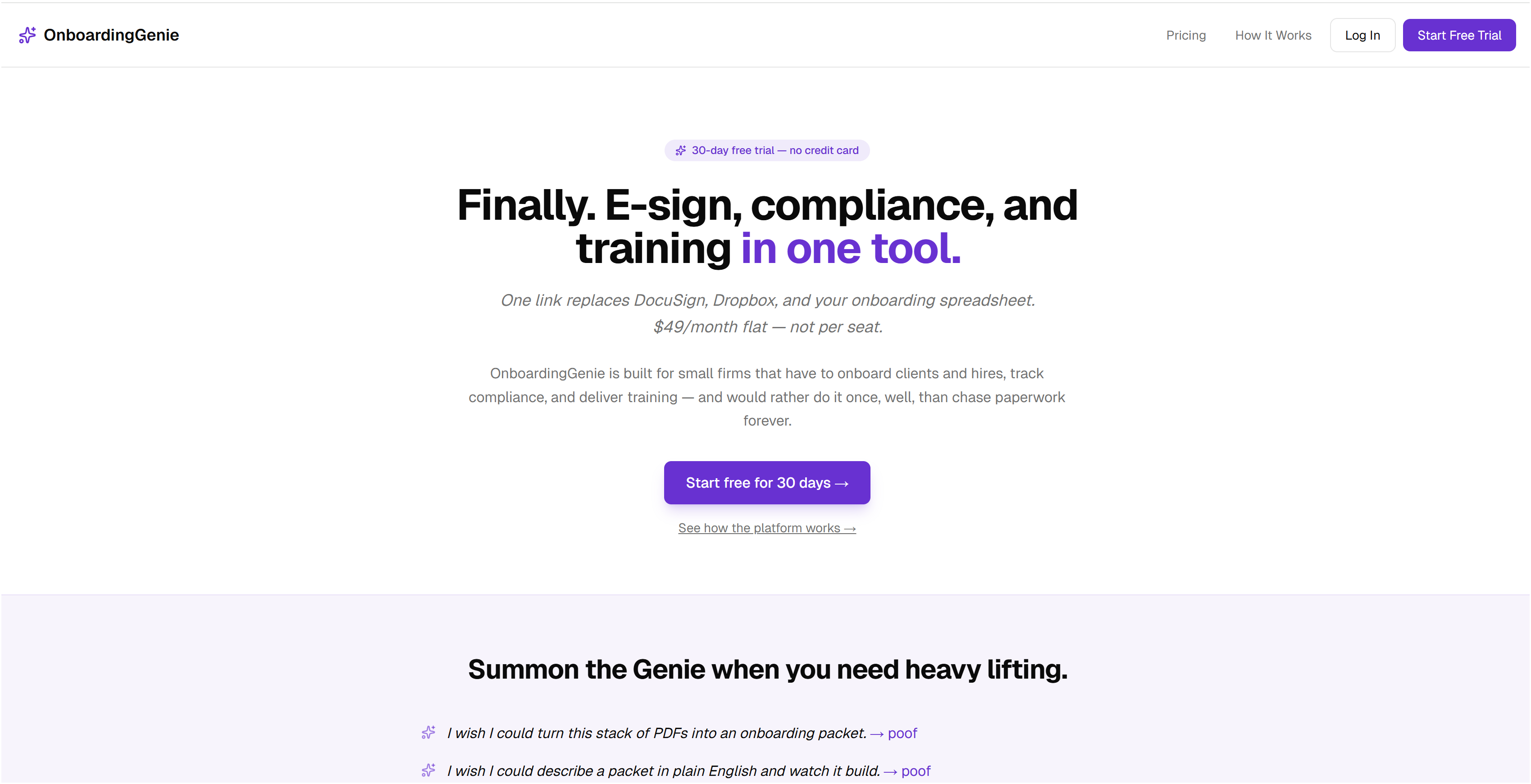
OnboardingGenie was built specifically for this problem. It gives HR managers and firm owners a single branded portal that consolidates training materials, compliance documents, task assignments, digital signatures, and forms into one workflow. There is no bouncing between tools. No chasing signatures over email. No wondering whether a new hire completed their compliance modules.
The platform includes manager dashboards for real-time progress visibility, buddy assignment workflows, and automated task reminders that keep onboarding on track without requiring constant manual follow-up. You can use pre-built templates designed for professional service firms to set up your 30-60-90 day training program in hours, not weeks.
Ready to see it in action? How OnboardingGenie works shows the full workflow from preboarding to probation completion. For firms with active compliance requirements, explore the compliance management features built specifically for SMBs. Or start a free trial and set up your first training workflow today.
Frequently asked questions
What is the difference between orientation and new hire training management?
Orientation is a one-day event covering administration and basic policies, while new hire training management is a structured, multi-month process aimed at developing skills, ensuring compliance, and integrating the new hire into their role with confidence and clarity.
How long should new hire training management last in a small professional firm?
New hire training management should span the full 90-day probation period, beginning with preboarding before day one and progressing through defined milestones. A comprehensive onboarding process runs from preboarding through the first 90 days with structured checkpoints throughout.
Can small firms manage new hire training effectively without digital tools?
Manual management is possible but consistently unreliable. Manual onboarding leads to delayed access, missed documentation, and inconsistent training delivery, all of which hurt retention and create compliance exposure for the firm.
What role should a manager play in new hire training management?
Managers should own role clarity, deliver or coordinate training, run regular check-ins, and provide actionable feedback throughout the onboarding period. Manager involvement is one of the strongest predictors of onboarding success, with clear expectations and ongoing coaching at the center of it.
How does compliance factor into new hire training management?
Compliance is not a separate task. It runs through every phase of onboarding, from pre-employment documentation to ongoing training completions. Failing compliance deadlines creates financial penalties and legal exposure, and integrated onboarding workflows are the most reliable way to prevent them.