
TL;DR:
- Most consulting firms treat onboarding as مجرد orientation, neglecting the critical role of sustained training. Effective onboarding requires phased, structured programs that integrate real tasks, continuous reinforcement, and measurable checkpoints to reduce turnover and client loss. Treating training as an ongoing system, not a one-time event, is essential for consultants to operate independently and confidently from the start.
Most consulting firms treat onboarding as an orientation event. They schedule a kickoff call, hand over a packet of documents, and consider the job done. The role of training in consultant onboarding is far more consequential than that, and firms that misunderstand this pay for it in early turnover, slow ramp-up times, and clients who leave before year two. Learners forget roughly 70% of new information within 24 hours without reinforcement. That statistic alone should reshape how you design the first 90 days for every consultant who walks in the door.
Table of Contents
- Key Takeaways
- Why structured training defines the consultant onboarding process
- Effective consultant training strategies that actually build readiness
- Advanced onboarding frameworks that improve performance and retention
- Practical steps to integrate training into your onboarding program
- Common pitfalls in consultant onboarding training
- What I've learned about training and why most firms still get it wrong
- How Onboardinggenie supports your consultant onboarding
- FAQ
Key Takeaways
| Point | Details |
|---|---|
| Training is not a one-day event | Consultants need sustained learning cadences integrated into their workflows, not just a day-one orientation. |
| Instructional design changes outcomes | Organizing training into clear, sequenced learning paths aligned to real consulting tasks significantly improves engagement and retention. |
| Pacing prevents overload | Layering logic-based training before compliance and tool training helps consultants build better judgment faster. |
| Structured onboarding reduces churn | Firms using phased onboarding systems report meaningful reductions in early client attrition and consultant turnover. |
| Measurement closes the loop | Tracking training effectiveness through assessments and feedback allows firms to iterate and improve their onboarding programs over time. |
Why structured training defines the consultant onboarding process
Consultants are not typical new hires. They are expected to manage client relationships, exercise independent judgment, and deliver billable work often within their first few weeks. Generic employee onboarding programs built for administrative staff or junior associates do not meet that standard. The importance of training for consultants is tied directly to how fast they can operate at full capacity without supervision.
The consequences of getting this wrong show up quickly. A consultant who does not understand your firm's methodology or client communication protocols will make errors that damage client trust. Clients who lose confidence early rarely stay. And the consultant, sensing they were set up to fail, starts looking elsewhere within the first six months.
Onboarding specialists need strong training and teaching skills to guide new consultants through processes and policies from day one. That sounds obvious, but many firms assign onboarding to the most available person rather than the most qualified one. The result is inconsistent, incomplete training that creates knowledge gaps no one catches until a client escalates.
A sustained learning cadence matters more than a comprehensive day-one dump. When training is spread across weeks and reinforced through real work, consultants retain what they learn and apply it correctly. When everything is front-loaded into a two-day orientation, most of it disappears before the first client call.
Pro Tip: Assign a dedicated onboarding lead for each new consultant, someone whose job it is to check comprehension weekly for the first 60 days. This person does not need to be a senior partner. They need to be organized, patient, and accountable for training follow-through.
Effective consultant training strategies that actually build readiness
The difference between training that produces confident consultants and training that produces confused ones usually comes down to instructional design. Instructional design improves onboarding engagement by organizing content into clear learning paths and aligning it to real job tasks. That means your training is not just a knowledge transfer exercise. It is a sequenced experience that mirrors the actual work your consultants will do.
Here is a practical framework for structuring training within your consultant onboarding process:
- Start with context, not content. Before a new consultant learns your CRM or compliance checklists, they need to understand your firm's positioning, client philosophy, and how decisions get made. Context gives everything else meaning.
- Sequence training to mirror real tasks. If a consultant's first client-facing activity is a discovery call, train them on discovery frameworks before their first week ends. Don't save it for week three after drowning them in compliance documents.
- Mix delivery formats. Video walkthroughs work well for process overviews. Knowledge checks after each module confirm retention. Guided practice on real documents or past client scenarios builds actual skill rather than passive familiarity.
- Build in checkpoints. Brief assessments at the end of each training block give you data on where gaps exist before they become client-facing problems.
- Standardize across teams and locations. If your firm has multiple offices or remote consultants, every new hire should move through the same training sequence. Inconsistency at this stage creates uneven quality across your practice.
Poor training pacing causes overload or boredom. Breaking content into segments of 20 to 30 minutes with clear objectives per session keeps consultants engaged without burning them out in the first week. This is not about coddling new hires. It is about protecting the investment you made in recruiting them.
Pro Tip: Build a shared training tracker visible to both the new consultant and their onboarding lead. When both parties can see what has been completed and what is pending, accountability increases and nothing falls through the gaps.

Advanced onboarding frameworks that improve performance and retention
Some consulting firms have moved well beyond basic orientation programs. The most effective ones run phased onboarding systems that treat the first 90 days as a structured progression, not a trial period. Firms using structured white-glove onboarding reduce early client churn by 40% and retain over 90% of their client base annually. Those numbers reflect what happens when onboarding is treated as a strategic function rather than an administrative one.
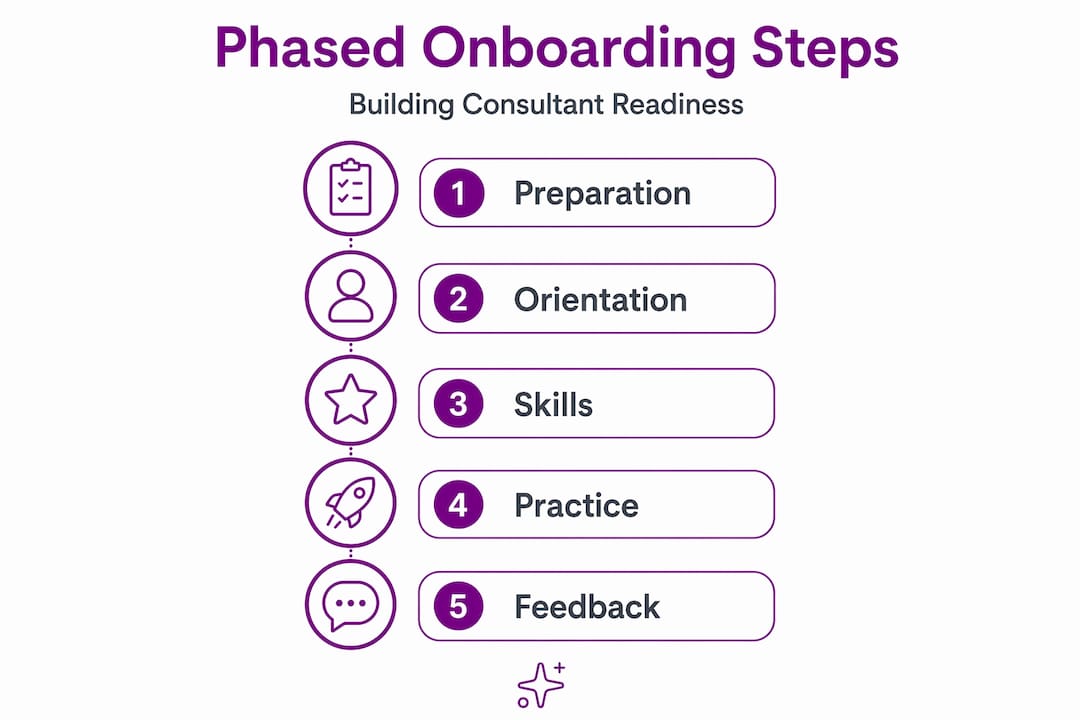
A five-phase system typically looks like this: pre-arrival preparation, orientation and context-setting, skills training with supervised practice, independent project involvement, and a formal 90-day review. Each phase has defined outcomes, and a consultant does not advance until those outcomes are confirmed.
Active learning is another distinguishing feature of high-performing onboarding programs. New consultants updating process maps and client rubrics during their first 90 days creates learning cycles that accelerate productivity far faster than passive consumption of training materials. When a new hire has to engage with real documentation and improve it, they learn your firm's logic from the inside out.
The sequencing of compliance and tool training also separates effective programs from ineffective ones. High-performing firms avoid front-loading compliance training, opting instead to layer logic-based training first so consultants develop judgment before they learn the rules.
| Framework Feature | Standard Onboarding | Phased White-Glove Onboarding |
|---|---|---|
| Training duration | 1 to 3 days | 60 to 90 days |
| Compliance training timing | Day one | Week three or later |
| Active learning components | Minimal | Process maps, real project tasks |
| Feedback checkpoints | End of orientation | Weekly throughout phases |
| Measured retention | Rarely tracked | Assessed at each phase exit |
| Client churn impact | Inconsistent | Up to 40% reduction |
For firms managing onboarding across diverse consultant types, a mixed-workforce onboarding approach can consolidate training workflows without sacrificing the personalization each role requires.
Practical steps to integrate training into your onboarding program
Before a consultant's first day, three things need to be ready: their role is clearly defined with written expectations, their tools and access are provisioned, and their training sequence is mapped and scheduled. Firms that scramble on day one signal disorganization to new hires before they have learned a single thing about the job.
Effective onboarding requires predefined workflows and clear protocols before consultants touch any active project. A kickoff call is not onboarding. It is a conversation. Real onboarding has a structure with decision-maker maps, data collection protocols, and escalation paths all documented before day one.
Beyond the first two weeks, consider these practices:
- Pair each consultant with a peer mentor who has been at the firm 12 to 24 months. Mentors answer the questions new hires are embarrassed to ask their managers.
- Schedule real-time coaching sessions tied to specific project milestones rather than generic check-ins. When coaching is anchored to actual work, the feedback lands.
- Build a 30, 60, and 90-day learning review into the calendar before the consultant starts. It forces both parties to stay accountable.
- After the formal onboarding period ends, maintain a monthly learning touchpoint. Consulting is a field that changes fast. Firms that stop training at day 90 watch their consultants' skills plateau.
Measuring how training impacts onboarding is not complicated, but most firms skip it. Track time-to-first-independent-project, error rates in client deliverables during the first 60 days, and 90-day retention. If those numbers are not improving after you redesign training, the program needs adjustment, not more content.
Pro Tip: Run a brief training retrospective with every consultant at the 90-day mark. Ask them what was missing, what was redundant, and what they wished they had learned sooner. Three retrospectives will give you enough data to significantly improve your program.
Common pitfalls in consultant onboarding training
Even firms that invest in onboarding training make predictable mistakes. These are the ones that show up most often.
- Treating orientation as onboarding. A welcome session with HR paperwork and a company overview is not training. It is administration. Firms that conflate the two end up with consultants who know where the bathrooms are but not how to handle a difficult client conversation.
- Information overload in the first week. Sending a new consultant 40 documents, six software logins, and three compliance modules in five days does not produce learning. It produces anxiety. Pacing is a training decision, not a scheduling convenience.
- No feedback loops. Training without assessment is hope. You have no idea whether a consultant absorbed the material until they demonstrate it. Build knowledge checks, scenario exercises, and supervisor observations into every phase.
- Ignoring adult learning principles. Consultants are experienced professionals. Training that does not connect to their prior knowledge or explain why something matters will be tuned out. Adults learn by doing and by understanding the purpose behind what they are doing.
- No reinforcement after week two. The 70% forgetting rate is not a theoretical concern. It is what happens in your firm right now if you are not running a sustained learning cadence. Monthly reinforcement touchpoints, even brief ones, make a measurable difference.
For a deeper look at how new hire training management works in small firms, the operational details matter more than the framework.
What I've learned about training and why most firms still get it wrong
I've spent years working with small professional service firms on their onboarding processes, and the pattern I see most often is this: a firm builds a solid training program once, it works reasonably well, and then they never touch it again. Three years later, the program is outdated, the consultants who remember why it was built have moved on, and new hires are learning from materials that no longer reflect how the firm actually operates.
The importance of integrating analytics and relationship-building into consulting onboarding is something most firms understand in theory but rarely execute. Training is treated as a fixed cost, not a living system. That is the mindset that keeps onboarding mediocre.
What I've found works is treating training as you would treat a client deliverable. It has owners, review dates, and quality standards. When someone owns the training program the way a practice leader owns a client relationship, it gets updated, improved, and defended. When it belongs to everyone, it belongs to no one.
I've also seen the opposite failure: firms that obsess over training completeness and build 200-hour curricula that overwhelm new consultants before they've had their first real win. The best onboarding programs I've seen prioritize early confidence. Get a consultant to their first successful client interaction quickly. Everything else builds from there.
The transition from training provider to trusted advisor does not happen through coursework alone. It happens through structured exposure, real feedback, and a firm culture that treats learning as ongoing rather than something you finish in week two.
— Chris
How Onboardinggenie supports your consultant onboarding
If your training program lives in a folder of PDFs, a spreadsheet someone built two years ago, and a series of emails that different people send at different times, you already know what the problem is. Pulling it together into one organized, repeatable process is exactly what Onboardinggenie was built for.
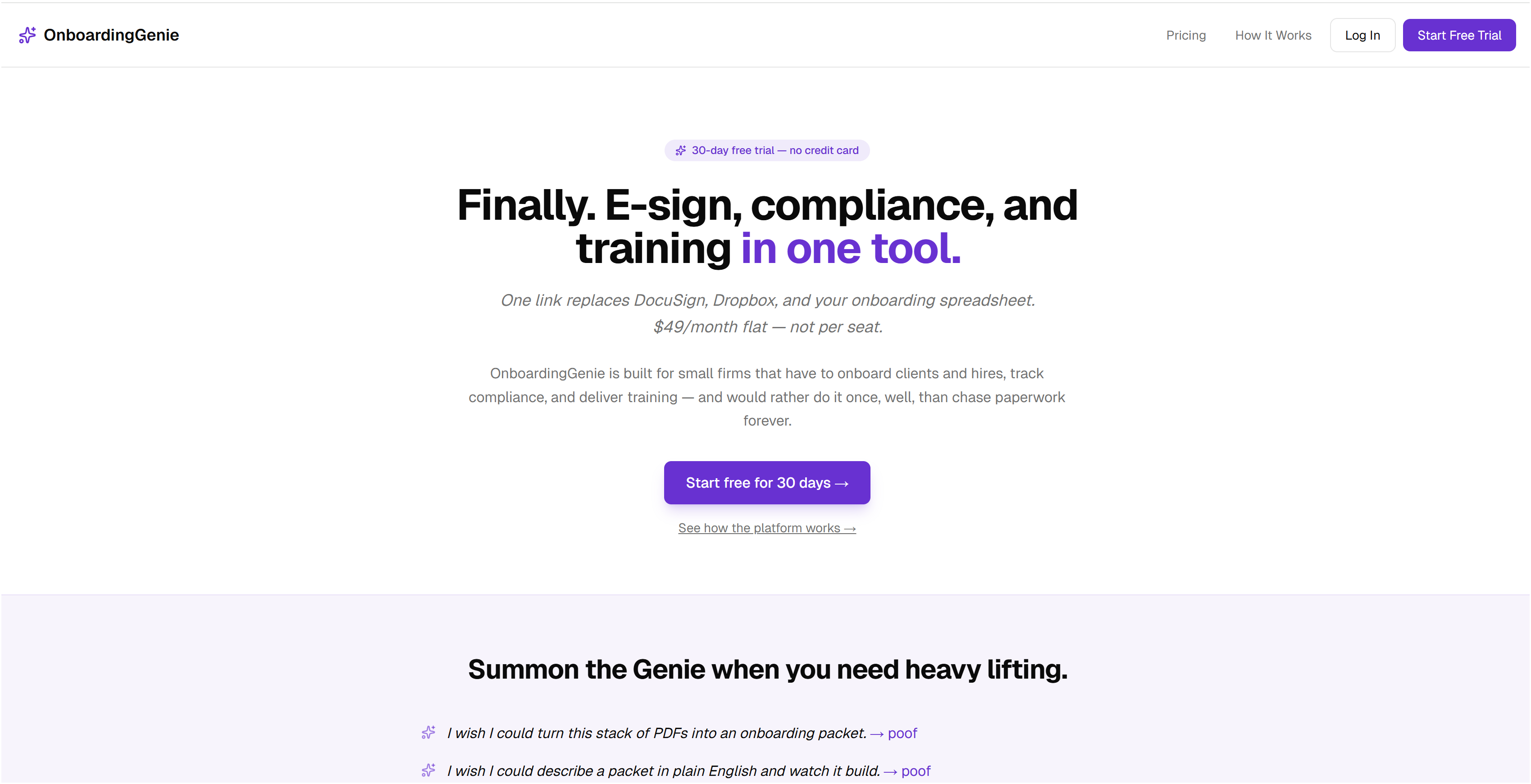
Onboardinggenie gives small and mid-sized consulting firms a single branded portal where training materials, compliance documents, forms, and signatures all live in one place. You can build a sequenced onboarding workflow that every new consultant moves through in the right order, with checkpoints that keep your onboarding lead informed without requiring daily manual follow-up. No enterprise price tag, no unnecessary complexity.
If you are ready to turn your consultant onboarding program into something you can actually control and repeat, start with a free trial and see how much cleaner the process can be.
FAQ
What is the role of training in consultant onboarding?
Training gives new consultants the knowledge, judgment, and practice they need to operate independently and serve clients at the expected level. Without structured training, even experienced consultants struggle to meet firm-specific standards quickly.
How long should consultant onboarding training last?
Phased onboarding programs typically run 60 to 90 days, with active training in the first 30 days and reinforcement cadences through the full period. A single orientation session is not sufficient for consulting roles.
What training methods work best for consultant onboarding?
A mix of sequenced video modules, guided practice on real documents, knowledge checks, and peer mentoring produces the strongest results. Passive reading and one-time presentations have the lowest retention rates.
How do you measure whether onboarding training is working?
Track time-to-first-independent-project, error rates in client deliverables during the first 60 days, and 90-day retention. If those metrics are not improving after a program change, the training content or pacing needs adjustment.
Why do consultants forget what they learn during onboarding?
Without reinforcement, learners forget up to 70% of new information within 24 hours. Consulting firms that space training across weeks and reinforce it through real project work significantly improve long-term retention.