
TL;DR:
- Most small businesses rely on informal training methods that risk costly errors and compliance gaps. Implementing structured SOP-based training over 30 to 90 days, with ongoing verification and documentation, significantly improves employee competence. Using dedicated platforms like Onboardinggenie streamlines training management, records, and compliance, fostering a more independent and efficient team.
Most small businesses train new employees the same way: pair them with whoever is available, answer questions as they come up, and hope enough knowledge sticks. It works until it doesn't. When ad hoc training methods cause a billing error, a compliance gap, or a client complaint, the cost shows up fast. A proper small business training program setup does not require a learning management system with a six-figure price tag. It requires documentation, structure, and a plan you can actually follow through on. This guide walks you through every step.
Table of Contents
- Key takeaways
- Laying the groundwork first
- Building your training materials
- Running the program from day one
- Common mistakes that derail small business training
- Measuring whether your program is working
- My honest take on training programs for small firms
- How Onboardinggenie supports your training program
- FAQ
Key takeaways
| Point | Details |
|---|---|
| Audit before you build | Identify gaps in your current training before writing a single procedure or checklist. |
| SOPs are your curriculum | SOP-based training can reduce time-to-competency by 50% and makes onboarding repeatable. |
| Phase training over 30 to 90 days | Spreading training over weeks prevents overload and improves actual knowledge retention. |
| Verify competency, not completion | Sign-offs and quizzes beat simple checkbox tracking for measuring real employee readiness. |
| Document every training event | Logged training records support compliance audits and give you data to improve the program. |
Laying the groundwork first
Before you write a single SOP or training checklist, you need to understand what you actually have. Most professional service firms, whether a four-person accounting shop or a 20-person consulting firm, discover during this audit that their training is person-dependent. One senior staff member holds the real knowledge. If she leaves, the knowledge walks out with her.
Start by mapping out every role in your firm and listing the core tasks each role performs. Then ask two questions: Is there written documentation for how this task is done? And could a new hire perform this task correctly after reading that documentation? If the answer to either question is no, you have found a training gap.
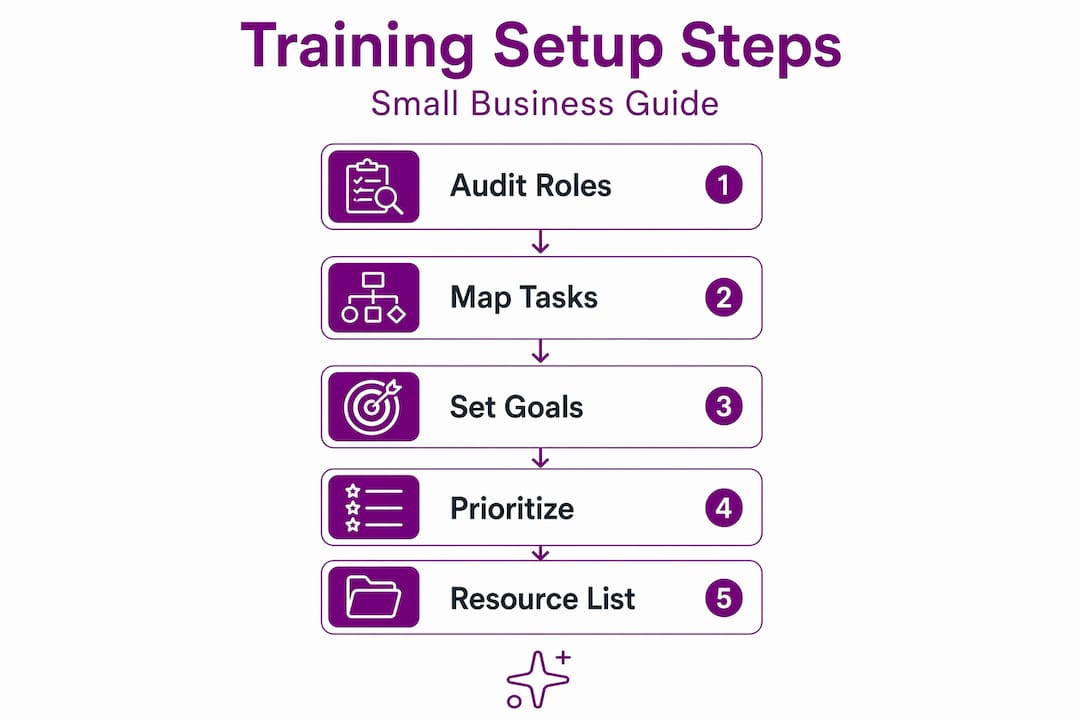
From there, prioritize which roles and tasks to address first. Focus on positions that touch clients directly, handle money, or carry compliance obligations. A new paralegal making errors on client intake forms costs more per mistake than almost any other onboarding failure. High-impact roles deserve the most thorough training content, and they should be your starting point.
Set goals that are specific and measurable before you start building anything. "Better training" is not a goal. "Reduce time to independent client handling from 60 days to 30 days" is a goal. Others might include reducing error rates on key procedures by a set percentage or achieving consistent compliance documentation across every new hire. Clear goals let you know when the program is working.
You will also need to list your resources honestly. Who will write the materials? Who will deliver the training? What tools do you currently use for documentation? Tools training is frequently overlooked but critical. An employee who does not know how to use your practice management software correctly will develop workarounds that create bigger problems later.
Pro Tip: Interview your two or three best performers before you write anything. Ask them to walk you through how they do their most important tasks. Their answers are the raw material for your first SOPs.
Building your training materials
Once you know what needs to be trained, you can start building the content. The backbone of any effective employee training program for a small business is the standard operating procedure. But an SOP written for reference is different from one written for training. A training SOP needs context, not just steps.
Here is the process that actually works:
- Write for a first-day reader. Every SOP should begin with a brief explanation of why the task matters, not just how to do it. A new hire at a law firm needs to understand why client intake accuracy affects the firm's conflict-check process before they care about the specific fields in the intake form.
- Use numbered steps with screenshots or screen recordings. Text alone is insufficient for software tasks. Screen recordings for software training let new hires learn at their own pace and return to the material as many times as they need. A five-minute narrated walkthrough of your billing software is worth ten pages of written instructions.
- Organize SOPs into role-specific training sequences. Group procedures by timing: what a new hire needs on Day 1 (access, orientation, communication expectations), what they need in Week 1 (core task procedures), and what they should be competent in by the end of Month 1 (independent task execution). This is how you turn a collection of documents into a real curriculum.
- Create shadowing protocols, not just shadowing. Unstructured shadowing rarely works. The new hire watches, nods, and misses half of what is important. A structured shadowing protocol gives the new hire a checklist of things to observe, questions to ask, and a debrief form to complete afterward.
- Train your trainers on how to use the materials. Even if you are the only trainer, decide in advance how you will use each SOP in a coaching conversation. The document is the reference. Your job as a trainer is to verify understanding and fill the gaps the document cannot address.
Version control is something most small firms skip until they regret it. Every SOP should have a version number and a last-reviewed date visible in the document header. When a process changes, update the SOP first, then notify anyone who has been trained on the old version. A guide to standardizing job documentation can help you build this habit from the start.
Pro Tip: Keep each SOP to one page if possible. If a procedure genuinely requires more, break it into sub-procedures. Short documents get read. Long ones get skimmed.
Running the program from day one
Having great materials does not automatically produce great training. Execution matters just as much. The single most common failure at this stage is front-loading. Handing a new hire a folder of 40 SOPs on their first day and expecting competency in two weeks is a reliable way to produce anxiety, not capability.
Phased training over 30 to 90 days works because the brain does not retain information delivered all at once. Structure your training schedule so each week introduces a defined set of procedures, with practice time built in before the next set arrives.
Here is how training verification should look in practice:
| Method | What it measures | When to use it |
|---|---|---|
| Observed practice | Can the employee perform the task correctly without prompting? | After each core procedure is introduced |
| Knowledge quiz | Does the employee understand the reasoning behind key steps? | End of Week 1 and Month 1 |
| Formal sign-off | Has a qualified reviewer confirmed competency? | Before an employee handles the task independently |
| Error rate tracking | How often does the employee make procedural mistakes? | Ongoing, 60 to 90 days post-onboarding |
Competency verification should never be a simple checkbox. An employee who reads an SOP and checks a box that says "completed" has not demonstrated competency. They have demonstrated literacy. Observed practice and sign-offs are the standard worth holding.
Documentation of each training event is also non-negotiable. Record the procedure trained, the date, the trainer's name, the trainee's name, and the assessment result. This serves two purposes. It gives you an audit trail if a compliance question comes up later. And it gives you data to improve the program over time. Which SOPs produce the most questions? Which tasks see the highest error rates after training? Those are your weak spots.

For firms managing new hire training records, keeping everything in one place rather than scattered across email threads and shared drives saves significant time when you need to pull documentation.
Common mistakes that derail small business training
Even firms that build solid training materials run into problems during execution. The most damaging mistake is allowing training to remain person-dependent. If your senior accountant is the only person who knows how to walk a new hire through the client billing process, you have not built a training program. You have built a dependency.
Watch for these issues specifically:
- Confusing completion with competency. A new hire who finishes all the modules is not automatically ready to work independently. Build in assessed checkpoints before granting independent task authority.
- Skipping ongoing training after onboarding. Ongoing employee development beyond the first 90 days is what separates firms with growing teams from firms that stay stuck. Monthly or quarterly skill reviews matter.
- Letting resistance to documentation win. Senior staff sometimes push back on writing SOPs because it feels like extra work. Reframe it: the documentation protects them. If they take time off, someone else can cover their work without calling them.
- Ignoring SOP updates. A documented process that reflects how the firm worked two years ago is worse than no documentation. Assign someone to review each SOP at least once a year, or whenever the underlying process changes.
- Information overload in the first week. Cover orientation, access, and one or two core procedures in the first few days. Nothing more. Let the new hire build confidence before adding complexity.
The firms that get training right are the ones where the owner is not the most knowledgeable person in the room on every topic. Structured training creates that outcome.
Measuring whether your program is working
A training program with no measurement is just activity. You need numbers to know whether the investment is producing results.
| Metric | What to track | Target improvement |
|---|---|---|
| Time to competency | Days until employee handles tasks independently | Reduce by 30 to 50% vs. informal training |
| Error rate | Procedural mistakes per task in first 90 days | Steady decline each month |
| Training completion rate | Percentage of scheduled training completed on time | 90% or higher |
| 90-day retention | Employees still active at 90 days post-hire | Track trend over 12 months |
| Trainer time per hire | Hours a senior staff member spends training each new hire | Reduction reflects better self-directed learning |
SOP-based training programs consistently reduce time-to-competency by around 50% compared to informal methods. That is not a marginal gain. For a firm billing by the hour, every week shaved off a new hire's ramp-up time translates directly to recovered revenue.
Feedback loops matter too. After each new hire completes their onboarding period, ask them which materials were unclear, which procedures they felt unprepared for, and what they wished they had learned earlier. That input is free, specific, and almost always accurate. Use it to revise your SOPs and your training sequence for the next hire.
My honest take on training programs for small firms
I spent years watching small business owners pour time into hiring and then lose half of that investment to poor onboarding. The owners who avoided this were not the ones with the fanciest tools. They were the ones who sat down and wrote out how their business actually worked.
What I have learned is that most small firm owners underestimate how much of their firm's knowledge lives only in their own heads. Without documented training materials, owners spend hours each month re-explaining the same fundamentals to different people at different times. That is not training. That is an inefficiency disguised as management.
The firms that benefit most from a structured training program are not the ones with the most complex work. They are the ones where the owner is willing to step back and say: "I want my team to be able to do this without me." That shift in thinking is what makes documentation worth the effort.
I also want to push back on the idea that training documentation has to be perfect before you use it. A 70% complete SOP used consistently is more valuable than a 100% complete SOP that never gets written. Start with your three most critical procedures and build from there. The program gets better with every hire.
Combining training records with compliance tracking in a single tool is something I wish more small firm owners knew about earlier. When a compliance question comes up, the last thing you want is to dig through three different spreadsheets to prove training happened.
— Chris
How Onboardinggenie supports your training program
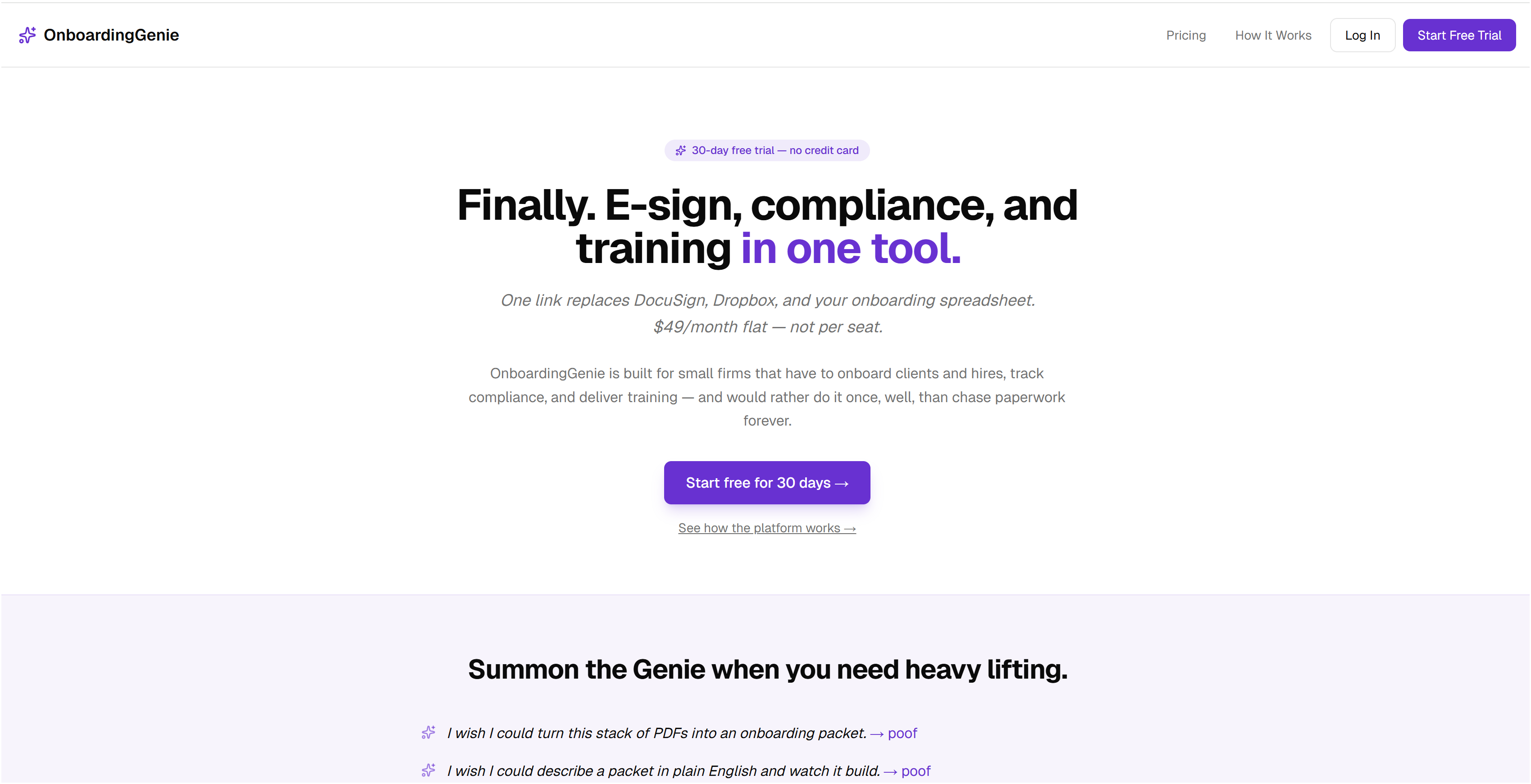
Onboardinggenie was built specifically for small professional service firms that need a training and onboarding process that actually holds together. The platform consolidates your training checklists, SOP documents, sign-off forms, and competency records into a single branded portal, so nothing lives in a separate spreadsheet or email thread. When a new hire joins, they get one link. Everything they need for Day 1, Week 1, and Month 1 is organized and waiting.
For firm owners who are setting up training for the first time, Onboardinggenie removes the overhead of managing multiple tools. You can assign training modules, track completion and sign-offs, and maintain an audit-ready record of every training event, all without enterprise-level costs or complexity. The platform's flat monthly fee means you know what you are paying regardless of how many new hires you bring on in a given quarter.
If compliance documentation is part of your firm's training obligations, the compliance management features work alongside your training records to keep everything in one place.
FAQ
What is the first step in a small business training program setup?
Audit your existing training practices before building anything new. Identify which roles lack documented procedures and which tasks have the highest error rates or longest ramp-up times.
How long should a small business training program take?
Spreading training across the first 30 to 90 days is more effective than front-loading. Phased training improves retention and reduces the chance of new hires feeling overwhelmed in the first week.
What should small business training materials include?
At minimum, role-specific SOPs with numbered steps and visuals, a Day 1 through Month 1 training schedule, and a competency sign-off record for each core procedure.
How do you verify that training actually worked?
Combine observed task practice, a knowledge quiz at the end of the first month, and a formal trainer sign-off before the employee works independently. Competency verification should reflect demonstrated ability, not just module completion.
How often should training materials be updated?
Review each SOP at least once a year, and immediately whenever the underlying process changes. Assign a specific person to own this review rather than leaving it as a shared responsibility that nobody takes.