
TL;DR:
- Most small firms mistakenly view onboarding as simple paperwork completion, risking compliance issues. A structured, multi-phase process that covers verification, training, and documentation is essential to ensure legal adherence and build a strong company culture. Automating and centralizing onboarding tasks help small teams manage compliance effectively and foster employee retention.
Most small professional service firms think onboarding means collecting a signed offer letter, handing over a laptop, and calling it done. That misunderstanding is exactly where compliance problems start. The employee onboarding process covers far more than paperwork. It's the structured sequence of steps that brings a new hire from acceptance to full productivity while satisfying legal requirements around employment verification, workplace safety training, and role-specific documentation. For HR managers and business owners at small firms, getting this right isn't optional. It's how you protect your firm, prepare your people, and build a culture worth keeping.
Table of Contents
- Understanding the employee onboarding process
- Key compliance components in onboarding: Form I-9 and OSHA training
- Organizing onboarding training for small professional service firms
- Common pitfalls and expert tips for efficient onboarding compliance
- Measuring onboarding success and continuous improvement
- Why most small firms get onboarding wrong—and how to fix it
- Simplify your employee onboarding with OnboardingGenie
- Frequently asked questions
Key Takeaways
| Point | Details |
|---|---|
| Onboarding is comprehensive | Employee onboarding includes paperwork, compliance, and training, not just hiring documents. |
| I-9 timing is critical | Form I-9 Section 2 must be completed within 3 business days of the hire date to avoid penalties. |
| OSHA training must be role-specific | Safety training during onboarding must be customized to job hazards and documented properly. |
| Organize training in phases | Phased onboarding training improves retention, compliance, and employee safety culture. |
| Automation reduces risk | Automating onboarding workflows helps small firms meet deadlines and maintain compliance easily. |
Understanding the employee onboarding process
The employee onboarding process is the end-to-end sequence of activities that begins when a candidate accepts an offer and continues well past their first week. It includes employment eligibility verification, benefits enrollment, policy acknowledgment, compliance training, role-specific orientation, and structured check-ins over the first 90 days. For employee onboarding in professional services, the stakes are higher than in many other sectors because your team handles sensitive client data, regulated financial records, or legal documents from day one.
What is employee onboarding for small teams, specifically? The scope is the same as larger organizations, but the resources are not. There's rarely a dedicated HR department managing every step. Instead, one office manager or a founding partner may be tracking Form I-9 deadlines, scheduling shadowing sessions, and setting up software access all at once. That's where a clear onboarding process outline becomes essential rather than aspirational.
Here are the core components every firm's onboarding should include:
- Pre-boarding (before day one): Offer letter, background check, Form I-9 Section 1 sent to the employee, IT provisioning, training enrollment
- Day one orientation: What is new hire orientation in practice? It's completing employment verification, reviewing firm policies, introductions, and starting life-safety training
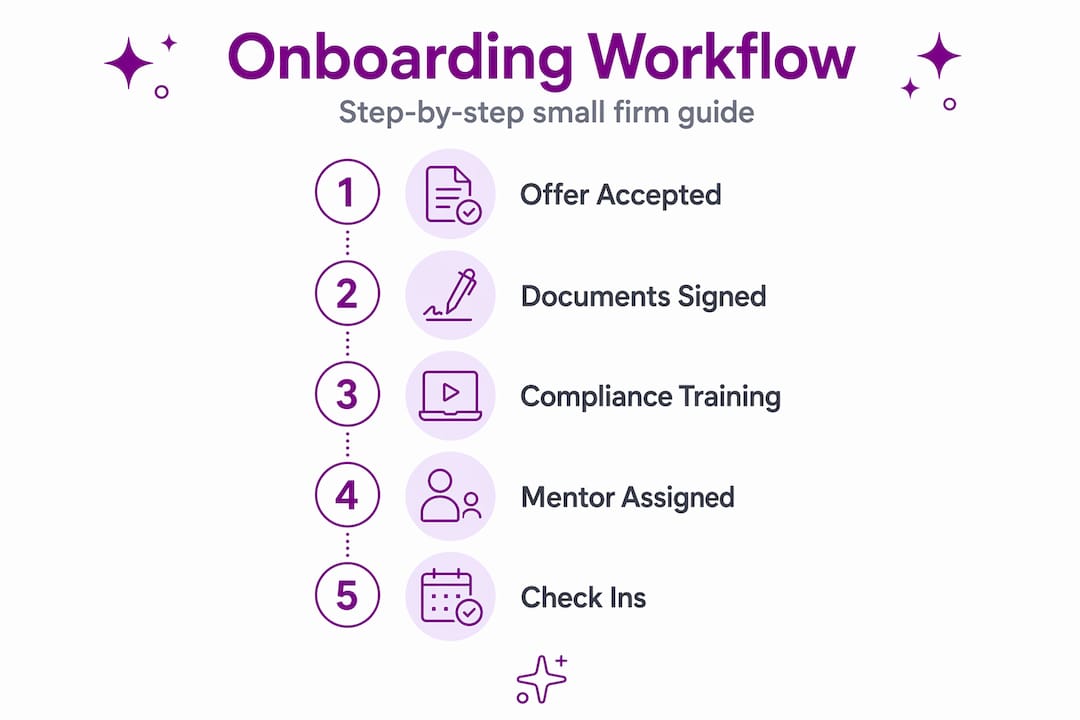
- First week: Role-specific training modules, compliance attestation, system access confirmation, mentor assignment
- 30 to 90 days: Competency checks, 30/60/90 day review conversations, documentation updates, feedback collection
The USCIS Form I-9 handbook is explicit that employers must complete verification steps within specific deadlines, which frames the entire onboarding sequence as a time-bound workflow rather than a loose collection of tasks. Miss those windows and you're not just disorganized. You're exposed.
Key compliance components in onboarding: Form I-9 and OSHA training
Compliance is not a sidebar to onboarding. It's the backbone. Two requirements trip up small firms more than any others: Form I-9 and OSHA workplace safety training. Understanding their timing and documentation requirements protects you from penalties that can reach thousands of dollars per violation.
Here's the required sequence for Form I-9:
- The employee completes Section 1 by the end of their first day of employment
- You, as the employer, must complete Section 2 within three business days of the employee's first day of work
- Physical or remote document inspection must happen before attestation is signed
- Retain the completed form for three years after the hire date or one year after separation, whichever is later
The three-business-day window for Section 2 is not flexible. A new hire who starts on Monday gives you until Thursday. Many small firms miss this because they batch administrative tasks on Fridays.
OSHA compliance adds another layer. The OSHA requirements for new hire training are clear: employees must receive hazard-specific safety training before being assigned to work unsupervised. For a professional services firm, this may seem less urgent than for a manufacturing floor. But if your team works with chemicals in a lab, operates vehicles for client visits, or handles hazardous materials in any form, the obligation applies directly to you.
Required OSHA training coverage during onboarding typically includes:
- Emergency evacuation procedures and exit routes
- Hazard communication (knowing what substances exist in the workplace and their risks)
- Personal protective equipment (PPE) use and storage
- Incident and near-miss reporting procedures
- Role-specific hazard exposure training
"Failing to document OSHA training before an employee works unsupervised is not a technicality. It's a direct compliance gap that exposes the firm to citations and liability if an incident occurs."
The documentation matters as much as the training itself. Keep signed acknowledgment forms, training dates, scores on any assessments, and the name of the trainer or platform used. Auditors don't take your word for it.
Compliance management for small firms becomes significantly easier when you have a centralized location for these records rather than scattered PDFs across email threads. Use your onboarding compliance checklist as an audit readiness tool from day one, not just an internal reminder.
Organizing onboarding training for small professional service firms
Knowing what training is required is one thing. Delivering it without overwhelming a new hire or burning out your team is another. The most effective onboarding techniques treat training as a phased delivery, not a single-day information dump.
A tiered training approach improves retention and satisfies OSHA documentation expectations by spreading content meaningfully across the employee's first weeks. Here's how to structure it:
- Day one: Life-critical information only. Emergency procedures, exits, incident reporting. Nothing else competes for that slot.
- Week one: Core compliance modules. Data handling policies, confidentiality agreements, role-specific software orientation.
- Weeks two and three: Job-skill training. Client communication protocols, workflow tools, firm-specific procedures.
- Days 30 to 60: Competency reinforcement through mentorship, observation, and structured feedback conversations.
Mix your delivery methods. eLearning modules work well for policy acknowledgment and compliance content because they're trackable. Instructor-led sessions build relationship and allow questions. Hands-on practice with real workflows builds competency faster than any slide deck alone. The goal is retention, not completion.
Pro Tip: Assign a buddy or mentor on day one, not week two. New hires who have a specific person to ask questions of retain information faster and feel less isolated. This is especially important in small firms where they may not naturally encounter many colleagues during their first days.

| Training phase | Content focus | Delivery method | Documentation required |
|---|---|---|---|
| Day one | Emergency procedures, exits | Instructor-led | Signed acknowledgment |
| Week one | Compliance, data privacy, I-9 | eLearning + forms | Completion certificate |
| Weeks two to three | Role skills, tools, client processes | Hands-on + shadowing | Competency checklist |
| Days 30 to 60 | Reinforcement, feedback | Mentor check-ins | Check-in notes on file |
Track completion dates, scores where applicable, and trainer names for every module. When an auditor asks for proof of training, your records are the answer. Visit the OnboardingGenie blog for practical guidance on small firm training setup, and see how managing training compliance becomes far simpler with a consolidated system.
Common pitfalls and expert tips for efficient onboarding compliance
Even firms with the best intentions fall into predictable traps. Recognizing them ahead of time is how you avoid the stress of a compliance scramble on day three of someone's employment.
The most common pitfalls in employee onboarding steps for small firms include:
- Treating Form I-9 as a "get to it when we can" task rather than a hard-deadline workflow
- Failing to provision IT access, email, and software before the employee's first day
- Delivering all training content on day one rather than pacing it over the first weeks
- Keeping compliance records in personal email inboxes or unsecured shared drives
- Skipping documentation for informal training like verbal policy walkthroughs
Missing the I-9 Section 2 deadline is one of the most common compliance pitfalls. The fix is calendar-triggered workflows with hard deadlines set the moment an offer is accepted. Think of it less as a calendar reminder and more as an automated trigger: offer accepted fires the clock, and the task closes with attestation on file.
Automating onboarding triggers from offer acceptance and start date is now considered a baseline expectation for efficient onboarding. Setting up IT access, training enrollment, and compliance task assignments before day one means the employee arrives to a functioning setup rather than a morning of waiting.
Pro Tip: Build a pre-boarding checklist that triggers the moment a start date is confirmed. Include IT provisioning, Form I-9 Section 1 delivery, training enrollment, and workspace setup. Everything on that list should be complete before 8 a.m. on day one.
Review common onboarding compliance pitfalls to understand where disconnected tools create gaps, and see why integrating compliance with onboarding in a single system changes the outcome.
Measuring onboarding success and continuous improvement
The benefits of onboarding don't show up automatically. You have to measure for them. Small firms often treat onboarding as a one-time event with a defined end. In reality, effective onboarding is an ongoing process that evolves with your team, your roles, and your regulatory environment.
Key measures to track:
- I-9 completion rate within the three-business-day window (100% is the only acceptable target)
- Training completion rates by module and by role
- Number of open compliance items at 30 days post-hire
- Near-miss and incident reports tied to newly onboarded employees
- Employee-reported confidence scores from 30/60/90 day check-ins
Regular check-ins and documentation updates ensure onboarding stays compliant and culturally effective over time. What worked for a role you hired six months ago may not apply to a new position with different risk exposures or client-facing responsibilities.
| Check-in milestone | Focus areas | Output |
|---|---|---|
| 30 days | Training retention, tool confidence | Gap identification, follow-up modules |
| 60 days | Role performance, peer integration | Mentor feedback, adjusted responsibilities |
| 90 days | Compliance audit readiness, culture fit | Updated documentation, formal review |
Pro Tip: When you update a workplace procedure or add a new tool to your firm's tech stack, revisit your onboarding documentation immediately. Outdated training materials are a compliance liability, not just an inconvenience.
Explore ongoing onboarding compliance to understand how small firms sustain these standards beyond the first 90 days, and see how evaluating onboarding effectiveness through structured feedback improves both retention and readiness.
Why most small firms get onboarding wrong—and how to fix it
Here's the uncomfortable reality: most small firms design their onboarding around the tasks they remember to do, not the structure that actually works. That's a meaningful distinction. Remembering to send over the employee handbook is not a system. A workflow that triggers specific tasks at specific times, with accountability built in, is a system.
The firms that struggle with onboarding compliance typically share one trait: they view onboarding as something that happens to them—a checklist to survive—rather than a process they've built intentionally. When Form I-9 documentation lives in an email thread, when training is delivered through a verbal walkthrough with no record, and when 30-day check-ins depend on someone's calendar memory, you're one audit away from a difficult conversation.
The fix isn't expensive software or an enterprise HR platform with features you'll never use. It's clarity about what needs to happen, in what order, with what documentation, and by what deadline. That's all. The integrated onboarding compliance approach of combining signatures, forms, training records, and compliance tracking into one workflow is not a luxury. For small firms operating without a dedicated HR team, it's the only practical way to stay consistent.
Onboarding built well also builds culture. When a new hire arrives to a firm that has clearly thought through their first week, they trust that the rest of the firm operates with the same care. That first impression is harder to reverse than most business owners realize.
Simplify your employee onboarding with OnboardingGenie
Knowing the process is one thing. Having the right tools to run it without added complexity is where most small firms get stuck. OnboardingGenie was built specifically for professional service firms that need a structured, compliant onboarding workflow without the bloat or cost of enterprise platforms.
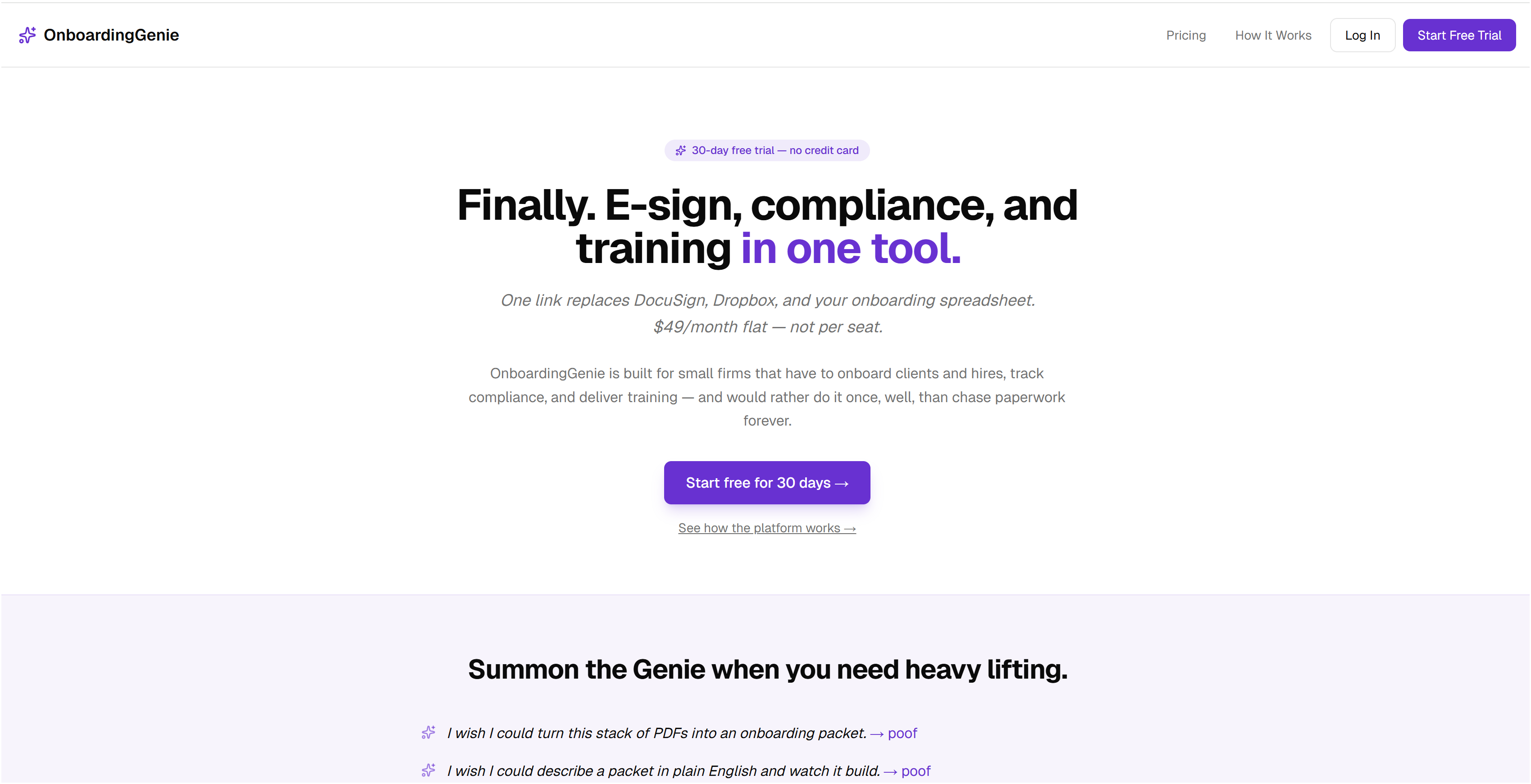
With OnboardingGenie, you can automate time-sensitive compliance tasks like Form I-9 verification reminders, centralize training assignments and completion records, and customize onboarding workflows to fit your firm's specific roles and risk profile. Everything, from signed forms to training documentation, lives in one branded portal delivered through a single link. No scattered PDFs. No chasing signatures across email. Start with a free trial and see how much lighter onboarding feels when compliance is built into the process from day one. Explore compliance management services or import your existing documents through AI-assisted document templates to get running quickly.
Frequently asked questions
What is the deadline for completing Form I-9 during onboarding?
Form I-9 Section 1 must be completed by the employee no later than their first day of employment, and Section 2 must be completed by the employer within three business days of the employee's first day of work.
Why is OSHA training important during onboarding in small firms?
OSHA training ensures new employees understand workplace hazards and emergency procedures before working unsupervised, and OSHA requires this training to be documented before any unsupervised work begins, which directly reduces injury risk and regulatory exposure.
Can onboarding tasks be automated to improve compliance?
Yes. Automating onboarding workflows triggered by offer acceptance and start date ensures timely assignment of training modules and completion of compliance steps like Form I-9 before the employee's first day.
How can small firms track onboarding progress and compliance effectively?
Maintain signed acknowledgment records, training completion logs, and schedule 30/60/90 day check-ins to verify retention, address gaps, and confirm all compliance documentation is audit-ready.
What happens if onboarding compliance tasks like Form I-9 are missed or delayed?
Employers can face citations and financial penalties if they miss Form I-9 deadlines, and those violations can also undermine the firm's ability to demonstrate lawful employment status during government audits or inspections.