
TL;DR:
- Most small firms see new hires decide to stay or leave within the first 90 days, making effective onboarding essential. Implementing practices like preboarding, structured 30-60-90 day plans, manager engagement, and automation can significantly improve retention and productivity. Small firms can succeed by focusing on deliberate design, manager accountability, and leveraging technology to handle administrative tasks efficiently.
Most new hires decide whether to stay long before their 90-day mark. For HR professionals and business owners at small to medium-sized firms, that window is both a challenge and an opportunity. Getting onboarding experience best practices right means more than collecting signatures and handing out a laptop. It means connecting people to purpose, role clarity, and the team fast enough that they want to stay. This article walks through the practices that actually move the needle, from preboarding through full integration, with a direct eye toward the resource constraints small firms live with every day.
Table of Contents
- Key Takeaways
- 1. Preboarding: engage new hires before day one
- 2. Design the first day and week for connection, not completion
- 3. Build a structured 30-60-90 day onboarding plan
- 4. Automate compliance and workflow tasks
- 5. Cover all five dimensions of effective onboarding
- 6. Situational recommendations: matching practices to firm size and resources
- What I've learned about why small firm onboarding actually fails
- How OnboardingGenie helps small firms put these practices in place
- FAQ
Key Takeaways
| Point | Details |
|---|---|
| Start before day one | Preboarding with digital welcome kits and completed paperwork reduces early drop-off and first-day overwhelm. |
| Structure the full 90 days | Phased onboarding with defined milestones improves retention up to 82% compared to orientation-only programs. |
| Make managers accountable | New hires are 3.4x more likely to rate onboarding successful when their manager actively participates. |
| Automate the routine, not the human | Use workflow tools to handle paperwork and compliance tracking, freeing HR to focus on culture and connection. |
| Centralize your tools | A single onboarding portal reduces errors, saves time, and gives both HR and new hires a clear path forward. |
1. Preboarding: engage new hires before day one
The period between offer acceptance and the first day is the most underused window in onboarding. Most firms treat it as dead time. The ones with strong retention use it deliberately.
Start with a digital welcome kit sent within 24 hours of acceptance. This kit should include a short note from the firm owner or managing partner, a one-page overview of what the first week looks like, and a brief video introducing the team. It does not need to be polished production. A two-minute Loom recording from the hiring manager covers more psychological ground than a formatted PDF ever will.
Complete compliance paperwork before day one. I-9 verification, direct deposit forms, benefits enrollment, and any role-specific agreements should all be sent digitally and completed before the new hire walks in. Manual onboarding consumes 6 to 12 HR hours per hire, and a significant portion of that is chasing forms that could have been finished before day one.
- Send the welcome kit within 24 hours of offer acceptance
- Complete all compliance forms digitally before the start date
- Assign a peer buddy and initiate a brief intro conversation before day one
- Send a manager message three days before start outlining week-one expectations
- Confirm system access, equipment, and workspace setup in advance
Pro Tip: Schedule the preboarding communication sequence as a workflow rather than a manual task list. Firms using a digital onboarding portal can trigger these touchpoints automatically based on the hire date, so nothing gets dropped when HR is stretched thin.
2. Design the first day and week for connection, not completion
The most common mistake firms make on day one is cramming every administrative task, policy briefing, and tool tutorial into eight hours. New hires leave exhausted and no more connected to the firm than when they arrived.

Spread administrative tasks across the first week instead of front-loading them onto day one. Reserve the first morning for workspace orientation, team introductions, and a candid conversation about the firm's culture and how work actually gets done. That last part matters more than most HR guides acknowledge. New hires absorb organizational norms fastest through observation and direct conversation, not an employee handbook.
The buddy system is one of the highest-ROI practices you can implement at almost no cost. Employees with an onboarding buddy are 23% more satisfied and reach full productivity 36% faster. A good buddy is not a trainer. They are a trusted peer who answers the questions new hires are too cautious to ask their manager.
- Limit formal presentations to no more than two hours on day one
- Schedule a 30-minute culture conversation with the firm owner or a senior team member
- Assign a buddy from a different team or function for broader firm exposure
- Give a meaningful first assignment by end of day two, even a small one
- Run a brief check-in at the end of day one to catch confusion early
Hybrid onboarding formats generate 75% higher satisfaction compared to fully remote methods, so if your team is distributed, build in at least one in-person or synchronous touchpoint during week one.
Pro Tip: Provide new hires with a "cheat sheet" of five to seven people they should know in their first week, including one sentence on what each person does and why that connection matters. It makes introductions feel purposeful instead of social obligation.
3. Build a structured 30-60-90 day onboarding plan
Short orientation programs feel complete but rarely produce the retention results firms need. Only 29% of companies run structured 90-day onboarding programs, and that gap directly correlates with early turnover. The firms that extend onboarding beyond initial orientation see measurable differences in both productivity and tenure.
A well-structured 30-60-90 day plan breaks integration into three distinct phases, each with its own goals and checkpoints.
| Phase | Focus | Key Milestones |
|---|---|---|
| Days 1-30 | Learning and orientation | Complete all compliance tasks, understand team roles, complete role-specific training modules |
| Days 31-60 | Application and contribution | Handle assigned projects independently, identify process gaps, share feedback with manager |
| Days 61-90 | Integration and performance | Meet measurable role targets, build peer relationships, complete initial performance review |
Manager check-ins should be weekly during the first 30 days and bi-weekly through day 90. This is not optional. 29% of employees receive no formal feedback in their first 90 days, and those employees leave at significantly higher rates. Managers at small firms often treat onboarding check-ins as something HR owns. They do not. The manager's active involvement is the single biggest driver of whether a new hire stays. New hires are 3.4x more likely to rate their onboarding experience as successful when a manager is directly engaged throughout the process.
For a concrete example: consider Meridian Consulting, a 12-person advisory firm where principal Dana Reyes introduced a 90-day onboarding plan after losing two strong hires in their first two months. Dana built a shared tracker with milestones for each phase, assigned managers a recurring one-on-one calendar invite, and tied the 60-day check-in to a simple written review form. Turnover in the first six months dropped from 40% to under 10% the following year. The plan itself was not complicated. The consistency was.
You can find a detailed framework for this in the complete small firm onboarding guide from OnboardingGenie, which includes phase-by-phase checklists adapted for firms without a dedicated HR team.
4. Automate compliance and workflow tasks
Compliance is the part of onboarding that cannot afford errors, and it is also the part that eats the most HR time. For small firms, those two facts create a real operational problem. Automated onboarding saves approximately $18,000 annually and reduces HR time on routine questions by 4.5 hours per week. That is a meaningful number for a firm where HR is often one person wearing four hats.
The most practical application of automation in small firm onboarding is not AI-driven personalization. It is event-driven workflows. When a hire date is confirmed, the system automatically triggers a sequence: welcome email sent, compliance forms routed, IT provisioning request filed, buddy assigned, manager briefed. Each step is owned, tracked, and time-stamped. Nothing slips because someone forgot to follow up.
- Automate digital paperwork routing and completion tracking for I-9, W-4, and firm-specific forms
- Use deadline-aware reminders to nudge new hires and HR when tasks are overdue
- Connect HR, IT, and finance through a shared onboarding workflow so account setup and payroll enrollment happen in parallel
- Track compliance attestations, policy acknowledgments, and certifications in one place
- Surface real-time completion dashboards so HR always knows where each hire stands
AI-powered onboarding tools show 82% improvements in new hire retention and 53% reductions in onboarding time when personalization and automation are applied together. For small firms, even partial automation of compliance tasks produces immediate time savings without requiring an enterprise-scale HR system.
The key distinction worth making here: automate the tasks, not the relationships. Compliance tracking tools handle the documentation. Human conversations handle culture and trust. Those two should never be confused.
5. Cover all five dimensions of effective onboarding
Most onboarding programs address compliance and role clarity. The ones with strong retention outcomes address all five dimensions that research consistently ties to reduced attrition: compliance, clarification, culture, connection, and confidence.
Compliance is the legal and regulatory foundation. Clarification is role-specific: does the new hire know exactly what good performance looks like in their position? Culture is the set of norms, values, and informal rules that define how work happens. Connection is the network of relationships that make someone feel like a member of the team rather than a contractor. Confidence is the accumulated sense that the hire has the skills, support, and access to succeed.
Small firms tend to handle compliance adequately, sometimes handle clarification, and frequently skip culture, connection, and confidence entirely. That is where turnover lives. A new associate at a 15-person law firm may know their billing targets clearly but have no idea how partners communicate expectations, who the informal go-to people are, or whether asking questions is considered strength or weakness at that firm.
Building all five into your employee onboarding checklist means adding deliberate activities for each. Culture gets covered by the owner conversation on day one. Connection gets covered by buddy assignment and structured introductions. Confidence gets covered by meaningful early assignments and consistent feedback. None of these require significant resources. They require intentional design.
6. Situational recommendations: matching practices to firm size and resources
Not every practice makes sense at every scale. A 6-person consulting firm and a 45-person accounting firm have very different HR capacity, and their onboarding programs should reflect that. The comparison below covers the most common practices and when each one is worth prioritizing.
| Practice | Best for | Budget level | Complexity |
|---|---|---|---|
| Digital preboarding packets | All firm sizes | Low | Low |
| Peer buddy program | Firms with 8+ employees | Zero cost | Low |
| Structured 30-60-90 plan | Firms with 10+ employees | Low | Medium |
| Compliance workflow automation | All firms with recurring hires | Low to medium | Low with right tool |
| Role-specific training modules | Professional service firms | Medium | Medium |
| HR portal with centralized tasks | Firms hiring 3+ per year | Low (flat fee tools) | Low |
For firms operating without a dedicated HR department, the priority order matters. Start with digital preboarding and a basic 30-60-90 plan. Add a buddy assignment process next. Automate compliance tracking once you have the first two working consistently. The onboarding without HR department guide from OnboardingGenie walks through this build sequence for firms that are hiring without HR infrastructure.
Pro Tip: Do not try to build a complete onboarding program in one sprint. Firms with the most effective onboarding built it in three to four iterations over 12 to 18 months, improving one phase at a time after each new hire cycle.
What I've learned about why small firm onboarding actually fails
I built OnboardingGenie after watching the same problem play out repeatedly. Firms would invest in a good hiring process, make a great offer, and then hand the new hire a folder of PDFs on day one and expect things to work out. They usually did not.
The real failure is not missing a checklist item. It is treating onboarding as an administrative event rather than a performance and retention investment. When HR is consumed by chasing paper, there is no time left for manager coaching, culture conversations, or the kind of check-ins that catch disengagement early.
What I have seen work consistently is this: use technology to absorb the administrative work so humans can do the human work. Compliance documentation, form routing, deadline reminders. those belong in a workflow tool, not on someone's to-do list. Manager engagement, culture context, peer relationships. those belong to people.
The other thing most guides do not say plainly enough: manager accountability is not optional. You can have the best onboarding portal in the world, but if the hiring manager does not show up for their week-two check-in, you will lose that hire by month three. I have seen it happen at firms of every size. Fix the manager behavior first. The technology makes everything else easier, but it cannot replace that.
— Chris
How OnboardingGenie helps small firms put these practices in place
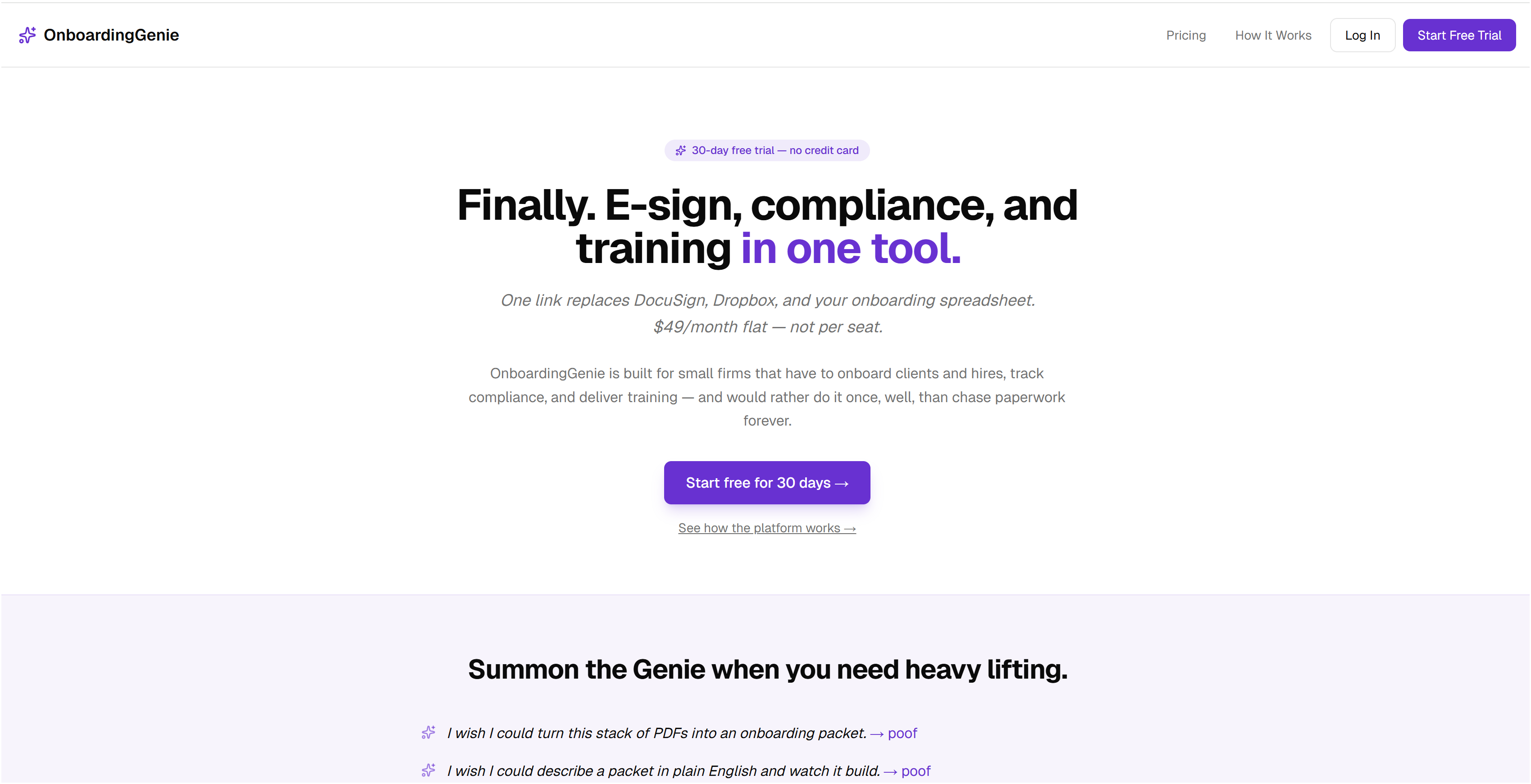
If you recognize the patterns described in this article, OnboardingGenie was built specifically for firms in your position. The platform consolidates compliance tracking, digital paperwork, form routing, and training delivery into a single branded portal. No disconnected tools, no PDF email chains, no manual follow-up reminders.
The compliance management features handle attestations, policy acknowledgments, and deadline-aware nudging automatically, so HR is notified when something is overdue rather than discovering it weeks later. For firms that are currently using DocuSign or manual signature workflows, the paperwork management tools replace that process with a single link that routes forms, collects signatures, and tracks completion in one place. Everything runs on a flat monthly fee, which means no per-seat pricing surprises as your team grows. If you want to see how other small professional service firms have structured their onboarding with OnboardingGenie, see how it works for firms your size.
FAQ
What are the most important onboarding experience best practices for small firms?
The highest-impact practices are digital preboarding, structured 30-60-90 day plans, manager check-ins, peer buddy assignment, and centralized compliance tracking. Small firms should prioritize these before investing in more complex automation.
How long should employee onboarding last?
Structured onboarding programs spanning 90 days improve retention up to 82% and productivity over 70%. Most experts recommend a minimum of 90 days, with role-specific training continuing beyond that point.
What should an employee onboarding checklist include?
A solid HR onboarding checklist covers preboarding compliance forms, day-one orientation activities, buddy assignment, 30-60-90 day goal setting, manager check-in schedule, role-specific training completion, and a formal 90-day performance conversation.
Can small firms onboard effectively without an HR department?
Yes. Firms without a dedicated HR person can run effective onboarding by assigning a manager as the onboarding owner, using a digital portal to handle compliance and paperwork, and following a structured 30-60-90 day plan. A centralized tool eliminates the coordination overhead that makes this difficult without HR support.
How does automation improve the onboarding experience?
Automation handles compliance documentation, form routing, and deadline reminders, freeing HR and managers to focus on culture, connection, and performance conversations. Automated onboarding saves approximately $18,000 annually and reduces time spent on routine questions by 4.5 hours per week.