
TL;DR:
- Effective onboarding training materials are structured to accelerate new hires’ productivity, compliance, and cultural integration from day one. They should be sequenced over 30, 60, and 90 days, with relevance, practice, and clear performance expectations guiding each stage, while feedback loops refine their effectiveness. Proper documentation, regular maintenance, and outcome-based metrics are essential, especially for small firms balancing live mentorship with curated knowledge.
Training materials in onboarding are the structured knowledge assets that enable new hires to perform their roles, meet compliance requirements, and integrate into a firm's culture from day one. In small to medium-sized professional service firms, where a single underperforming hire carries disproportionate cost, the role of training materials in onboarding is not a nice-to-have. It is the difference between a new hire who contributes within 30 days and one who quietly struggles for six months. This article covers what effective materials look like, how to build them for compliance and productivity, and how to measure whether they are actually working.
How training materials accelerate new hire productivity
The fastest path to early contribution is role-sliced, task-aligned content tied directly to what a new hire will do in their first 30 days. This is the opposite of the document dump approach, where firms hand over a folder of policies and call it onboarding. When materials match the actual work, new hires build confidence faster and ask fewer disruptive questions.

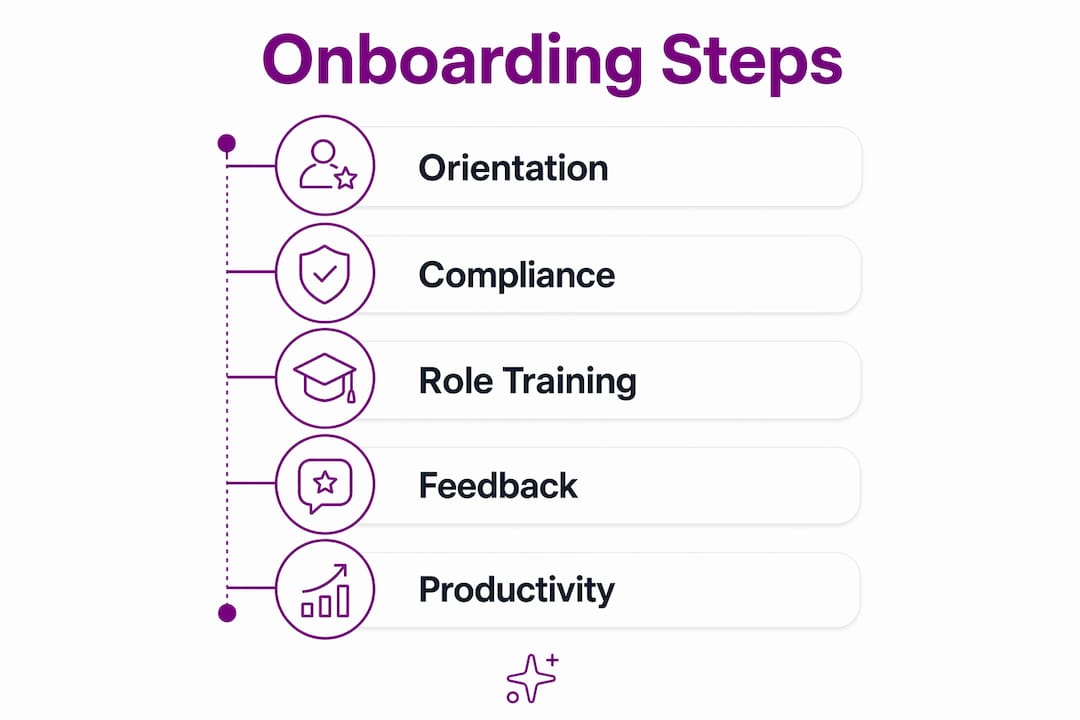
The 30-60-90 day sequencing model is the industry standard for phased delivery. A structured 30-60-90 plan starts with orientation and compliance in week one, moves to role-specific skills and tools in weeks two through four, and introduces culture, judgment, and decision-making context in months two and three. This sequencing prevents cognitive overload and gives new hires time to absorb each layer before the next arrives.
Three design principles separate effective training materials from generic ones:
- Immediate relevance. Every module should connect to a task the new hire will perform within the current phase. If a customer service coordinator does not touch the billing system until month two, that training belongs in month two.
- Practice opportunities. Simulations, real task assignments, and scenario-based exercises outperform passive reading. A consulting firm onboarding a junior analyst, for example, might include a mock client intake exercise in week two rather than a slide deck about client relationships.
- Clear performance expectations. Materials should state what "good" looks like at each milestone. Linking training content to measurable first-30-day goals gives both the new hire and their manager a shared reference point.
Feedback loops close the design cycle. Asking new hires what was confusing, redundant, or missing at the 30-day mark produces specific, actionable data. Google's approach of surveying throughout the first year to continuously refine training relevance is the clearest documented example of this working at scale. For a 10-person accounting firm, the equivalent is a 15-minute check-in conversation with a structured set of questions at day 30.
Pro Tip: Build a "day one packet" that contains only what the new hire needs to complete their first three tasks. Everything else goes into a shared drive or portal, clearly labeled by phase. This single change reduces the overwhelm that kills early momentum.
Does compliance training require documented proof of completion?
Compliance training requires documented completions with timestamps, employee acknowledgments, and version control to meet legal requirements. Verbal training alone is insufficient as legal defensibility depends on tamper-evident records that prove what was delivered, when, and to whom. For HR managers in professional service firms, this means the delivery method matters as much as the content itself.
The table below shows the difference between a minimal compliance training setup and an audit-ready one:
| Element | Minimal setup | Audit-ready setup |
|---|---|---|
| Completion tracking | Spreadsheet checkbox | LMS with timestamped records |
| Policy versioning | Single PDF | Version-controlled document tied to training record |
| Employee acknowledgment | Email confirmation | Digital signature with date stamp |
| Role-based assignment | Manual manager assignment | Automated by role and location |
| Export capability | None | Full audit trail export on demand |
An LMS integrated with your HRIS automates training assignments and eliminates the inconsistent delivery that creates documentation gaps. For a 20-person law firm with staff in two states, this matters because workplace safety requirements, harassment prevention training deadlines, and data privacy obligations differ by location. Manual tracking across those variables is where compliance failures happen.
Phased delivery also improves legal defensibility. Presenting all compliance content in a single day-one session produces low retention and weak acknowledgment records. Spreading mandatory training across the first two weeks, with a signed acknowledgment at each module, creates a stronger paper trail and better actual comprehension. For HR compliance training specifics, the best practices for small firms guide covers the documentation standards worth building toward.
Pro Tip: Tie each compliance module to the specific policy version it covers. When a policy updates, you need to know which employees completed the old version and who needs to complete the revised one. This is version control in practice, and it protects you in an audit.
How to design training materials for small to medium firms
Designing effective training materials starts with a gap analysis, not a content brainstorm. Sit down with two or three top performers in each role and ask them what knowledge they wish they had in their first 60 days. Then ask their managers what gaps they most commonly see in new hires at the 90-day mark. The overlap between those two answers is your content priority list.
From there, sequence content in three logical layers. The first layer covers orientation: firm structure, tools access, communication norms, and day-one compliance. The second layer covers role-specific skills tied to the new hire's actual responsibilities. The third layer covers culture, judgment, and the unwritten rules that determine what success looks like at your firm. Skipping to layer three before layer one is complete is a common mistake that produces confusion rather than integration.
Format choices should match your resources and your new hire's learning context. A medical practice onboarding a front-desk coordinator benefits from short video walkthroughs of the scheduling software, not a 40-page manual. A consulting firm onboarding a senior associate may find annotated case studies more useful than interactive modules. The onboarding experience best practices for small firms consistently point to format variety as a retention driver, not just a preference accommodation.
Keep materials concise and focused on immediate contribution. Training materials that match actual job tools and workflows prevent confusion and build consistent mental models. A checklist for completing a client intake form is more useful than a paragraph describing the intake process. Practical, task-level materials reduce the gap between knowing and doing.
Maintenance is where most small firms fall short. Training materials become outdated the moment a process changes, a tool is replaced, or a regulation updates. Assign one person ownership of each material set with a quarterly review calendar. When a new hire flags something as confusing or outdated, treat it as a defect report and fix it within two weeks.
What metrics actually measure training effectiveness?
Measuring training effectiveness requires looking beyond completion rates to engagement depth, time-to-competency, and retention. Completion rates tell you whether the training was accessed. They do not tell you whether it changed behavior or built capability. For HR managers running lean teams, tracking the right metrics from the start saves time and produces better decisions.
The most useful measurement framework uses both leading and lagging indicators:
- Completion rate by module. Useful as a baseline, but only as a starting point. Low completion on a specific module signals a delivery or relevance problem worth investigating.
- Time-to-competency. How long does it take a new hire to perform a task independently without manager support? This is the clearest measure of whether training is working.
- Engagement depth. Are new hires watching full videos, completing all sections, or dropping off at a specific point? Drop-off data identifies where materials lose relevance or become too dense.
- Support ticket volume. A spike in questions about a specific process in the first 60 days indicates a gap in the training materials covering that process.
- Retention at 90 and 365 days. Early turnover is the most expensive signal that onboarding failed. Tracking it by cohort and correlating it with training completion patterns reveals systemic gaps.
Surveys at 30, 90, and 365 days produce qualitative data that metrics alone cannot capture. A new hire who completed every module but still feels unclear on decision-making authority will not show up in your completion dashboard. That gap shows up in a 30-day survey question like "Do you know who to ask when you are unsure how to proceed?" The role of training in consultant onboarding follows the same measurement logic: outcomes matter more than activity counts.
Key takeaways
Structured, phased training materials are the single most controllable factor in how quickly a new hire becomes a productive, compliant member of your team.
| Point | Details |
|---|---|
| Phase content over 30-60-90 days | Sequencing prevents cognitive overload and aligns training to actual job tasks at each stage. |
| Compliance requires documented proof | Timestamped completions, policy versioning, and digital acknowledgments are legally required, not optional. |
| Gap analysis drives design | Interview top performers and managers before building materials to identify what actually matters. |
| Measure outcomes, not just completions | Track time-to-competency, support ticket volume, and retention alongside completion rates. |
| Maintenance is non-negotiable | Assign ownership and a quarterly review cycle to keep materials accurate as processes change. |
Why most small firms get training materials wrong
Here is what I have seen consistently across small professional service firms: the training materials exist, but they were built once, never updated, and handed to every new hire regardless of role. A paralegal and a billing coordinator at the same five-person law firm receive the same onboarding packet. Neither of them gets what they actually need.
The deeper problem is that most firms treat onboarding as an event rather than a measurable capability-building process. The packet gets sent, the boxes get checked, and the new hire is considered "onboarded." What actually happened is that the firm transferred documents, not knowledge. The new hire spends the next 60 days reverse-engineering how the firm actually works by watching colleagues and asking questions that should have been answered in week one.
The fix is not expensive software or a complete rebuild. It is deciding that training materials are a living system with an owner, a review cycle, and a feedback mechanism. The firms that get this right are not the ones with the most polished materials. They are the ones that treat a confused new hire as a signal to improve the materials, not as evidence that the new hire is a poor fit.
One more thing worth saying directly: the balance between live exposure and curated materials matters. No checklist replaces sitting with a senior colleague for two hours. The best onboarding programs use materials to handle the transferable, repeatable knowledge and use people to handle the contextual, judgment-based knowledge. Getting that division right is what separates firms that retain good hires from firms that keep wondering why good people leave.
— Chris
How OnboardingGenie handles training materials for small firms
OnboardingGenie is built specifically for small professional service firms that need onboarding, compliance tracking, and training materials managed in one place without the cost or complexity of enterprise platforms. The platform assigns training automatically by role and location, tracks completions with audit-ready records, and consolidates signatures, forms, and training content into a single branded portal. For firms currently managing onboarding through PDFs, spreadsheets, and email threads, it replaces that stack with one organized workflow. You can see exactly where each new hire stands, what they have completed, and what is still outstanding, without chasing anyone down. Explore onboarding and compliance tools built for firms your size.
FAQ
What is the role of training materials in onboarding?
Training materials in onboarding deliver the structured knowledge new hires need to perform their roles, meet compliance requirements, and integrate into company culture. Without them, knowledge transfer depends entirely on informal conversations, which produces inconsistent results across hires.
How long should onboarding training materials cover?
Effective onboarding training materials should span at least 90 days, with content sequenced from orientation and compliance in week one through role-specific skills and cultural context in months two and three. Research supports phased delivery to prevent cognitive overload and improve retention.
What records does compliance training require?
Compliance training requires timestamped completion records, employee acknowledgments, and version-controlled policy documentation to meet legal standards. Verbal or informal training does not satisfy audit requirements in most regulated industries.
How do you measure whether training materials are working?
Track time-to-competency, support ticket volume in the first 60 days, and retention at 90 and 365 days alongside completion rates. Completion alone does not confirm that training changed behavior or built the capability the role requires.
What formats work best for onboarding training materials in small firms?
Short videos, task-level checklists, and annotated examples of real work outperform long manuals for most roles in small firms. Format choice should match the new hire's actual work context and the resources available to maintain the materials over time.