
TL;DR:
- Small and medium-sized professional service firms often treat HR compliance training as a mere checkbox, risking legal exposure. Effective programs require role-specific content, management enforcement, documented skill outcomes, and automated tracking to ensure actual compliance. Tailoring training to roles, measuring skills, automating recertifications, and involving leadership are crucial for sustained, meaningful compliance.
Most small and medium-sized professional service firms treat HR compliance training as a box to check. Send the policy, collect the signature, move on. That approach is exactly what creates legal exposure. Effective hr compliance training best practices, as compliance professionals call them, require something more deliberate: role-specific content, management enforcement, documented skill outcomes, and a system that proves the training actually happened. This article covers the criteria that matter, the methods that work for firms under 50 people, and how to build a program that holds up to scrutiny.
Table of Contents
- Key Takeaways
- HR compliance training best practices: the framework that matters
- 1. Build role-based learning paths from day one
- 2. Shift from completion tracking to skill measurement
- 3. Use microlearning to increase retention
- 4. Automate compliance tracking and recertification
- 5. Integrate training with HR and risk management systems
- 6. Apply AI-driven skills gap analysis carefully
- 7. Make management participation non-negotiable
- 8. Comparing training delivery methods for small firms
- 9. Tailor training programs to your firm's specific constraints
- My take on what actually separates good compliance training from paper compliance
- How OnboardingGenie supports compliance training for small firms
- FAQ
Key Takeaways
| Point | Details |
|---|---|
| Role-specific content is non-negotiable | Training must address the actual compliance risks each employee faces, not a one-size-fits-all policy review. |
| Completion metrics are not enough | Measure demonstrable skill outcomes, not just who clicked through the course. |
| Management must model and enforce | A compliance culture fails without visible leadership participation and consistent consequence management. |
| Automation reduces documentation gaps | Automated tracking and audit trails eliminate the spreadsheet chaos that sinks small firms during audits. |
| Continuous improvement keeps programs valid | Annual reviews using employee feedback and audit findings prevent stale, ineffective training content. |
HR compliance training best practices: the framework that matters
Before selecting a tool or drafting a course, you need a framework for what good compliance training actually looks like. The industry term is a compliance management system, and the DOJ has been explicit about what it expects to see. The DOJ's three-pronged evaluation assesses whether training is tailored to specific roles, delivered periodically, and genuinely applied within the organization. Generic annual training with a completion checkbox does not satisfy that standard.
For small firms, this framework translates into six criteria worth evaluating:
- Regulatory alignment. Does the training address the specific laws and regulations your firm is actually subject to? A 12-person accounting firm and a 20-person immigration law practice have almost no regulatory overlap.
- Role specificity. Different departments need tailored content that reflects their actual compliance exposure. Your front desk staff and your managing partner face different risks.
- Periodic delivery and recertification. Compliance training is not a one-time event. Laws change. People forget. Annual or semi-annual recertification keeps knowledge current.
- Management enforcement and accountability. The DOJ emphasizes consequence management alongside positive incentives. If managers do not model the behavior, the training will not stick.
- Documentation and auditability. You need records that show who completed what, when, and with what result.
- Measurable skill outcomes. Organizations that only track completions miss whether skills were actually built. The goal is measurable skill outcomes, not completion counts.
Pro Tip: Build your HR training compliance checklist around these six criteria before you select any platform or vendor. The checklist tells you what you need; the platform helps you deliver it.
1. Build role-based learning paths from day one
Generic compliance training frustrates employees and misses the point. A paralegal in a family law practice needs training on client confidentiality and document retention. The firm's billing coordinator needs training on invoice accuracy and IOLTA compliance. The same 45-minute video serves neither well.
Role-based learning paths group employees by job function and assign content tied to their actual compliance exposure. This is not a complicated concept, but it takes deliberate setup. Start by mapping each role to the regulations that apply: HIPAA for medical support staff, FINRA rules for financial advisors, state bar requirements for legal professionals. Then build or source modules that speak directly to those scenarios. The compliance tracking guide for professional services firms covers how to structure that mapping for service-based organizations specifically.
2. Shift from completion tracking to skill measurement
A firm that records "100% completion" but cannot demonstrate that employees retained anything has a documentation problem disguised as a training program. In 2026, learning and development is shifting from content delivery to skills-first outcomes. That means pre- and post-assessments, scenario-based evaluations, and documented evidence that behavior changed.

For a small firm, this does not require a sophisticated learning management system. A short written assessment after each module, scored and retained, is enough to demonstrate genuine comprehension. The key is connecting training completion to a verifiable skill test, not just an acknowledgment form.
3. Use microlearning to increase retention
Sitting employees down for a 90-minute compliance marathon once a year produces low retention and high resentment. Microlearning and gamification increase engagement and knowledge retention by delivering content in short, focused bursts. Think 5 to 10 minute modules covering a single concept, followed by a brief check.
Consider how Marcus Webb, operations manager at a 16-person consulting firm in Austin, restructured his compliance calendar. Instead of one annual session, he runs 12 monthly 8-minute modules tied to real scenarios from the firm's work. Staff complete them on their own time, and tracking is automatic. Reported comprehension scores went up, and he now has 12 documented touchpoints per year instead of one.
Pro Tip: Tie microlearning modules to real scenarios your team has actually encountered. Fictional case studies are fine, but stories drawn from your own firm's near-misses land with considerably more weight.
4. Automate compliance tracking and recertification
Manual tracking through spreadsheets creates gaps, and gaps create liability. Automated tracking systems provide audit trails that show exactly when each employee completed each module, what score they received, and when recertification is due. That level of documentation matters when a regulator or litigant asks whether your firm took compliance seriously.
For firms without a dedicated compliance officer, automation is not optional. It is how you maintain a defensible record without a full-time administrator. Platforms that integrate training delivery with automated reminders and deadline tracking reduce the human oversight required without removing it entirely. The case study of a small law firm that abandoned annual spreadsheet-based compliance tracking illustrates exactly what this shift looks like in practice.
5. Integrate training with HR and risk management systems
Compliance training that lives in isolation from HR records, risk registers, and onboarding workflows creates duplication and inconsistency. When a new hire joins, their compliance training should start automatically. When a regulation changes, the relevant training module should update and trigger recertification for affected roles. Integrating training with HR and risk platforms improves consistency and makes reporting straightforward.
For small firms, this often means choosing a platform that handles onboarding and compliance in the same place. Trying to synchronize three separate tools, an HRIS, a learning management system, and a document signing tool, produces the exact kind of fragmentation that leads to missed training and undocumented completions.
6. Apply AI-driven skills gap analysis carefully
Modern platforms can use AI to analyze individual performance on assessments and recommend personalized training paths. AI-powered skill assessments identify where individual employees are weak and surface targeted content. For a 30-person firm, this kind of personalization is genuinely useful, particularly when staff have varied backgrounds and experience levels.
That said, AI-driven tools require good underlying data to function accurately. If your assessments are superficial, the AI recommendations will be too. Use AI to guide, not replace, the human judgment that should drive your training design decisions.
7. Make management participation non-negotiable
Strong compliance programs require leadership modeling and cultural integration beyond written policies. If partners and managers skip the training or treat it as staff-only, the message to employees is clear: this does not really matter.
Practically, this means partners complete the same modules as junior staff. It means managers are held accountable for their team's completion rates. And it means positive incentives, not just penalties, for employees who demonstrate strong compliance behavior. Consequence management cuts both ways.
8. Comparing training delivery methods for small firms
Not every delivery format works equally well across firm sizes, workforce distributions, and budget constraints.
| Method | Cost | Scalability | Engagement | Tracking ease | Best fit |
|---|---|---|---|---|---|
| In-person sessions | High | Low | High (when facilitated well) | Manual, limited | Firms under 10 with regulatory complexity |
| Online self-paced | Low to medium | High | Variable | Automated | Distributed or hybrid teams |
| Hybrid (online + live Q&A) | Medium | Medium | High | Semi-automated | Firms 15 to 50 with mixed roles |
| Manual documentation | Minimal | Very low | None | High-risk | Not recommended for ongoing compliance |
For most professional service firms in the 10 to 50 person range, online self-paced modules with role-specific paths and automated tracking deliver the best return. Hybrid delivery adds value when regulatory complexity is high or staff have questions that self-paced content cannot anticipate. The HR training module delivery guide for SMBs goes deeper on structuring each format for small firm workflows.
9. Tailor training programs to your firm's specific constraints
A 40-person medical billing firm in Texas faces a different compliance picture than a 12-person immigration practice in Illinois. Effective HR compliance strategies account for firm size, regulatory environment, workforce distribution, and available resources.
Several practical steps make this easier:
- If you have no dedicated compliance staff, assign a compliance lead from operations or HR who owns the calendar, the tracking, and the update cycle. One person with clear ownership outperforms a committee with shared responsibility.
- For hybrid or distributed teams, online delivery with automated reminders is the only realistic option. In-person annual sessions will always generate scheduling conflicts and incomplete participation.
- For industries with dense regulatory requirements, such as healthcare, financial services, or legal practice, prioritize third-party content providers who specialize in your sector. Generic employment law modules miss the specific rules that actually create exposure in your field.
- Balance cost and risk honestly. A firm with 10 employees and significant regulatory exposure should spend proportionally more on compliance training than a 10-person firm in a low-risk sector. The cost of a training program is almost never larger than the cost of a single regulatory violation.
Continuous improvement belongs here too. Periodic program reviews and employee surveys prevent training from going stale. Review your program at least annually using completion data, assessment scores, and feedback from staff about what content felt unclear or irrelevant.
My take on what actually separates good compliance training from paper compliance
I've spent years watching small firms build compliance programs that look correct on paper and fail in practice. The pattern is consistent. A firm invests time creating or sourcing training content. Staff complete it, attestations are collected, and the files go into a folder somewhere. A year later, the same training runs again. Nobody checks whether anything changed.
What I've found is that the firms with genuinely effective programs share one trait: management treats compliance as an operational standard, not a legal formality. The training is specific enough that employees recognize their own work in the scenarios. Assessments are rigorous enough that completion actually means something. And the records are organized well enough that you could pull an audit trail in an afternoon.
The uncomfortable truth is that most small firms are one regulatory inquiry away from discovering that their documentation does not hold up. The fix is not more training, it is better-designed training with actual accountability baked in. Start with honest assessment: could you prove, today, that every employee in a compliance-sensitive role completed relevant training within the past 12 months and demonstrated comprehension? If that answer is uncertain, the framework above gives you a clear path to fix it. The reinforcement piece matters too. Initial training without follow-through is just orientation.
— Chris
How OnboardingGenie supports compliance training for small firms
Running compliance training without the right infrastructure turns the process into a second job. OnboardingGenie was built specifically to solve this for firms under 50 people that cannot justify enterprise pricing but cannot afford the gaps that manual systems create.
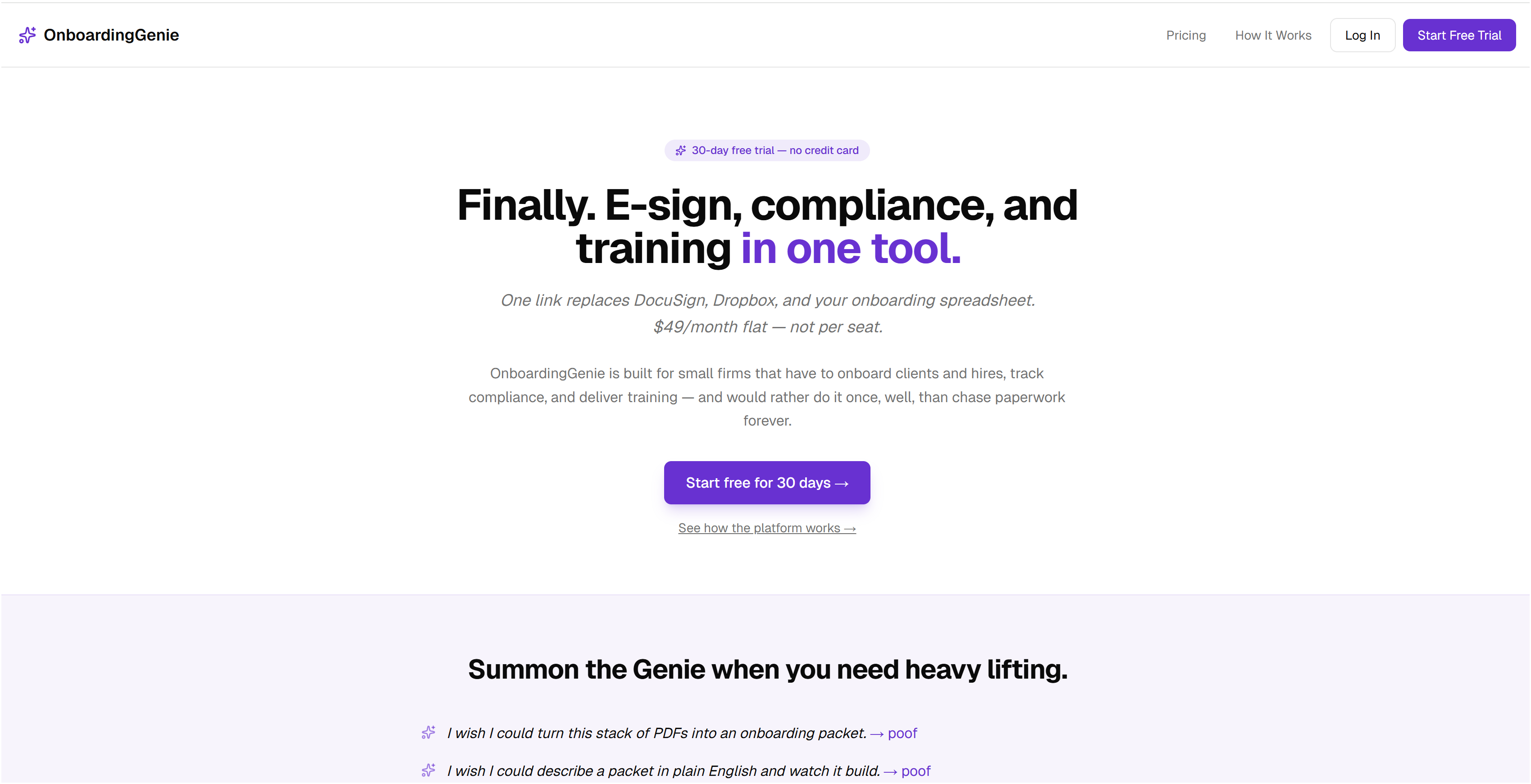
The platform consolidates compliance tracking, training delivery, document signing, and employee records into a single portal. When a new hire joins, their role-specific training queue starts automatically. Recertification reminders go out on schedule. Completion records, assessment scores, and signed attestations live in one place, retrievable in minutes, not hours. There are no disconnected tools to synchronize and no spreadsheets to maintain manually.
For firms that need a starting point, OnboardingGenie's compliance management tools are designed around the workflows small professional service firms actually use. Or take a look at the full services overview to see how compliance tracking fits into the broader onboarding and HR process. Flat monthly pricing means you know the cost before you commit.
FAQ
What does the DOJ look for in compliance training programs?
The DOJ evaluates whether training is role-specific, delivered periodically, and genuinely applied within the organization, not just documented as complete. Management enforcement and consequence management are also assessed.
How often should compliance training be repeated?
Compliance training should be delivered at minimum annually, with recertification triggered when relevant regulations change. Ongoing reinforcement through short refresher modules is more effective than a single annual session.
What is the difference between completion tracking and skill-based compliance training?
Completion tracking records that an employee accessed a course. Skill-based training measures whether the employee can demonstrate the required knowledge through assessments tied to real job scenarios, which is what regulators and courts actually care about.
Can a small firm run effective compliance training without a dedicated compliance officer?
Yes. Assign one person as the compliance lead to own the training calendar, tracking, and annual review. Pair that role with a platform that automates reminders, records completions, and flags overdue recertifications.
How should compliance training differ across roles in a professional service firm?
Each role should receive content tied to its specific regulatory exposure. Administrative staff, client-facing professionals, and firm principals typically face different compliance risks and should not receive identical training modules.