
TL;DR:
- Onboarding compliance tools are essential for small firms to meet deadlines, track credentials, and avoid violations. Selecting human-led, deadline-aware platforms tailored for small teams reduces audit risks cost-effectively while ensuring timely documentation and secure audit trails. Proper implementation and workflow integration are critical to maintaining ongoing compliance without relying on expensive enterprise systems.
Onboarding compliance tracking tools are no longer optional for professional service firms. Between I-9 deadlines, credential reverifications, document retention rules, and the ever-present risk of an ICE audit, small HR teams are managing a regulatory load that paper processes and spreadsheets simply cannot handle safely. Miss one Section 2 deadline or let a license expiration slip through, and your firm faces substantive violations with no cure opportunity. This article walks you through the criteria that matter when evaluating compliance tools, profiles five platforms built for firms your size, and gives you a side-by-side comparison to make the decision faster.
Table of Contents
- Key Takeaways
- 1. What to look for in onboarding compliance tracking tools
- 2. OnboardingGenie: unified onboarding and compliance for small firms
- 3. Certemy: credential and license tracking for regulated professions
- 4. HRCloud: checklist-based I-9 tracking with audit risk reduction
- 5. Amiqus: compliance onboarding with integrated identity checks
- 6. RealStaff: all-in-one platform with payroll integration
- 7. Side-by-side comparison of top tools
- 8. Best practices for choosing and implementing a compliance tool
- What I've learned from small firms managing compliance manually
- How OnboardingGenie handles compliance tracking for small firms
- FAQ
Key Takeaways
| Point | Details |
|---|---|
| Deadline enforcement is non-negotiable | I-9 Section 2 must be completed within 3 business days of hire; tools that enforce this reduce your biggest audit risk. |
| Audit trails are a compliance requirement | Electronic I-9 systems without proper audit logging create substantive violations that cannot be corrected after the fact. |
| Hire date accuracy prevents system errors | Automated systems can pre-fill incorrect start dates, causing compliance failures unless tools validate dates independently. |
| Integration reduces manual errors | Connecting onboarding to payroll or HRIS validates hire dates and cuts the risk of missed reverification milestones. |
| Small firms need tools sized for them | Enterprise compliance software is overbuilt and overpriced for 1-50 person firms; purpose-built platforms deliver better fit. |
1. What to look for in onboarding compliance tracking tools
Before comparing any specific platform, you need a clear set of criteria. Compliance tracking is not a feature checkbox exercise. It is about whether the tool matches how your regulatory obligations actually work in practice.
The most critical capability is deadline-driven workflow management. Form I-9 Section 2 must be completed within 3 business days of an employee's first day of employment, and retention rules require you to keep the form for 3 years after hire or 1 year after separation, whichever is longer. A tool that does not enforce those timelines with automatic alerts is not a compliance tool. It is a filing cabinet.
Here are the core features to evaluate:
- Deadline-aware task management: Structured workflows that trigger tasks at preboarding, Day 1, and reverification milestones automatically.
- Electronic I-9 compliance: The system must meet ICE standards for electronic signature, audit trail standards, and retention. ICE treats failures in electronic system compliance as substantive violations with no cure path.
- Credential and license expiration tracking: Automated alerts when certifications or work authorization documents are approaching expiration.
- HRIS and payroll integration: Syncing hire dates across systems to avoid the "date drift" problem discussed later in this article.
- Audit logging and document storage: A separate, searchable I-9 repository with timestamped entries that can be produced for an inspector on short notice.
- Usability for small teams: If your HR function is one person, the tool needs to work without a dedicated administrator.
- Transparent pricing: For firms with fewer than 50 employees, per-employee pricing models used by enterprise platforms often make no economic sense.
Pro Tip: When evaluating any platform, ask the vendor specifically whether their electronic I-9 system has been used in an actual ICE audit and what the outcome was. Most vendors will not have a clean answer, but the question itself tells you a great deal about how seriously they take the compliance architecture.
2. OnboardingGenie: unified onboarding and compliance for small firms
OnboardingGenie is built for professional service firms with 1 to 50 employees that have outgrown paper-based processes but do not need the complexity of an enterprise system. The platform consolidates onboarding documents, signatures, forms, and compliance tracking into a single branded portal delivered through one link.

For compliance specifically, OnboardingGenie provides I-9 deadline tracking with automated reminders, reverification alerts, and a secure document repository. The platform's compliance management features are designed to surface expiring work authorization and approaching reverification dates before they become violations. The flat monthly fee model makes budgeting predictable, which matters when compliance software costs are weighed against the actual risk exposure of a firm your size.
What separates OnboardingGenie from general HR tools is the emphasis on human-led workflows. The platform does not try to automate every decision. It structures the process so that the right person takes the right action at the right time, with the documentation to prove it.
3. Certemy: credential and license tracking for regulated professions
Certemy is purpose-built for industries where professional licenses are a condition of employment, including healthcare, legal, engineering, and financial services. Its core strength is tracking license expirations and verifying status between renewal cycles across an entire workforce.
For small professional service firms, Certemy is most relevant when credential lapse is itself a compliance event, not just an HR inconvenience. A lapsed law license or expired CPA certification on file creates regulatory and liability exposure. Certemy sends automated alerts to both the employee and the HR administrator when a credential is approaching expiration, and it maintains a full history of credential status over time.
Certemy is less focused on the new-hire onboarding workflow itself and more on the ongoing credential management cycle. Firms that need both functions may find themselves pairing Certemy with another platform, which adds cost and integration complexity.
4. HRCloud: checklist-based I-9 tracking with audit risk reduction
HRCloud takes a structured checklist approach to onboarding compliance. The platform provides I-9 onboarding checklists that address the most common audit failure point: late completion of Section 2. Most I-9 errors are process failures, not intentional violations. They happen because no one enforced the deadline.
HRCloud's workflow organizes I-9 tasks by timing, so the HR administrator gets prompted to complete Section 2 before the 3-day window closes. The platform also includes document storage and an audit trail, giving you evidence of when each step was completed.
The limitation for small firms is that HRCloud is broader than it is deep on compliance. The checklists are well-designed, but the overall platform is built for mid-market companies with more HR infrastructure than a 10-person consulting firm typically has.
5. Amiqus: compliance onboarding with integrated identity checks
Amiqus is a UK-founded platform that has expanded into markets where anti-money laundering (AML) and Know Your Customer (KYC) requirements apply to employee onboarding as well as client onboarding. For US professional service firms in financial services, real estate, or legal, where staff may require identity verification as part of regulatory onboarding, Amiqus handles that process within a single workflow.
The platform combines identity verification, right-to-work checks, and document collection into a structured onboarding flow. If your firm is subject to sector-specific compliance requirements beyond standard employment law, Amiqus addresses a compliance gap that most HR tools ignore entirely.
For firms where the primary compliance need is I-9 and credential management, Amiqus may be more than the situation requires. Its pricing and feature set are calibrated toward firms with regulatory onboarding obligations that go beyond standard employment law.
6. RealStaff: all-in-one platform with payroll integration
RealStaff takes a different structural approach. Rather than adding compliance to an HR platform, it combines scheduling, credentialing, onboarding, and payroll to maintain continuous compliance visibility across the employment lifecycle. The integration between payroll and onboarding is particularly significant for preventing hire date errors.
When hire date data is siloed in a separate payroll system, there is a real risk of what compliance professionals call "date drift," where automated systems pre-fill incorrect start dates on forms like the I-9. RealStaff's integrated architecture validates hire dates across systems, reducing that specific failure mode.
For firms that run scheduling-intensive operations alongside professional services, RealStaff offers a level of visibility that separate tools cannot replicate. For a 10-person law firm with straightforward hiring patterns, the full feature set may be more than needed.
7. Side-by-side comparison of top tools
Here is a direct comparison across the features that matter most for compliance tracking at small to medium-sized firms.
| Feature | OnboardingGenie | Certemy | HRCloud | Amiqus | RealStaff |
|---|---|---|---|---|---|
| I-9 deadline enforcement | Yes | Limited | Yes | Limited | Yes |
| Electronic I-9 with audit trail | Yes | No | Yes | No | Yes |
| License/credential expiration tracking | Yes | Yes (core focus) | Limited | Partial | Yes |
| Reverification alerts | Yes | Yes | Yes | Partial | Yes |
| Payroll/HRIS integration | Partial | Limited | Yes | Limited | Yes (core focus) |
| AML/identity verification | No | No | No | Yes (core focus) | No |
| Built for small firms (1-50 staff) | Yes | Partial | Partial | Partial | Partial |
| Flat/predictable pricing | Yes | No | No | No | No |
The pattern here is consistent. No single tool wins every category. Your selection should match your firm's primary compliance risk, whether that is I-9 management, credential tracking, identity verification, or integrated payroll compliance.
8. Best practices for choosing and implementing a compliance tool
Selecting the right platform is only half the work. Implementation decisions determine whether the tool actually reduces compliance risk or just adds another system to manage.
Here is a practical sequence for getting this right:
- Audit your current workflow first. Before contacting any vendor, document every step in your current onboarding process and mark where deadlines are most likely to slip. Common gaps include no automated reminder for I-9 Section 2, no tracking for Form I-9 retention cutoff dates, and no system alert for expiring work authorization.
- Match the tool to your compliance risk profile. A legal firm with credentialed attorneys has different primary risks than a consulting firm with general employment compliance needs. Choose the tool that addresses your highest-risk exposure first.
- Involve your compliance stakeholders early. HR, your external employment attorney, and any compliance officer should review the shortlist before you run a trial. They will identify gaps that a feature comparison table cannot.
- Validate hire date handling specifically. Ask each vendor how their system handles the risk of incorrect hire dates. A good answer involves a clear workflow where hire dates are confirmed independently from form timestamps.
- Set up audit reporting before you need it. Configure the platform's reporting and document export features during implementation, not during an audit. You need to know exactly what an inspector would see before they ask.
- Review workflows after any regulatory change. USCIS updates I-9 procedures periodically. When that happens, your compliance tool's workflow needs to reflect the current version. Schedule a quarterly review of your onboarding compliance checklist against current USCIS guidance.
Pro Tip: Run a simulated audit on your own records 30 days after implementation. Pull five random I-9 files and check whether each one has a completed Section 2 within the 3-day window, correct retention dates, and no missing signatures. If the tool is working correctly, every file should be clean. If it is not, you have found the gap before a real auditor does.
For a broader foundation on building the full onboarding process for small professional service firms, the guide at OnboardingGenie's blog covers the end-to-end workflow with compliance integrated from the start.
What I've learned from small firms managing compliance manually
I built OnboardingGenie after watching small firms manage compliance with spreadsheets and shared drives, and then scrambling when an audit request arrived. Here is what I've actually observed, not what the compliance guides say in theory.
The most common failure is not ignorance of the rules. Most HR professionals I've spoken with know that I-9 Section 2 has a 3-day deadline. The problem is execution. When onboarding lives in email threads and PDF attachments, structured checklists do not replace the missing system. The deadline passes because no one got a reminder tied to the actual hire date.
The second failure I see consistently is treating compliance as a separate function from onboarding. When you do that, compliance becomes a catch-up task rather than a concurrent workflow. The firms that have the cleanest audit records are the ones where compliance documentation is part of the same tool as the rest of onboarding, not bolted on afterward.
My honest take: you do not need an expensive enterprise platform to maintain solid compliance. You need a tool that enforces timing, stores documents with proper audit trails, and alerts you before problems become violations. For most firms with fewer than 50 employees, that is achievable without a six-figure software contract.
— Chris
How OnboardingGenie handles compliance tracking for small firms
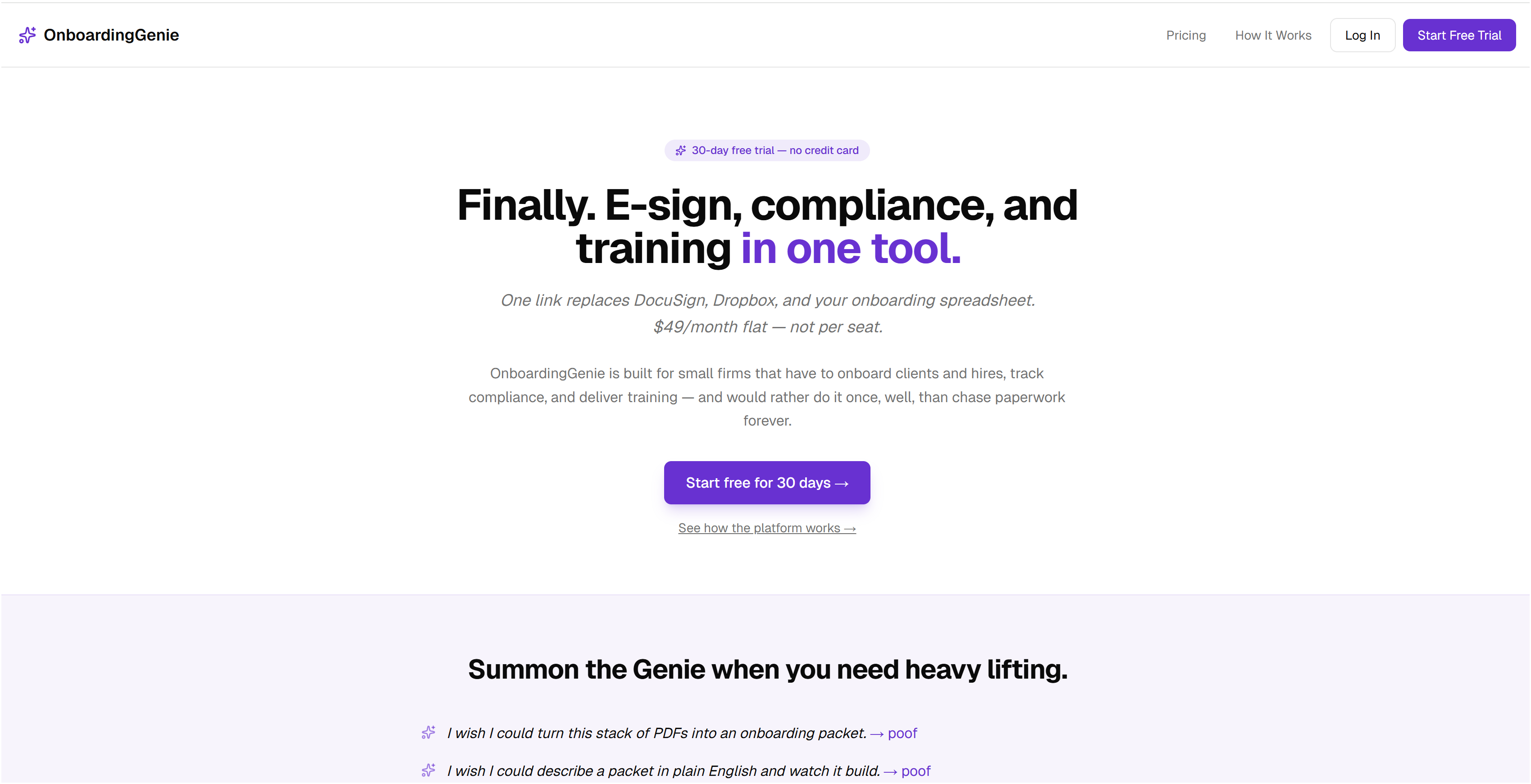
OnboardingGenie was built specifically for 1 to 50 person professional service firms that need real compliance management without the enterprise price tag. The platform brings I-9 deadline enforcement, reverification alerts, secure document storage, and audit-ready reporting into a single portal. No juggling between an I-9 system, a credential tracker, and a document management tool. Everything lives in one place, organized by employee, with timestamps on every action.
The flat monthly fee means your compliance costs do not scale unpredictably as you hire. And because the workflow is human-led rather than fully automated, your team stays in control of every decision while the system handles the timing, reminders, and documentation.
If you want to see how it works for a firm your size, start a free trial and run a real hire through the system. The compliance workflow is live from day one.
FAQ
What is an onboarding compliance checklist?
An onboarding compliance checklist is a structured list of required documentation and deadline-driven tasks that a firm must complete when hiring a new employee, including I-9 verification, tax forms, and any credential or license confirmations required by the role.
How do I track onboarding compliance without an HR department?
Use a dedicated onboarding compliance tracking tool that automates deadline reminders and stores documents with audit trails. Small firms without full HR staff rely on these platforms to surface tasks at the right time without manual follow-up.
What is legal onboarding compliance?
Legal onboarding compliance refers to the federal and state requirements that govern new hire documentation and verification, including Form I-9 completion timelines, E-Verify participation where required, and applicable credential or licensing verification for regulated professions.
What happens if I-9 Section 2 is completed late?
Late completion of I-9 Section 2 is treated as a substantive violation during an ICE audit. Penalties for substantive I-9 violations range from $272 to $2,701 per violation for a first offense, and the error typically cannot be corrected after the fact.
Can small firms use the same compliance management software as large companies?
They can, but enterprise compliance management software is often overbuilt and priced per-module or per-employee in ways that do not make sense for firms under 50 people. Purpose-built platforms for small firms deliver the critical compliance features at a cost structure that matches the actual risk exposure.