
When a new hire or client slips through the cracks during onboarding, the damage is rarely obvious at first. A missing I-9, an unsigned policy acknowledgment, or an unreviewed exception can stay buried for weeks before creating a serious compliance problem. For small and medium-sized professional service firms, those gaps are more than administrative inconveniences. They're liability. Onboarding can last up to 12 months, and every phase carries its own oversight requirements. This guide gives you the steps, tools, and checkpoints to build a process that keeps humans in control without creating more work.
Table of Contents
- What is human oversight in onboarding and why does it matter?
- What you need before you start: people, tools, and critical checkpoints
- Step-by-step: Building a compliant, oversight-driven onboarding process
- How to verify, track, and improve your onboarding oversight process
- Perspective: Why human oversight is your competitive edge in onboarding
- Next steps: Implementing oversight-friendly onboarding in your firm
- Frequently asked questions
Key Takeaways
| Point | Details |
|---|---|
| Oversight is operational | True human oversight means embedding checkpoints, audits, and clear ownership into your onboarding workflows. |
| Start with core compliance | Complete critical documents and checks early to avoid legal and operational setbacks. |
| Assign clear owners | Make every approval and escalation step accountable by tying it to a specific person. |
| Iterate and audit | Review and refine your process with regular audits and structured check-ins to maintain compliance over time. |
What is human oversight in onboarding and why does it matter?
Now that you understand the stakes and the promise of better oversight, let's clarify what true human oversight looks like in onboarding. It goes well beyond a simple checkbox.
Human oversight, in the context of practice management onboarding, is the active involvement of people in reviewing, approving, and correcting key steps in a workflow. It's not just a policy statement that says "a manager will review forms." It's an operational system with named owners, decision logs, exception alerts, and clear escalation paths.
There's an important distinction here between a policy and a process. A policy says what should happen. A process defines who does it, when, how it gets recorded, and what happens when something goes wrong. Most firms have the policy. Very few have the process.
Making oversight concrete means embedding it into runbooks, audit trails, observability layers, and change-control procedures. Without that structure, oversight is just an intention.
Why does this matter in regulated industries? Because audit trails, exception handling, and AI transparency in onboarding are no longer optional safeguards. They're expected by clients, required by regulators, and relied on by your own team when disputes arise. Human oversight is what transforms an onboarding workflow from something that "usually works" into something you can stand behind when it's examined.
Here's how policy, process, and outcomes relate in practice:
| Layer | What it looks like | Compliance outcome |
|---|---|---|
| Policy statement | "All new hires complete I-9 on day one" | Defines intent but not accountability |
| Operational mechanics | Named reviewer, approval gate, deadline alert | Creates trackable, verifiable steps |
| Compliance outcome | Audit log, signed record, exception flag | Defensible documentation in any review |
Scenarios where oversight is especially critical include:
- Employment eligibility verification under federal law
- Client engagement agreements that require attestation before work begins
- Role-specific training acknowledgments that must be documented
- Financial services disclosures where timing and version matter
- Contractor onboarding with distinct classification requirements
What you need before you start: people, tools, and critical checkpoints
With the reasons for oversight clear, let's get practical. What do you need in place to build an oversight-driven onboarding process?

The first element is role clarity. Every firm, regardless of size, needs at least four defined roles in onboarding oversight. The firm owner or operations lead who sets the standard. An HR admin or office manager who runs the day-to-day workflow. An escalation contact who handles edge cases and exceptions. And for compliance-heavy firms, a compliance officer or external advisor who audits the process periodically.
A practical human oversight model for compliance-heavy workflows should operationalize oversight using approval checkpoints, escalation paths for uncertain situations, exception alerts for outliers, and scheduled periodic audits. That structure is what separates a real oversight process from a well-intentioned policy that no one monitors.
The second element is a set of critical control points, which are the moments in the workflow where a human must stop, review, and decide. Think about it like a relay race. The checkpoint isn't a slowdown. It's where the baton passes safely. Missing a checkpoint means the next runner starts without knowing whether they're holding the right thing.
Here's a comparison of how oversight differs across common onboarding approaches:
| Approach | Oversight level | Risk exposure | Audit readiness |
|---|---|---|---|
| Manual onboarding (paper, email, spreadsheets) | Low, dependent on memory | High, no consistent trail | Poor, hard to reconstruct |
| Automation without oversight | Medium, tasks run but humans don't review | Medium, errors propagate undetected | Partial, logs exist but aren't reviewed |
| Automation with human oversight | High, humans approve at key gates | Low, exceptions are flagged and resolved | Strong, decisions are logged and traceable |
The clear winner isn't full automation or fully manual. It's a structured hybrid. Going beyond e-signatures in onboarding is part of this shift. A signature tool captures consent. An oversight-driven platform captures the entire workflow, including who reviewed what, when, and what happened next.
Pro Tip: Don't try to add oversight to every single task at once. Start by identifying your three highest-risk onboarding steps, assign a named owner to each, and build from there. Breadth comes after depth.
The compliance lifecycle after onboarding is also part of your preparation. Compliance doesn't end when the packet is complete. It continues through training completions, acknowledgment renewals, and periodic reviews. Your oversight structure should account for that from day one.
Step-by-step: Building a compliant, oversight-driven onboarding process
Now let's break down the process into actionable steps so you can make oversight a real, day-to-day part of onboarding.
Compliance-dense onboarding phases, such as employment eligibility forms like I-9 and payroll forms like W-4, create scheduling constraints. Best practice is to complete mandatory forms early, ideally within the first two hours of day one. The I-9 must be completed within three business days of employment. That's the legal deadline. Day one completion is the operational standard you should hold your process to.
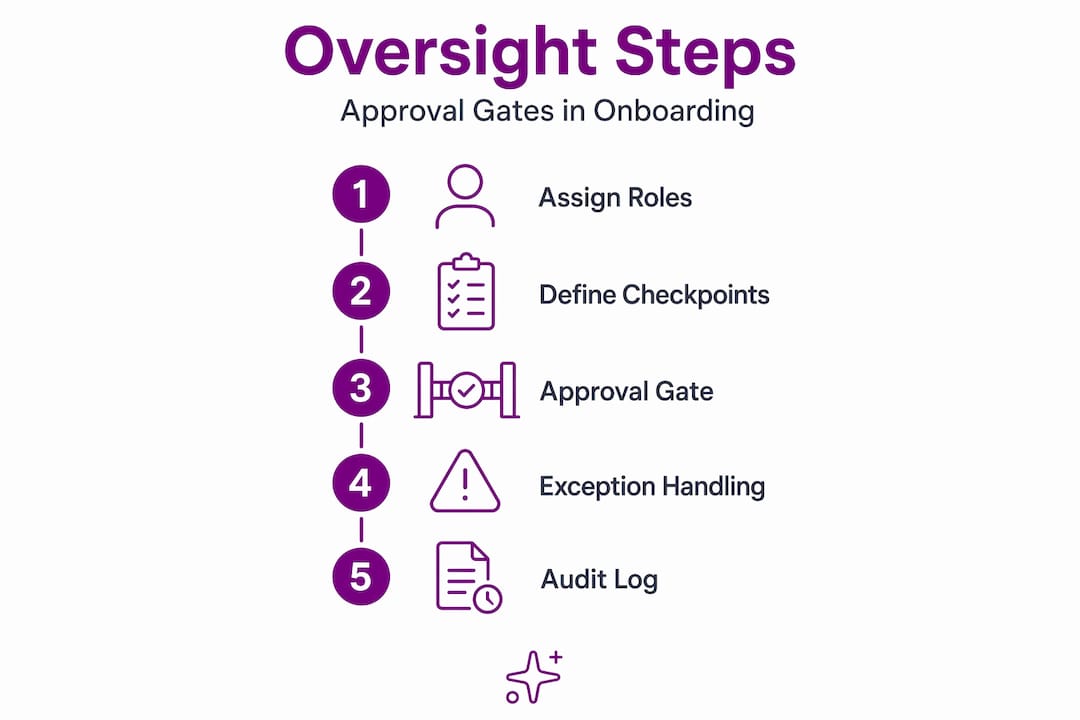
Here is a numbered workflow that embeds oversight at every stage:
-
Pre-boarding packet sent. Send all required forms, documents, and policy acknowledgments before the start date. Assign a named owner to confirm receipt and flag anything incomplete.
-
Compliance forms completed first. On or before day one, prioritize I-9 verification, W-4 submission, and any state-specific employment forms. This is your highest-risk checkpoint. Log the timestamp and the reviewer's name.
-
Document review gate. A designated reviewer (HR admin or compliance officer) verifies that all documents are complete, correctly filled, and appropriately signed before moving the person to the next phase.
-
Exception escalation. If any document is missing, incomplete, or raises a question, it routes to the escalation contact before proceeding. No exceptions advance without resolution. An alert triggers automatically, and the resolution is logged.
-
Training and policy onboarding phase. Role-specific training modules, handbook acknowledgments, and firm-specific protocols are assigned. Completion is tracked with timestamps, not just checkboxes.
-
Approval gate for integration. Before the new hire or client gains full access to systems, accounts, or sensitive data, a final human review confirms that all prior steps are complete and verified.
-
Compliance audit snapshot. At the end of the initial onboarding phase, generate a summary log showing every completed step, reviewer, date, and any open exceptions. This becomes your baseline audit record.
The key principle behind integrating approval gates into the workflow is that humans approve before execution advances. Automation can move the task to the right person and send reminders. But a person decides whether to proceed.
Pro Tip: Always assign a fallback for each checkpoint. If the primary reviewer is unavailable, the workflow should route to a named backup rather than stall or silently skip. Build that redundancy into your process from the start.
For mixed-workforce onboarding, where you're managing employees, contractors, and clients simultaneously, the same numbered framework applies. The forms differ, but the logic of checkpoint, review, escalate, and log stays constant.
Handling ongoing compliance needs starts at step seven. The audit snapshot isn't a finish line. It's a starting point for the cycle of reviews that continues throughout the employment or engagement period.
How to verify, track, and improve your onboarding oversight process
After building your workflow, it's essential to ensure the oversight mechanisms actually work, are maintained, and deliver ongoing value.
Closing the loop means more than running the process. It means monitoring whether the process performs the way you designed it to. Three core tools make that possible: audit logs, exception reports, and structured check-ins.
SHRM recommends treating onboarding as a strategic process that can last up to 12 months, with structured check-ins at the one-month mark and again between three and six months depending on the role. These check-ins aren't just relationship-building conversations. They're operational reviews. Did the compliance documents stay current? Did training get completed? Did any exceptions from onboarding get resolved properly?
"Regular audits of your onboarding process don't slow things down. They speed up future cycles by surfacing what broke, what was missed, and what can be simplified." That's a lesson most firms learn the hard way, after a problem surfaces during an external review rather than an internal one. Getting outside perspective on process reviews can also help identify gaps you've become too familiar to see.
Here's a practical overview of monitoring tools and what they catch:
| Monitoring tool | What it tracks | Typical issue it surfaces |
|---|---|---|
| Audit log | Every action, reviewer, and timestamp | Missed approvals, out-of-order steps |
| Exception report | Flagged items that bypassed normal flow | Documents not reviewed, forms resubmitted |
| Automated reminders | Overdue tasks and expiring documents | Late I-9 completions, unsigned policies |
| Scheduled check-in review | Long-term compliance gaps | Missing renewal acknowledgments, training lapses |
Common issues that structured monitoring reveals and how to address them:
- Forms submitted but never reviewed: assign a daily review task to a named owner and add an alert if no review action is taken within 24 hours
- Escalations that stall: set a maximum resolution window (for example, 48 hours) and escalate further if unresolved
- Training completions logged without verification: require a confirmation step where the reviewer checks for understanding, not just completion
- Audit records that are incomplete: use a platform that auto-generates a log entry at each checkpoint rather than relying on manual notes
- Compliance lifecycle gaps after onboarding: schedule six-month and annual reviews of each file to catch anything that expires or requires renewal
The improvement cycle ties everything together. After each onboarding cohort or quarter, review the exception reports, check-in notes, and audit logs as a set. Look for patterns. If the same step keeps generating exceptions, that's a process design problem, not a people problem. Fix the process.
Perspective: Why human oversight is your competitive edge in onboarding
With your oversight system running, consider why this approach pays off in ways that go far beyond box-checking.
There's a pervasive assumption in the small business market that automation is always the goal, and human involvement is just a necessary friction to be reduced. That assumption is wrong, and for professional service firms it can be genuinely costly.
Here's the counterintuitive truth: the firms that invest in structured human oversight often onboard faster, not slower. Not because automation isn't valuable, but because a well-designed oversight process eliminates the rework that happens when automated steps run without review. When an I-9 gets misprocessed and no one catches it for two weeks, the cost of fixing that error is far higher than the 60 seconds it would have taken a reviewer to flag it at the checkpoint.
Strong oversight also builds trust faster. New employees and clients notice when onboarding feels organized, intentional, and responsive. When someone reaches out because a form didn't work and they get an immediate response from a named contact, that experience sets a tone. It signals that your firm pays attention. For professional service firms, that perception of attentiveness is a core part of your brand promise.
The deeper lesson is about judgment. Automation is excellent at executing known steps reliably. It's not equipped to recognize when a situation is outside the expected pattern. A new hire presents a document combination the system hasn't seen before. A client's engagement scope changes mid-onboarding. A compliance requirement shifts. These are human judgment calls. The firms that make AI accountable and position automation as a tool in service of human decision-making will consistently outperform those that treat automation as a replacement for it.
The practical wisdom here is: don't rush to automate a checkpoint until you fully understand what that checkpoint is catching. Run it manually first, document what you find, and only then decide whether automation can handle it reliably. Slowing down early means scaling up with confidence later.
Next steps: Implementing oversight-friendly onboarding in your firm
Ready to put a modern oversight process in place? Here's your launchpad to smarter, more compliant onboarding.
OnboardingGenie was built specifically for professional service firms that need structured, trackable onboarding without the complexity or cost of enterprise software. Every client and employee packet goes through a single branded portal that consolidates signatures, forms, documents, and training into one link.
The platform keeps humans in control at every stage, with approval checkpoints, exception alerts, and audit logs built into the workflow by design. If you're ready to replace scattered PDFs and email chains with a clear, compliant, oversight-ready process, you can explore compliance management for small firms, see how it works in practice, or start onboarding for free today. Building oversight into your process doesn't require more complexity. It requires the right tool.
Frequently asked questions
What is human oversight in onboarding?
Human oversight in onboarding is a structured system where people review and approve key workflow steps to ensure decisions are compliant, ethical, and defensible. Making oversight concrete means embedding it into runbooks, audit trails, and change-control procedures, not just stating it as a policy.
When must compliance documents like I-9 be completed?
The I-9 must be completed within the first three business days of employment, but best practice is to complete mandatory forms such as I-9 and W-4 within the first hours of day one to reduce scheduling risk.
How do I set up approval and escalation checkpoints?
Assign a named owner to each checkpoint, require a logged decision or exception note before the workflow advances, and configure automatic alerts for unresolved escalations. A practical oversight model includes approval checkpoints, escalation for uncertain cases, exception alerts for outliers, and periodic audits.
Why treat onboarding as a process lasting 12 months?
Onboarding up to 12 months with structured check-ins at one month and three to six months ensures compliance stays current and that new hires or clients are genuinely integrated, not just processed.
How can small firms balance automation with oversight?
Use staged autonomy for high-impact decisions: let automation handle routine task routing and reminders, but keep humans in control for approvals, exceptions, and any compliance-critical step where errors carry real consequences.