

TL;DR:
- A structured, time-boxed retainer onboarding process transitions clients from signed agreements to active service, emphasizing ongoing communication and renewal mechanisms. Critical steps include immediate welcome communication, access setup, a kickoff call, and a formal day-30 review with decision-makers to maximize renewal likelihood. Implementing standardized micro-steps, quarterly reviews, and usage dashboards helps maintain client engagement and reduces early churn.
A retainer onboarding process is the structured, time-boxed sequence of steps that moves a client from a signed retainer agreement into active service delivery, while establishing the recurring communication, reporting, and renewal mechanisms that keep the engagement healthy long-term. Unlike a one-time project kickoff, this process includes formal checkpoints at day 1, day 30, and each quarter, along with usage dashboards and escalation paths that are specific to ongoing retainer relationships. The industry standard, documented by Gatilab and Agency Supply, targets a first deliverable within 10 to 14 business days of contract signing. Getting this right from the start is the clearest predictor of whether a client renews at month 12 or quietly churns at month 4.
What is a retainer onboarding process, step by step?
A well-run retainer onboarding process separates into two parallel tracks: the work layer and the relationship layer. The work layer covers access setup, deliverable production, and billing configuration. The relationship layer covers communication cadence, expectation setting, and the formal reviews that signal ongoing value to the client. Both tracks must run simultaneously, and each step needs a named owner and a service level agreement.
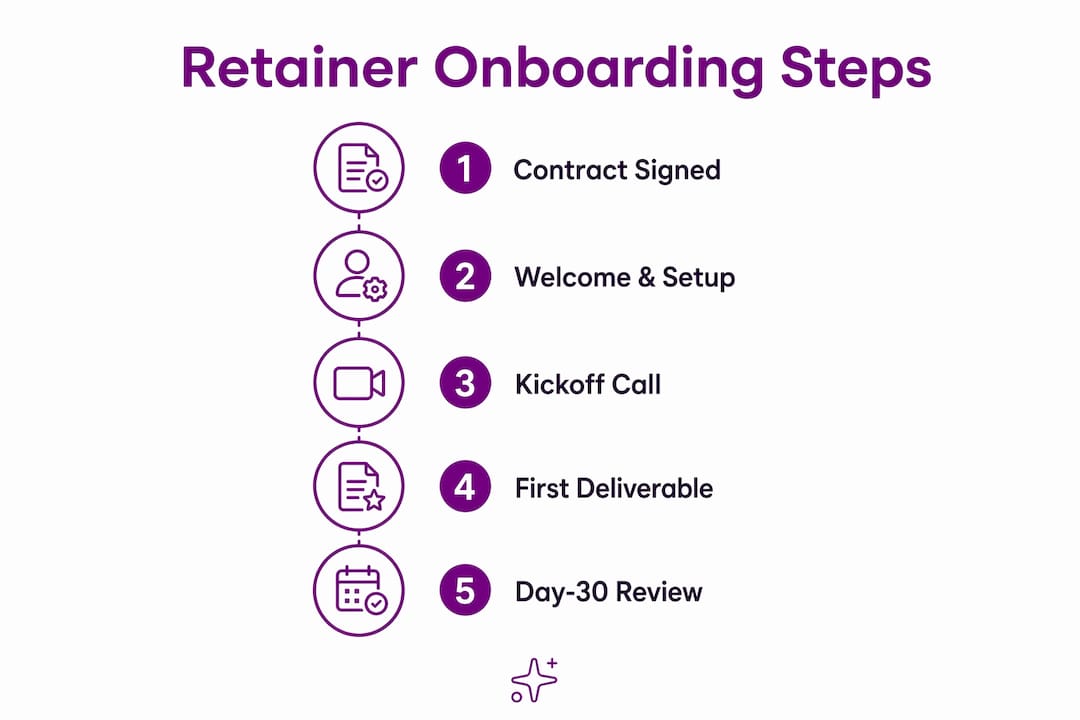
Here is the standard sequence that professional service firms use:
- Welcome communication within one hour of contract signing. Send a branded welcome email that confirms the engagement, outlines the first week, and sets the tone. Sending within one hour reduces buyer's remorse and signals operational readiness.
- Intake form and account access setup on days 1 to 2. Collect credentials, brand assets, billing details, and any background documents the team needs. This is also when you configure autopay for the monthly retainer fee. Autopay setup during onboarding reduces days-to-payment by 60%, which means fewer manual invoice follow-ups every month.
- Kickoff call scheduled and held on days 3 to 5. This call covers success metrics, communication preferences, escalation contacts, and the definition of urgent work. Do not skip the escalation conversation. Documented escalation paths for requests like "need this in 24 hours" reduce relational friction and prevent the implicit tests that damage trust early in a retainer.
- First deliverable shipped by day 14. The first tangible output is a retention signal, not just a work product. Clients who see measurable progress within two weeks are significantly more likely to stay through month 6.
- Day-30 formal review with the decision-maker. This is the most critical checkpoint in the entire process. The review covers hours used, outcomes against the agreed success metrics, any friction surfaced, and an explicit renewal conversation. Day-30 reviews held on time correlate directly with higher 12-month renewal rates. Delay this meeting even one week and you lose the psychological window.
Pro Tip: Assign separate owners for the work layer and the relationship layer from day one. In a five-person firm, that might be the same person wearing two hats, but the tasks should be tracked separately. Conflating them is how kickoff calls get scheduled but escalation paths never get documented.
How does retainer onboarding differ from project onboarding?

Project onboarding has a defined end date. Retainer onboarding does not, and that single difference changes the entire structure of what you need to build. A project client needs to understand the scope, timeline, and deliverables. A retainer client needs to understand all of that plus the ongoing rhythm, the renewal mechanism, and how they will perceive value every single month.
The table below summarizes the structural differences:
| Element | Project onboarding | Retainer onboarding |
|---|---|---|
| Timeline | Fixed end date | Ongoing, monthly renewal |
| Formal reviews | Kickoff and closeout | Day-30, then quarterly |
| Usage tracking | Scope-based milestones | Monthly usage dashboards |
| Escalation paths | Defined in scope | Documented and recurring |
| Billing setup | Invoice per milestone | Autopay, monthly cycle |
| Churn risk window | Delivery quality | Month 4 to 7 without reviews |
The three retainer-specific elements that project onboarding skips entirely are quarterly strategic reviews, usage dashboards, and urgent work escalation paths. Skipping quarterly reviews is the top cause of retainer churn by month 7. The reason is straightforward: without a scheduled strategic conversation, clients stop seeing the connection between their monthly fee and the outcomes your team produces. Usage dashboards solve the perception problem by giving clients real-time visibility into hours consumed and work completed.
Pro Tip: Frame month one explicitly as a mutual evaluation period during the kickoff call. Tell the client: "We treat the first 30 days as a trial for both of us. At day 30, we review together and confirm we are the right fit." This language reduces anxiety, sets clear expectations, and makes the day-30 review feel natural rather than confrontational.
What are best practices and common pitfalls in onboarding retainer clients?
The best practices for retainer client onboarding come down to precision, transparency, and timing. The pitfalls almost always trace back to vagueness, delay, or over-indexing on administrative tasks at the expense of relationship setup.
What works:
- Hold the day-30 review on exactly day 30, with the decision-maker present. Timing and decision-maker inclusion are the single strongest predictors of 12-month retainer success. Drifting past day 30 correlates with churn at months 4 and 5.
- Use a client health scoring system after each check-in. Assign a green, yellow, or red status based on engagement, satisfaction signals, and deliverable feedback. Health scoring after check-ins correlates with 30 to 40% lower churn in the first 90 days. A yellow flag at day 30 is recoverable. A red flag at month 5 usually is not.
- Standardize every micro-step with a named owner and a time box. An 11-minute retainer onboarding ritual that produces concrete outputs like an access audit and an escalation protocol can be run by a junior team member. Standardization is what allows you to onboard 10 retainer clients without degrading the experience for any of them.
- Communicate the trial nature of month one clearly and in writing. Clients who understand the mutual evaluation framing are more likely to engage actively in the day-30 review.
What fails:
- Over-focusing on administrative onboarding while skipping the operating system setup: access roles, escalation contacts, and communication preferences. Overemphasizing admin tasks at the expense of these structural elements undermines client trust and retainer longevity.
- Delaying the first deliverable beyond 14 days. Every day past that window increases the client's perception that the retainer fee is not yet producing value.
- Skipping quarterly reviews after the day-30 check-in. The day-30 review is not the end of the formal cadence. It is the beginning.
Retainer onboarding requires multiple follow-up checkpoints beyond the kickoff call to manage retention risk proactively. Firms that treat onboarding as a one-time event rather than a 90-day structured program consistently see higher churn in the middle months of the first year.
How to implement and scale a retainer onboarding process in your firm
Scaling retainer onboarding means converting a process that currently lives in someone's head into a documented, distributable system. The goal is that any team member can run the process correctly without direct supervision.
- Build a master checklist with step ownership. Every item gets a name attached to it, a due date, and a definition of done. Use a tool like Asana, ClickUp, or a dedicated onboarding platform to track completion. The checklist should cover both the work layer and the relationship layer as separate sections.
- Automate the communications that do not require judgment. The welcome email, the kickoff call scheduling link, the intake form reminder, and the day-30 review invitation can all be triggered automatically. Automation here does not replace human judgment. It removes the risk that a busy team member forgets to send a welcome email at 4:00 PM on a Friday.
- Set up a client portal for usage tracking. Clients who can log in and see hours consumed, deliverables completed, and upcoming milestones do not need to email you asking for status updates. Quarterly reviews and usage transparency directly affect client perceptions and reduce churn risk. A portal makes that transparency automatic.
- Configure billing and autopay during intake, not after. Billing setup belongs in the first 48 hours of onboarding, not as an afterthought after the first invoice is late.
- Run a post-onboarding retrospective after your first three retainer clients. Note where steps were skipped, where clients asked questions you had not anticipated, and where the timeline slipped. Adjust the checklist before the fourth client.
Pro Tip: Create two separate onboarding packet templates: one for clients who are new to retainer engagements and one for clients who have worked on retainer before. New-to-retainer clients need more explanation of the quarterly review cadence and the usage dashboard. Experienced retainer clients want to skip straight to the escalation protocol and success metrics.
The 90-day consultant onboarding playbook approach applies directly here. Treat the first 90 days as three distinct phases: orientation (days 1 to 14), calibration (days 15 to 30), and rhythm (days 31 to 90). Each phase has different goals and different owner responsibilities.
Key takeaways
A retainer onboarding process succeeds or fails based on three factors: the timing of the day-30 review, the clarity of escalation paths, and the consistency of quarterly strategic conversations.
| Point | Details |
|---|---|
| Day-30 review timing | Hold it exactly on day 30 with the decision-maker present to protect 12-month renewal rates. |
| Work and relationship layers | Track operational tasks and relationship milestones separately, each with a named owner. |
| Retainer-specific elements | Quarterly reviews, usage dashboards, and escalation paths are required additions beyond project onboarding. |
| Standardize micro-steps | Time-boxed checklists allow junior staff to run consistent onboarding without quality loss. |
| Health scoring | Green, yellow, red status after each check-in reduces first-90-day churn by 30 to 40%. |
Why I think most firms underestimate the day-30 review
After working with small professional service firms on their onboarding processes, the pattern I see most often is this: the kickoff call is polished, the welcome email goes out on time, and then the day-30 review gets pushed to day 38 because someone's calendar was full. That two-week slip is not a scheduling inconvenience. It is a retention risk.
The day-30 review is the moment when the client decides, consciously or not, whether this retainer is worth continuing. If you are not in the room with the decision-maker on that day, you are leaving that decision to chance. I have seen firms with genuinely excellent work product lose retainer clients at month 4 simply because no one ever sat down and explicitly confirmed that the engagement was working.
The other mistake I see regularly is treating the retainer agreement process as the finish line. Signing the contract is the starting gun. The onboarding process is what converts a signed agreement into a client who renews. Firms that invest in structured client onboarding see that investment pay back in renewal rates, referrals, and the kind of client relationships where you are not constantly re-justifying your fee.
Build the process once, document it thoroughly, and run it consistently. The firms that do this do not wonder why their retainer clients stay. They know exactly why.
— Chris
How OnboardingGenie supports retainer client onboarding
If you are managing retainer clients across a small professional service firm and still relying on PDFs, scattered emails, and manual signature requests, the administrative overhead compounds fast.
OnboardingGenie consolidates signatures, intake forms, compliance documents, and training materials into a single branded portal link. Every retainer onboarding packet goes out through one link, with deadline-aware nudging built in so nothing stalls waiting for a client to open an email. For firms that want a DocuSign alternative without the enterprise pricing, OnboardingGenie runs on a flat monthly fee and is built specifically for 1 to 50 person firms. You get pipeline visibility, client health tracking, and a process your whole team can run without a manual.
FAQ
What is included in a retainer onboarding process?
A retainer onboarding process includes a welcome communication, intake and access setup, a kickoff call, a first deliverable, and a formal day-30 review. It also includes retainer-specific elements like quarterly strategic reviews, usage dashboards, and documented escalation paths.
How long does retainer onboarding typically take?
The core onboarding sequence runs 10 to 14 business days from contract signing to first deliverable, with the formal day-30 review completing the initial onboarding phase.
What happens at the day-30 retainer review?
The day-30 review covers hours used, outcomes against agreed success metrics, any friction surfaced during the first month, and an explicit renewal decision. It must include the client's decision-maker to be effective.
How is retainer onboarding different from project onboarding?
Retainer onboarding adds quarterly strategic reviews, monthly usage dashboards, and escalation path documentation that project onboarding does not require. These elements exist because retainer clients need ongoing proof of value, not just delivery confirmation.
What causes retainer clients to churn during onboarding?
Skipping quarterly reviews is the top cause of retainer churn by month 7. Delayed first deliverables, missing day-30 reviews, and unclear escalation paths also contribute significantly to early churn.