
TL;DR:
- Poorly structured onboarding often leads to early client churn, but most consulting firms treat it as an afterthought.
- A well-designed, automated onboarding process reduces delays, builds trust, and significantly improves retention within the first 90 days.
Poorly structured onboarding is one of the most preventable causes of early client churn, yet most consulting firms treat it as an afterthought. When consultant onboarding new clients goes wrong, the damage happens quietly. Clients grow uncertain, emails pile up without direction, and trust erodes before the real work even begins. Disorganized onboarding erodes trust while structured onboarding builds it. This guide walks through a practical, phase-by-phase approach to onboarding that reduces delays, sets the right expectations, and delivers measurable early wins within the first 90 days.
Table of Contents
- Key takeaways
- Preparing for new client onboarding
- Executing onboarding step by step
- Verifying onboarding success
- Advanced strategies for scaling onboarding
- My take on why most consultants undervalue onboarding
- How OnboardingGenie supports your client onboarding
- FAQ
Key takeaways
| Point | Details |
|---|---|
| First 90 days define retention | Clients who experience structured onboarding are 40% less likely to churn within the first year. |
| Early wins convert skeptics | Delivering tangible value within 14 days turns initial client doubt into lasting trust. |
| Automation cuts setup time dramatically | Automated document workflows reduce new-client setup from 10 days to 3 business days. |
| Segmentation prevents one-size-fits-all failures | Personalizing onboarding paths by client type reduces confusion and improves engagement. |
| Check-ins prevent silent dissatisfaction | Scheduled 30-day and 60-90 day experience reviews catch problems before they become exits. |
Preparing for new client onboarding
Before a single welcome email goes out, the foundation has to be in place. What separates firms that retain clients through year two from those that lose them in month three is almost always operational readiness, not service quality. The work starts before the client does.
Define your workflow and segment your clients
Start by mapping your onboarding workflow into discrete milestones: contract signed, intake form submitted, kickoff meeting scheduled, first deliverable shared. Without this map, your team improvises, and clients sense it. Segmenting clients matters just as much. A 12-person manufacturing company and a solo founder need different onboarding paths. One needs a detailed project charter and department stakeholder introductions. The other needs a one-page scope summary and a single point of contact. Forcing both through the same process buries them in steps that don't apply.
Consider these foundational elements before you onboard your next client:
- A defined onboarding workflow with at least five named milestones
- Client segments (by size, industry, or service type) with separate intake templates for each
- Pre-built communication templates for welcome messages, document requests, and kickoff agendas
- Clear role assignments within your team, including who owns the first 48-hour response window
- A single platform to track all documents, signatures, and progress without switching between tools
Tools and software for small consulting firms
Small firms often make the mistake of piecing together tools that don't talk to each other. A PDF gets emailed, a signature is collected through one platform, documents are stored in another, and follow-ups happen through a third. That fragmentation is exactly where things fall through the cracks.
| Setup Approach | Average Setup Time | Document Error Rate | Client Satisfaction |
|---|---|---|---|
| Manual (email/PDF) | 10+ business days | High | Inconsistent |
| Partially automated | 5-7 business days | Moderate | Moderate |
| Fully automated portal | 3 business days | Low | High |
Automation reduces setup time from 10 days to 3 business days and eliminates 85% of missing-document delays. For a firm taking on 5 to 10 new clients per month, that time savings compounds fast.
Pro Tip: Build your onboarding checklist for professional firms once, then test it with two or three clients before treating it as final. Small friction points that seem minor internally often feel significant to clients experiencing them for the first time.
Executing onboarding step by step
Getting the steps right matters less than getting the sequence right. A kickoff meeting before intake forms are complete wastes everyone's time. An engagement letter sent three days after signing signals disorganization before you've delivered a single result. The execution phase is where your firm's credibility gets established or undermined.
Here is a reliable step-by-step sequence for the first 30 days:
- Send a personalized welcome within 24 hours of contract signing. This is not a generic "thanks for choosing us" email. Reference the specific challenge the client mentioned during the sales conversation. Name the person on your team who owns their account. Set the expectation for when they will hear from you next.
- Deliver the intake packet within 48 hours. The intake should be segmented by client type. Asking a startup founder to fill out a 14-field corporate questionnaire when only four fields apply creates friction and signals that your process is not built for them. Platforms that let you automate document collection by client segment solve this problem cleanly.
- Schedule and hold the kickoff meeting within the first week. The kickoff has one job: align on what success looks like in 30, 60, and 90 days. Document agreed success criteria in writing and share them with the client immediately after the meeting.
- Deliver an early win by day 14. Clients form lasting opinions within the first days. Providing tangible value within 14 days increases retention because early wins convert client skepticism into conviction. This does not need to be a major deliverable. A competitor landscape summary, a quick-win recommendation memo, or even a well-organized project dashboard counts. The goal is to show the client they made the right decision.
- Conduct a 30-day check-in focused on experience, not status. Most consultants check in to report progress. The better question is: "How is this process feeling for you?" That shift surfaces friction the client might not have volunteered.
Pro Tip: Record a two-minute video walkthrough of what the client can expect in their first 30 days and include it in the welcome email. Clients who understand the process upfront ask fewer anxiety-driven questions and feel more confident in your firm from day one.
Verifying onboarding success
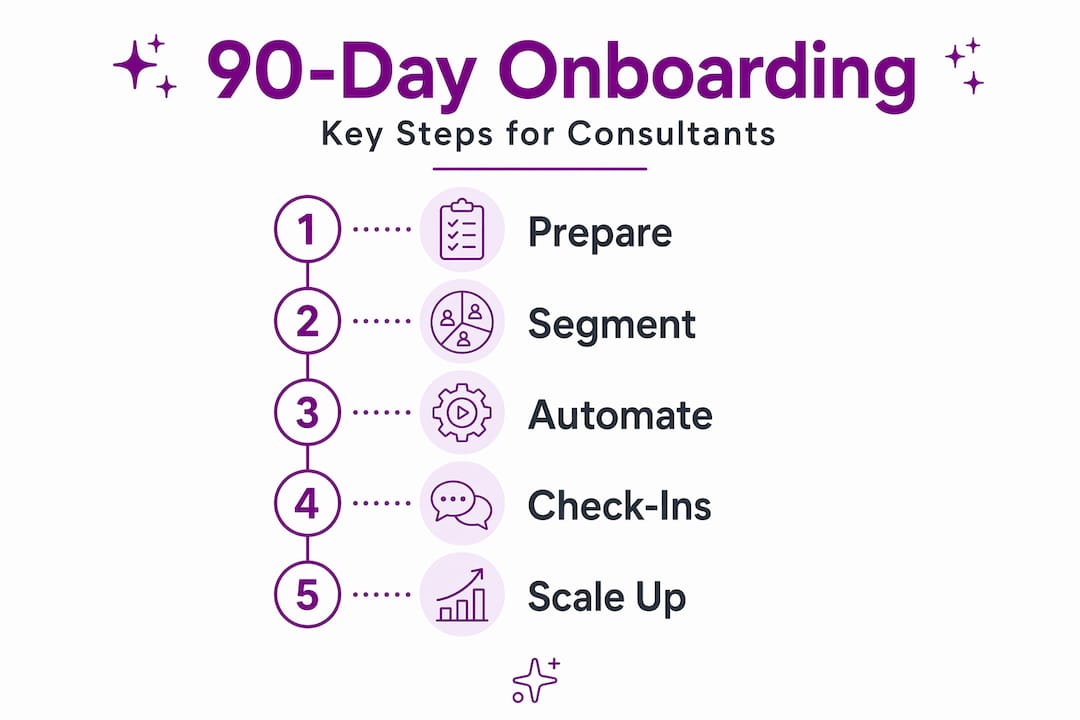
You cannot manage what you do not measure. The firms that consistently retain clients through year two and beyond treat onboarding as an ongoing process, not a one-time event. A 5-phase onboarding system spanning 90 days is the foundation for reducing churn and creating conditions for expansion revenue.

Key metrics to track
Tracking onboarding effectiveness means watching more than just whether the contract was signed. The metrics that actually predict long-term retention include:
- Onboarding duration: Days from contract signing to first deliverable. Target under 10 business days for most engagements.
- Document completion rate: Percentage of required intake documents submitted within the first 5 days. Below 80% signals friction in your intake process.
- Satisfaction score at day 30: A simple 1-5 rating on the onboarding experience so far. This is your earliest warning system.
- Kickoff meeting held on time: Yes or no. Delays here compress the entire schedule and set a negative precedent.
The 30-day and 60-90 day check-in structure
Scheduling a dedicated 30-day experience check-in helps catch issues before they solidify into resentment. The "black hole" period after contract signing, when clients hear little and wonder what is happening, is where most early churn originates. A structured 60-90 day review gives you a natural opening to discuss scope expansion, referrals, and longer-term goals.
| Check-In Timing | Primary Focus | Common Outcome |
|---|---|---|
| Day 30 | Experience and friction points | Catches process gaps early |
| Day 60 | Deliverable progress and alignment | Reconfirms scope and priorities |
| Day 90 | Satisfaction and expansion opportunity | Sets foundation for renewal or growth |
The most common onboarding pitfalls are delayed document collection, inconsistent communication between team members, and client confusion about who to contact for what. Centralized dashboards that show clients their own progress in real time reduce anxiety and eliminate most "just checking in" emails.
Advanced strategies for scaling onboarding
Once your baseline process is working, the next question is how to handle more clients without proportionally increasing the manual work. Consultants who build automated onboarding can handle 60 to 70 percent of touchpoints without manual effort, which is what allows a 10-person firm to take on 30 active clients without burning out the delivery team.
Triggered workflows and segmented paths
Triggered workflows use event-driven parallel sequences, so when a client accepts a proposal, the system automatically sends the intake form, schedules the kickoff meeting reminder, and notifies the assigned team member simultaneously. No one has to remember to do these things. They happen because the client took an action.
Segmentation drives personalization at scale. Generic onboarding processes cause client disconnection, while tailored communication improves engagement significantly. A firm that serves both early-stage startups and established mid-market companies should have at least two distinct onboarding tracks, each with its own intake questions, communication cadence, and milestone structure.
| Onboarding Approach | Personalization Level | Manual Effort Required | Suitable For |
|---|---|---|---|
| Single universal process | Low | High | Solo practitioners, 1-2 client types |
| Segmented with templates | Medium | Moderate | Firms with 3+ client categories |
| Triggered multi-track workflows | High | Low | Firms scaling to 20+ active clients |
The balance point is important. Multi-format content delivery through calls, videos, and documents caters to different client learning styles. Automation handles the logistics. Consultants focus on the strategic check-ins, the interpretive conversations, and the early wins that no workflow can replace. For firms building out this model, a human oversight onboarding process that works means automation handles repetition while people handle relationship.
Pro Tip: Audit your onboarding process every quarter by asking your three most recent clients to describe what surprised them, positively or negatively. Their answers will tell you more than any internal review.
My take on why most consultants undervalue onboarding
I have watched a lot of small firms invest heavily in sales and almost nothing in what happens the week after the deal closes. The assumption is that onboarding is just administration. Get the paperwork done, hold a kickoff, and get to work. That framing misses something significant.
In my experience, the onboarding phase is where the client's expectations either get calibrated correctly or get set up to disappoint. When I started thinking about onboarding as the first real service delivery moment rather than a bureaucratic prerequisite, everything shifted. The welcome message stopped being a formality. The intake form became a diagnostic tool. The kickoff became a trust-building conversation instead of a scope recitation.
What I have also learned is that automation, when used thoughtfully, does not depersonalize the process. It actually creates more space for the human moments that matter. If a system is handling document reminders and status updates automatically, you are free to spend that time on the call where you actually listen to what the client is anxious about. That call is where retention gets decided.
The caution I would offer is against copying another firm's onboarding process wholesale. A consulting client onboarding checklist borrowed from someone else's context will have gaps you do not recognize until a client falls through one of them. Build it from your own delivery patterns. Test it, measure it, and keep refining it.
— Chris
How OnboardingGenie supports your client onboarding
If you have been managing onboarding through a combination of email threads, PDFs, and shared folders, you know exactly how much time that wastes and how many things fall through the cracks. OnboardingGenie was built specifically for small professional service firms that need structure without enterprise-level complexity or pricing.
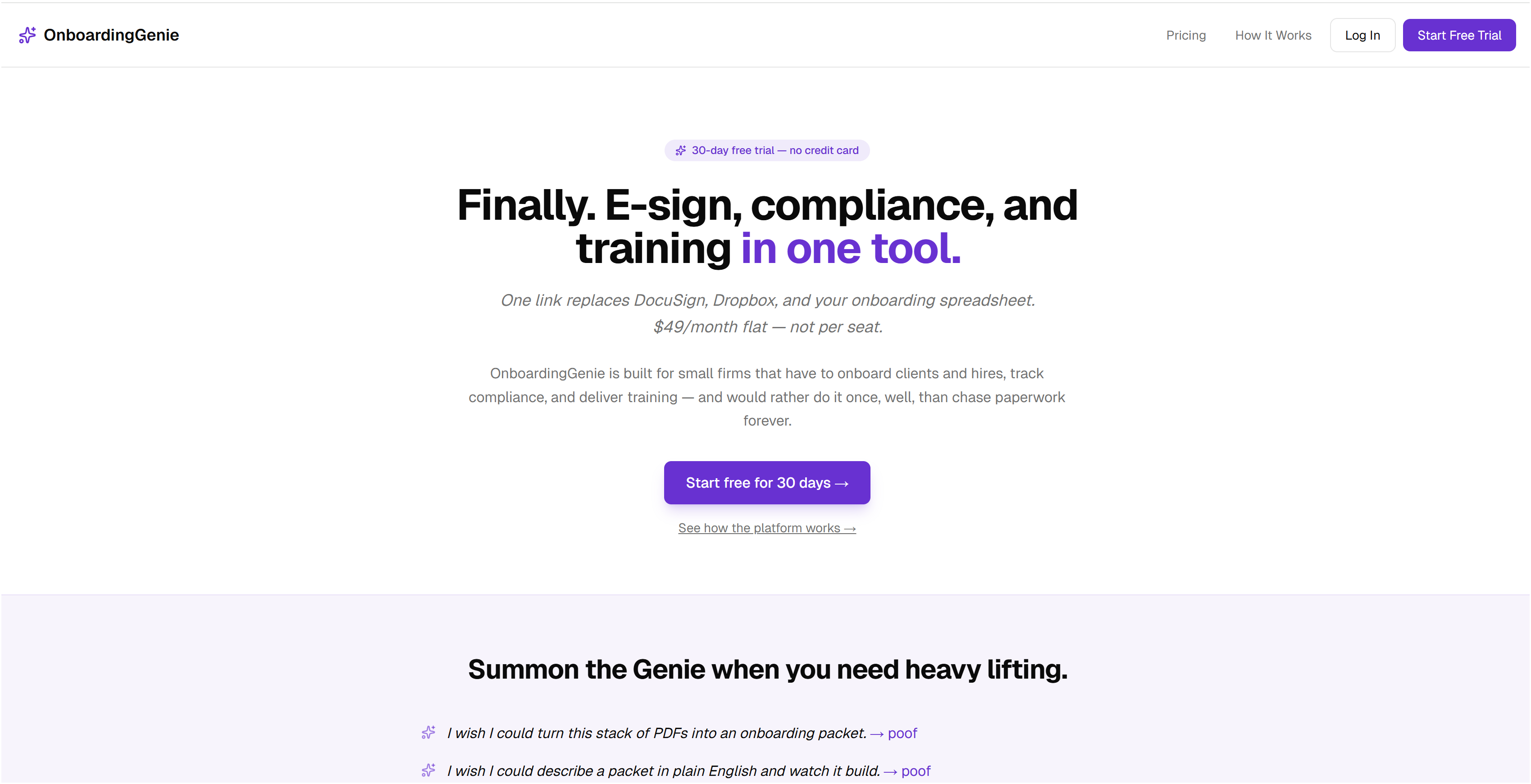
The OnboardingGenie platform consolidates signatures, intake forms, compliance documents, and training materials into a single branded portal delivered through one link. No more chasing documents across three platforms. No more clients emailing to ask where they are in the process. The pipeline view shows you exactly where every client stands, and deadline-aware nudging handles the follow-ups automatically. For firms that also need to track compliance obligations alongside onboarding, the compliance management tools sit inside the same platform. You can start a free trial and have your first onboarding packet ready within a day.
FAQ
What is consulting client onboarding?
Consulting client onboarding is the structured process of transitioning a new client from contract signing to active engagement, covering intake, goal alignment, document collection, and early deliverable milestones typically within the first 30 to 90 days.
How long should a consultant onboarding process take?
Most consulting firm onboarding processes run 7 to 30 days depending on engagement complexity. Automated workflows can reduce initial setup to as few as 3 business days, with the full onboarding cycle completed by day 90.
What should a consulting client onboarding checklist include?
A consulting client onboarding checklist for professional firms should cover welcome communication within 24 hours, segmented intake forms, a kickoff meeting with documented success criteria, an early win by day 14, and scheduled 30-day and 90-day experience check-ins.
What is stakeholder onboarding in consulting?
Stakeholder onboarding in consulting refers to the process of aligning all decision-makers and influencers on the client side with the engagement's goals, communication protocols, and escalation paths. It typically happens during the kickoff phase and prevents misaligned expectations later in the project.
What are the best onboarding platforms for professional services firms?
The best onboarding platforms for professional services consolidate document collection, e-signatures, compliance tracking, and client communication into a single portal. Small firms benefit most from platforms with flat monthly pricing and no-code setup rather than enterprise tools built for organizations 10 times their size.