

You might be losing clients and staff before they ever feel settled, and the culprit is often an onboarding process that nobody has formally designed. Poor onboarding leads to 25 to 35% early client loss in firms that rely on ad-hoc approaches, which means scattered emails, unsigned PDFs sitting in inboxes, and no clear path for new hires to follow. Practice management onboarding is the structured answer to that problem. This article cuts through the confusion, defines exactly what it covers, and shows you how to build a process that actually holds people in your firm.
Table of Contents
-
Nuances and common pitfalls in practice management onboarding
-
What most onboarding guides miss: Human elements drive retention
Key Takeaways
| Point | Details |
|---|---|
| Define onboarding clearly | Practice management onboarding structures the client and staff integration process to ensure compliance and efficiency. |
| Follow phased steps | Pre-onboarding, training, and post-onboarding reviews are essential for smooth transitions. |
| Use software judiciously | Automation handles routine tasks well, but critical decisions and mentorship require a human touch. |
| Adapt for remote and compliance | Tailor onboarding processes for remote hires and regulated industries to address unique risks. |
| Retention is human-driven | Personal mentoring and ongoing relationships are the strongest levers for retaining clients and staff. |
Defining practice management onboarding
With the risk clearly established, we need to clarify exactly what practice management onboarding is and why it’s more than just a new trend.
At its core, practice management onboarding is a structured set of processes designed specifically for professional service firms. Think law offices, accounting practices, medical groups, and consulting agencies. These firms carry compliance obligations and client relationship standards that generic HR onboarding tools simply were not built to handle.
“Practice management onboarding refers to the structured processes within professional services firms for integrating new clients and/or employees into the firm’s practice management systems and workflows, ensuring compliance, efficiency, and smooth operations.”
This definition matters because it draws a clear line. Onboarding in a professional services context is not just handing someone a laptop or sending a welcome email. It involves two distinct tracks running in parallel: integrating new clients into your service model and integrating new employees into your firm’s operations. Both tracks require documentation, compliance steps, and deliberate human touchpoints.
For small to mid-sized firms, this dual focus is especially important. You don’t have a dedicated HR department or a client success team. The same partner who handles billing might also be the one walking a new associate through your document management system. That’s exactly why having a clear, repeatable process matters so much. When you follow onboarding best practices built for your firm size, you stop reinventing the wheel every time someone new walks through your door.
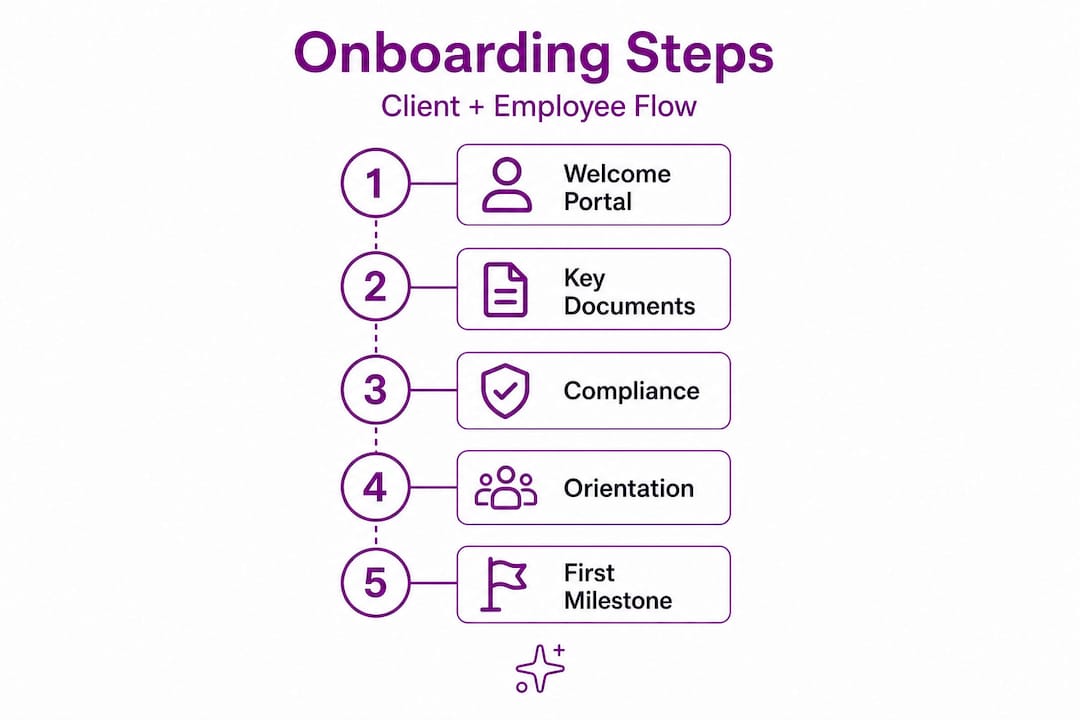
What does smooth onboarding actually look like in practice? It means a new client receives a branded portal link, signs their engagement letter, uploads their documents, and completes a conflict check acknowledgment before their first call. It means a new employee has IT access on day one, completes required compliance training in week one, and has a scheduled check-in at the 30-day mark. No chasing. No confusion. Just a clear path forward.

Key phases and mechanics of onboarding
Now that you know what onboarding encompasses, let’s map out how these processes actually unfold stage by stage.
Structured onboarding follows a phased approach that applies across professional service settings, whether you’re running a law firm, a medical practice, or a financial advisory group. Each phase has a distinct purpose, and skipping one creates gaps that show up later as compliance problems or disengaged staff.
The four core phases look like this:
-
Pre-onboarding. This is everything that happens before day one. For clients, it means conflict checks, document collection, and retainer agreements. For employees, it means IT provisioning, background checks, and sending out paperwork in advance so orientation isn’t buried in administrative tasks.
-
Orientation. This phase introduces the person to your firm’s culture, systems, and expectations. Clients get a kickoff call and a walkthrough of your secure portal. New hires get an overview of your policies, billing procedures, and communication norms.
-
Role-specific training. This is where the real work happens. Employees learn the tools they’ll use daily, including timekeeping, billing software, and compliance protocols. Clients receive guidance on how to submit documents, how billing cycles work, and who to contact for different needs.
-
Check-ins and feedback. The 30, 60, and 90-day check-ins are not optional extras. They are the mechanism that catches problems early and signals to both clients and employees that your firm is paying attention.
Here’s a side-by-side look at what each track involves:
| Onboarding task | Client track | Employee track |
|---|---|---|
| Initial paperwork | Engagement letter, retainer | Offer letter, tax forms |
| Compliance step | Conflict check, BAA if needed | HIPAA training, policy acknowledgment |
| System access | Secure client portal | IT setup, software licenses |
| Relationship touchpoint | Kickoff call | Mentor assignment |
| Ongoing check-in | Satisfaction review | 30/60/90-day meeting |
For compliance in onboarding, the key insight is that compliance is not a separate task you bolt on at the end. It’s woven into every phase. An engagement letter is a compliance document. A policy acknowledgment is a compliance document. When you treat them as part of the flow rather than as bureaucratic hurdles, people complete them without friction.
It’s also worth noting that onboarding goes steps beyond signature collection. A signed document is a starting point, not a finish line. The real value comes from what happens after the signature: training completion, check-in scheduling, and audit-ready documentation that proves your firm met its obligations.
Software’s role: Practice management onboarding platforms
Understanding the stages is crucial, but the right technology makes or breaks onboarding effectiveness. Here’s where software fits in, and where it doesn’t.
Practice management software onboarding typically handles data migration, customized setup, training on timekeeping and billing, and integrations with compliance tools. Platforms built for professional services can automate the repetitive parts of onboarding so your team focuses on the work that actually requires judgment.
Here’s what good onboarding software handles automatically:
-
Sending intake forms and collecting e-signatures
-
Triggering training modules after a form is completed
-
Tracking document status in real time
-
Generating audit-ready records of compliance acknowledgments
-
Sending reminders for outstanding tasks
And here’s what always needs a human:
-
Mentoring a new associate through their first complex case
-
Reading a client’s tone on a kickoff call and adjusting your approach
-
Making judgment calls on conflict check edge cases
-
Building the relationship that makes a client want to stay
Pro Tip: When evaluating practice management platforms, ask specifically whether the tool tracks training completion alongside document signatures. Many platforms handle one or the other, not both. That gap is where compliance risk hides.
| Feature | Generic document tools | Specialized onboarding platforms |
|---|---|---|
| E-signatures | Yes | Yes |
| Training tracking | No | Yes |
| Compliance acknowledgment logs | No | Yes |
| Branded client portal | Rarely | Yes |
| Flat monthly pricing for small firms | Rarely | Yes |
The table above reflects a real tension that small firms face. Enterprise tools are overbuilt and overpriced. Generic document tools cover signatures but miss the compliance layer. The sweet spot is a platform designed specifically for firms your size, one that consolidates signatures, forms, training, and documentation into a single workflow without charging you for features you’ll never use.
Compliance management tools built into your onboarding platform mean you’re not toggling between three different systems to confirm that a new hire completed their required training and signed their confidentiality agreement. Everything lives in one place, and your audit trail is automatic.
Nuances and common pitfalls in practice management onboarding
While platforms help, modern firm leaders must account for live challenges and pitfalls that risk eroding all your efforts.
The biggest shift in the last several years is the rise of remote and hybrid work. Remote and hybrid hires need virtual mentors, secure portal access, and deliberate communication structures that replace the informal learning that happens naturally in an office. If your onboarding process was designed for in-person work, it probably has gaps you haven’t noticed yet.
Regulated industries add another layer. Medical practices need Business Associate Agreements, known as BAAs, completed before any client data is shared. Law firms need conflict checks documented before engagement. Financial advisors need specific disclosure acknowledgments. These aren’t optional steps, and they can’t be handled by a generic onboarding checklist.
Common pitfalls that cost firms real money and relationships:
-
Treating onboarding as a one-week event. Onboarding that ends after orientation leaves people without support during the hardest part of the learning curve.
-
Skipping the compliance documentation. Verbal confirmations don’t hold up in audits. If it isn’t documented, it didn’t happen.
-
Using disconnected tools. When signatures live in one system, training records in another, and client files in a third, things fall through the cracks. Guaranteed.
-
No feedback loop. If you never ask clients or employees how onboarding felt, you’ll repeat the same mistakes indefinitely.
-
Assuming remote hires will self-manage. Remote employees need more structure, not less. A virtual mentor assignment and a clear 30-day check-in schedule are non-negotiable.
Pro Tip: Build your custom onboarding templates around the specific compliance requirements of your practice area, not around a generic HR checklist. A law firm’s onboarding template looks different from a medical practice’s, and both look different from a financial advisory firm’s.
For remote onboarding, the process of verifying identity documents, completing I-9 forms, and establishing secure access needs to be handled through a structured digital workflow. Firms that try to handle this over email or video call without a proper system often find themselves with incomplete records and compliance exposure. A dedicated remote onboarding solution closes that gap by building verification steps directly into the onboarding flow.
The firms that get this right share one habit: they treat onboarding as an ongoing process with defined milestones, not a checklist to complete as fast as possible.
What most onboarding guides miss: Human elements drive retention
Here’s the uncomfortable truth that most onboarding content avoids. You can have a perfectly structured process, a beautiful branded portal, and a complete compliance audit trail, and still lose clients and employees within the first 90 days. Because the technical infrastructure is necessary but not sufficient.
Structured onboarding reduces admin burden and boosts retention through human elements like mentoring, not just through checklists and automation. That finding matters because most firms invest heavily in the process side of onboarding and almost nothing in the relationship side.
Think about the last time a new client felt genuinely welcomed by your firm. Not just efficiently processed, but actually welcomed. Did someone call them after their first week to ask how things were going? Did a senior partner take 15 minutes to explain the firm’s philosophy? Those moments are what clients tell other people about. They’re also what makes a client stay when a competitor comes calling with a lower rate.
The same logic applies to employees. A new associate who has a mentor they can actually talk to will ask better questions, make fewer mistakes, and feel a sense of loyalty to your firm that no onboarding checklist can manufacture. The continuous compliance strategies that work best are the ones embedded in ongoing relationships, not just annual training modules completed in isolation.
My honest take: most firms fixate on the first week of onboarding because that’s when the paperwork happens. But the real retention work happens in weeks two through twelve. That’s when the novelty wears off, the real questions emerge, and people decide whether they’re going to commit to your firm or start looking elsewhere. If your onboarding process ends at week one, you’re walking away from the most important part of the relationship.
Invest in the human layer. Assign mentors. Schedule real check-ins, not just automated reminders. Ask for feedback and actually use it. The firms that do this consistently are the ones that don’t lose clients to competitors or employees to burnout.
Get onboarding right with the tools that fit your firm
If the phases and pitfalls we’ve covered feel familiar, you’re not alone. Most small and mid-sized professional service firms are running onboarding processes that were never formally designed, they just accumulated over time. The good news is that fixing it doesn’t require an enterprise budget or a dedicated operations team.
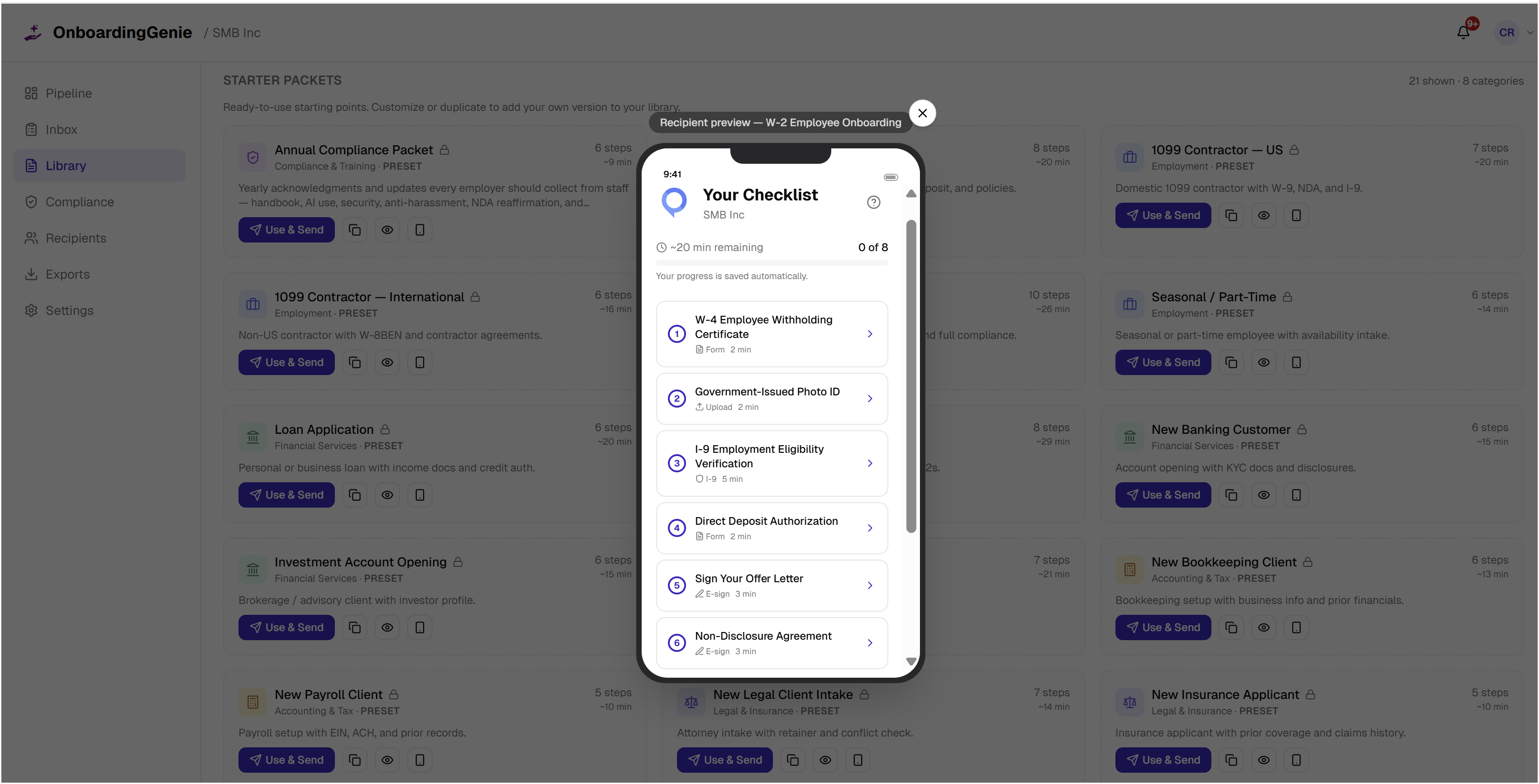
OnboardingGenie was built specifically for firms like yours: small enough to feel the pain of disconnected tools, serious enough to need real compliance tracking. With a single branded portal link, you can consolidate signatures, forms, training materials, and compliance acknowledgments into one clean workflow. No toggling between systems. No chasing down unsigned PDFs. Just a clear, repeatable process that you control.
Get started with OnboardingGenie and see how quickly you can build a structured onboarding flow that covers both clients and employees. You can also explore compliance management features built directly into the platform, or automate onboarding templates tailored to your practice area. Flat monthly pricing means no surprises, and the setup is designed for founders and firm managers, not IT departments.
Frequently asked questions
What are the main steps in practice management onboarding?
The core steps include pre-onboarding paperwork and setup, orientation to firm systems and policies, role-specific training, and structured compliance check-ins at 30, 60, and 90 days for both clients and employees.
How does onboarding software help small firms?
It automates repetitive tasks like form collection and training reminders, tracks compliance documentation in one place, and frees your team to focus on the personal connection and mentorship that actually drives retention.
How do remote hires affect onboarding processes?
Remote and hybrid hires require virtual mentor assignments, secure portal access, and digital compliance verification steps that replace the informal learning and document review that happens naturally in an office setting.
What’s the difference between client and employee onboarding?
Client onboarding centers on conflict checks, engagement paperwork, and portal setup, while employee onboarding focuses on IT access, compliance training acknowledgments, and role-specific mentorship within the firm’s systems.