
TL;DR:
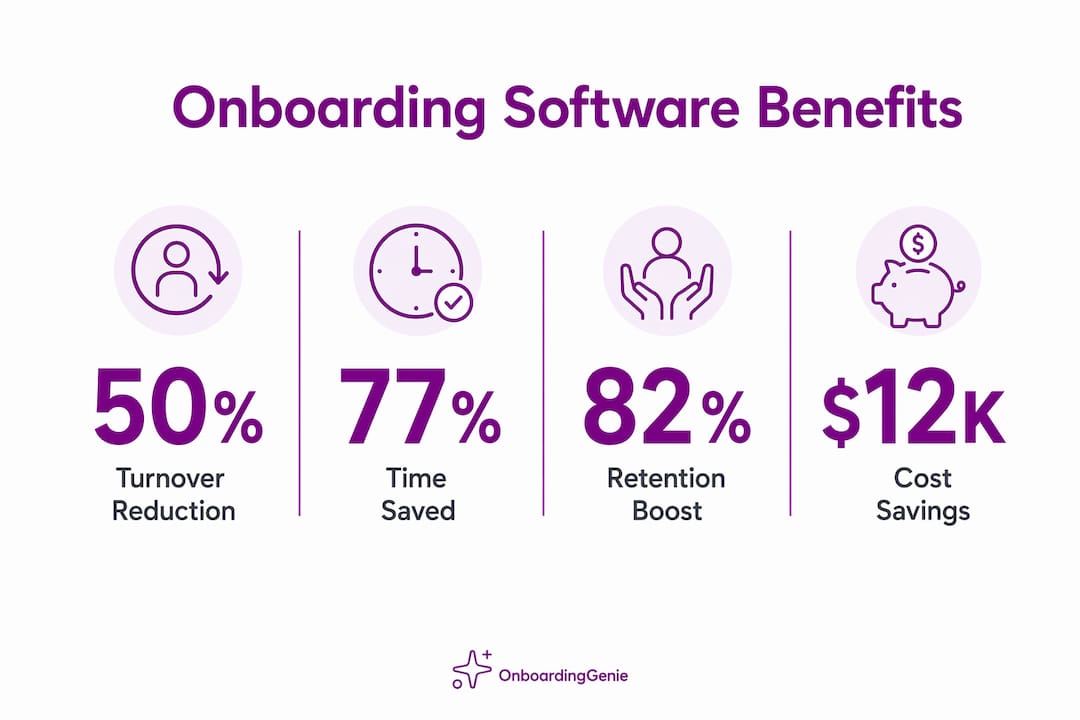
- Onboarding software improves retention rates by up to 82% and reduces manager onboarding time by 77 percent. It automates document collection, task orchestration, and compliance tracking, freeing HR to focus on human interactions that foster new hire integration. For small professional service firms, investing in tailored onboarding platforms enhances efficiency, consistency, and legal compliance without overcomplicating processes.
Onboarding software is a digital platform that automates and organizes the entire process of integrating new employees into a firm, from document collection and compliance tracking to task assignment and training delivery. The case for why businesses need onboarding software is grounded in measurable outcomes: structured onboarding improves retention by 82% and boosts productivity by over 70% compared to informal processes. For small and mid-sized professional service firms, those numbers represent real dollars and real people. Platforms like BambooHR, Qooper, and Onboardinggenie each approach this differently, but the underlying logic is the same. Get the first 90 days right, and you keep the hire. Get them wrong, and you start over.
Why businesses need onboarding software: the retention and productivity case
The most direct argument for onboarding software is what happens without it. 20% of new hires leave within 90 days due to poor onboarding experiences, and 33% exit within the first year. For a 10-person accounting firm or a boutique law practice, losing a second-year associate after six months of training is not just an inconvenience. It is a budget event.
"Structured onboarding reduces first-year turnover by 50%." That single figure, drawn from SHRM and Gallup research, reframes onboarding from an HR administrative task into a retention strategy with a calculable return.
The productivity side is equally concrete. New hires at firms with structured onboarding reach full productivity faster because they are not waiting on IT access, chasing down forms, or guessing at their first-week priorities. The role of onboarding software in growth is not abstract. It compresses the ramp-up curve by removing the friction that slows down every new hire's first weeks. When a paralegal at a 12-person firm spends day one filling out paper forms instead of shadowing a senior attorney, that is a direct cost to the firm's output.
Poor onboarding also carries a cultural cost that does not show up on a spreadsheet until someone quits. New hires who feel disorganized or unsupported in their first weeks form a lasting impression of how the firm operates. Onboarding software creates a consistent, professional first experience regardless of which partner is in the office or how busy the front desk is that week.

What features actually matter in onboarding tools
Not every feature in an enterprise HR platform is relevant to a 15-person consulting firm. The capabilities that deliver real value for small professional service firms fall into five categories.
- Digital document management with e-signatures. Collecting W-4s, I-9s, confidentiality agreements, and benefits enrollment forms through a single portal eliminates the back-and-forth of emailed PDFs. Secure storage with audit trails also satisfies compliance requirements without a separate document management system.
- Automated task orchestration. When a new hire is added to the system, the software triggers tasks across departments simultaneously: IT provisioning, payroll setup, benefits enrollment, and manager orientation scheduling. No one has to remember to send the checklist.
- New-hire self-service portals. Preboarding portals increase document completion to 71%, and that rate climbs to 89% when automated reminders are added. This matters because it shifts the data-accuracy burden onto the employee, reducing HR entry errors before day one.
- Compliance tracking with automated reminders. Automated checklists and audit trails reduce legal risk from missed deadlines or incomplete forms. For firms in regulated industries, this is not optional. A missed I-9 deadline or an unsigned harassment policy acknowledgment creates real exposure.
- Conditional logic for workflow continuity. Conditional logic prevents a single delayed task from stalling the entire onboarding sequence. If an employee has not completed benefits enrollment, the system escalates that task independently while proceeding with non-sensitive steps like equipment setup and training assignments.
Pro Tip: When evaluating onboarding tools, test the conditional logic before you buy. Ask the vendor: what happens if a new hire does not complete step three? If the answer is "the whole workflow pauses," that tool will create more problems than it solves for a small firm with limited HR bandwidth.
The HR compliance role in onboarding is often underestimated until something goes wrong. Building compliance checkpoints directly into the onboarding workflow means they happen automatically, not when someone remembers to follow up.
Manual onboarding vs. software: a direct comparison
The time cost of manual onboarding is the clearest argument for switching. Hiring managers spend an average of 6.2 hours on administrative onboarding tasks per new hire. Automated onboarding reduces that to 1.4 hours, a 77% reduction. At a billing rate of $150 per hour for a senior manager, that is roughly $720 saved per hire in manager time alone.
| Factor | Manual onboarding | Software-assisted onboarding |
|---|---|---|
| Manager time per hire | 6.2 hours | 1.4 hours |
| Average cost per hire | $12,429 total | Significantly reduced |
| Document completion rate | Variable, often under 60% | Up to 89% with reminders |
| Compliance risk | High (manual tracking) | Low (automated audit trail) |
| New hire first-day experience | Inconsistent | Consistent and structured |
The $12,429 average cost of manual onboarding per hire includes $4,129 in administrative overhead and $8,300 in lost productivity. That figure makes the monthly subscription cost of most onboarding platforms look negligible by comparison.
Manual processes also create inconsistency. When onboarding depends on a specific HR coordinator or office manager, the experience varies based on who is available, how organized they are, and whether they remember every step. A new hire joining during tax season at a CPA firm gets a different experience than one joining in July. Software eliminates that variability.
Pro Tip: Before switching platforms, map your current manual onboarding steps on paper. List every form, every email, every task that gets assigned verbally. That map becomes your workflow template in the new system, and it usually reveals three to five steps that nobody realized were being skipped regularly.
The payroll integration during onboarding is one area where manual processes create the most errors. Payroll setup requires accurate tax withholding data, direct deposit information, and benefits deductions from day one. When that data flows directly from the onboarding portal to payroll, the error rate drops substantially.
How onboarding software supports human-centered HR
Automation handles the administrative burden so HR managers can focus on the work that actually shapes a new hire's experience. That distinction matters more than most firms realize. New hires rate social integration 2.5 times more important than paperwork completion for onboarding satisfaction. The forms are necessary, but they are not what makes someone feel like they belong.
The shift from processing new hires to shaping contributors is the real value proposition of onboarding software. When the system handles task routing, document collection, and deadline reminders, the HR manager's time opens up for the conversations that matter: introductions to the team, clarity on expectations, and early check-ins on how the new hire is settling in.
Here is how that plays out in practice for a firm that has made the switch:
- Before the start date, the new hire completes all paperwork through a self-service portal, reviews the employee handbook, and watches a brief orientation video. HR touches none of it manually.
- On day one, the manager's schedule is clear for a 90-minute orientation conversation instead of a 90-minute form-signing session.
- At the 30-day mark, the system automatically sends a check-in survey to the new hire and flags the results for the HR manager to review.
- At 90 days, the system prompts the manager to schedule a formal review and confirms that all compliance documents are complete and stored.
Automated onboarding maintains consistent quality across hybrid and remote workforces, which is increasingly relevant for small firms that hire outside their immediate geography. A remote paralegal in another state gets the same structured, professional experience as someone sitting in the main office.
The best practices for HR onboarding at small firms consistently point to one principle: use automation to protect time for human interaction, not to replace it. The goal is not a fully automated onboarding experience. It is an onboarding experience where the human moments are deliberate and well-supported.
Key takeaways
Onboarding software reduces first-year turnover by up to 50%, cuts manager administrative time by 77%, and creates a consistent, compliant new hire experience that manual processes cannot reliably deliver.
| Point | Details |
|---|---|
| Retention impact | Structured onboarding improves new hire retention by 82% versus informal processes. |
| Time savings | Automation reduces manager onboarding time from 6.2 hours to 1.4 hours per hire. |
| Compliance protection | Automated checklists and audit trails reduce legal risk from missed forms and deadlines. |
| Human experience | Automation frees HR time for social integration, which new hires value 2.5x more than paperwork. |
| Cost reduction | Manual onboarding costs an average of $12,429 per hire; software cuts that substantially. |
What I've learned from watching small firms onboard without a system
I built Onboardinggenie after watching the same pattern repeat across small professional service firms. The founding partner handles onboarding personally for the first few hires, and it works fine because they are paying close attention. Then the firm grows to eight or twelve people, and suddenly onboarding is whoever has time that week. Forms get missed. New hires sit idle on day one waiting for system access. A compliance deadline slips.
The firms that resist onboarding software usually cite one of two reasons: they think they are too small to need it, or they tried an enterprise tool and found it too complicated to configure. Both are understandable. Enterprise platforms like Workday or SAP SuccessFactors are genuinely overkill for a 20-person firm, and the implementation cost alone can exceed a year's subscription for a purpose-built tool.
What I have found is that the right onboarding software for a small firm is not the one with the most features. It is the one that maps cleanly to how the firm actually works, requires minimal IT involvement to set up, and gives the HR manager or office administrator clear visibility into where every new hire stands. The complete small firm onboarding guide covers this in more detail, but the short version is: start with your current process, automate the repetitive parts, and protect the human touchpoints.
The firms that get the most value from onboarding software are not the ones that automate everything. They are the ones that automate the right things.
— Chris
How Onboardinggenie handles onboarding for small professional service firms
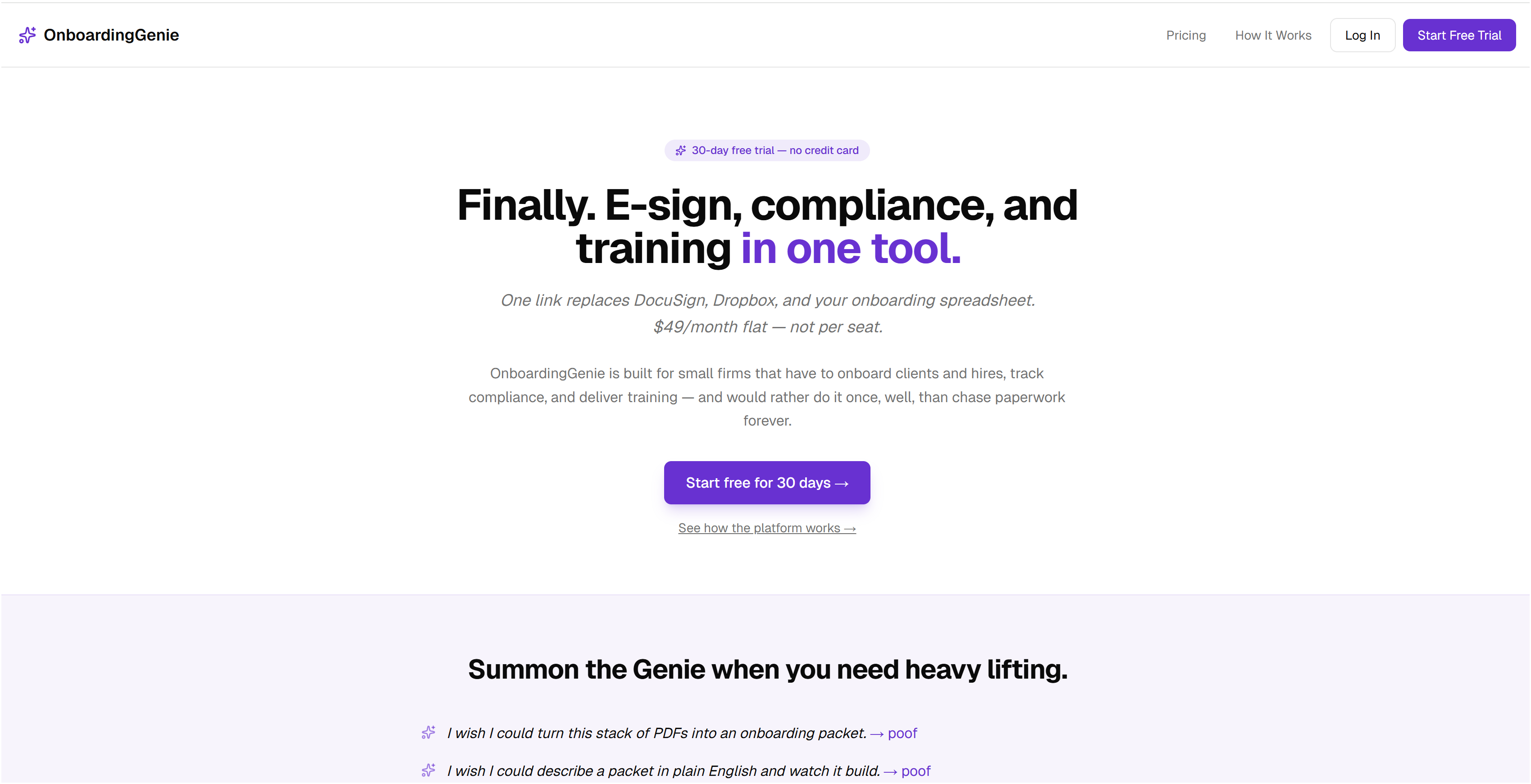
Onboardinggenie is built specifically for small professional service firms that need a structured, compliant onboarding process without the overhead of an enterprise platform. The platform consolidates document collection, e-signatures, compliance tracking, and training delivery into a single branded portal, delivered through one link. There is no IT setup required, no per-seat pricing that scales against you, and no features you will never use. If you are running a law firm, accounting practice, or consulting firm with fewer than 50 employees and your current onboarding process lives in a folder of PDFs and a shared spreadsheet, see how Onboardinggenie works or review the full onboarding and compliance services to find the right fit.
FAQ
What does onboarding software actually do for a small firm?
Onboarding software automates document collection, task assignment, compliance tracking, and new hire communications through a single platform. For small firms, this replaces manual email chains, paper forms, and verbal checklists with a repeatable, auditable process.
How much does poor onboarding cost per hire?
Manual onboarding costs an average of $12,429 per hire when you account for administrative overhead and lost productivity. That figure makes even a mid-range onboarding platform cost-effective after the first two or three hires annually.
Does onboarding software help with I-9 and compliance deadlines?
Yes. Automated checklists and audit trails enforce completion of required forms like I-9s and signed policy acknowledgments, reducing the risk of missed deadlines that create legal exposure for the firm.
How long does it take a new hire to complete preboarding with a self-service portal?
Most new hires complete preboarding documents within 24 to 48 hours when using a self-service portal with automated reminders. Completion rates reach 89% with reminder sequences, compared to significantly lower rates with manual follow-up.
Is onboarding software worth it for a firm with fewer than 10 employees?
For firms hiring two or more people per year, the time savings and retention improvement justify the cost. The human oversight onboarding approach works well at this scale because it keeps the process simple while protecting compliance and consistency.