

Most consulting firms lose two to four weeks of productive output every time they bring on a new hire, simply because their training content lives in five different places and nobody agrees on what "ready" actually means. The result is slower client delivery, frustrated managers, and new consultants who either sink or swim based on who happens to mentor them. Research from Rocketlane's 2026 benchmark confirms that faster onboarding directly correlates with stronger performance outcomes in professional services. This guide walks you through planning, building, running, and measuring a training program that works reliably, every time.
Table of Contents
- Laying the groundwork: Key components for a successful setup
- Designing role-based learning paths and benchmarks
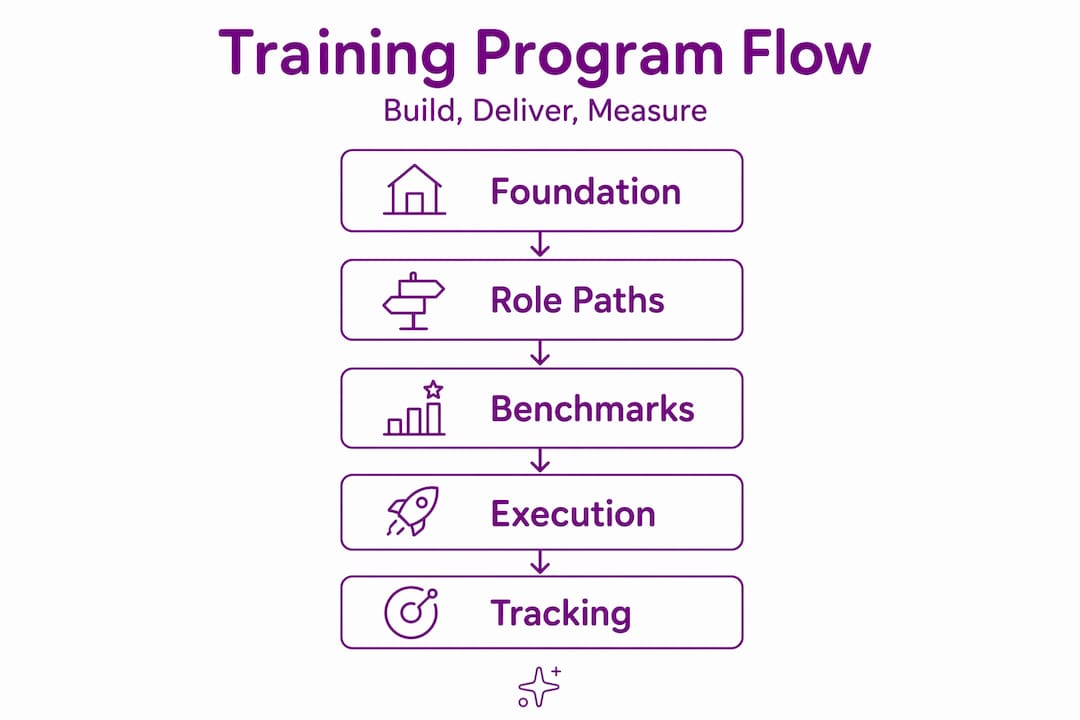
- Executing onboarding and training: Steps for predictable success
- Measuring impact: Verifying, tracking, and evolving your training program
- Why most consulting firm training programs fail—and how to break the cycle
- Supercharge your training setup with OnboardingGenie
- Frequently asked questions
Key Takeaways
| Point | Details |
|---|---|
| Build structured foundations | Invest in role-based skill mapping, a strong infrastructure, and clear milestone tracking before launching your training program. |
| Customize and verify learning | Create role-specific paths with measurable benchmarks and use continuous feedback to guide improvements. |
| Focus on outcomes | Ensure every training step links back to faster productivity, client value, and clear business KPIs. |
| Avoid common pitfalls | Don’t let vague requirements, skipped milestones, or lack of evidence derail your onboarding efforts. |
| Leverage technology and feedback | Use modern onboarding tools and regular manager check-ins to drive ongoing program optimization. |
Laying the groundwork: Key components for a successful setup
Before you write a single training module, you need the right infrastructure in place. Think of it like framing a house before you hang drywall. Without the frame, everything shifts. In consulting, that frame is a combination of tools, skill categories, and feedback mechanisms that work together to support every hire, regardless of role or experience level.
Start with your tools. At minimum, you need a central document repository where all training materials live in one location, not scattered across email attachments and shared drives. You also need a way to deliver and track learning, which could be a dedicated learning management system or an integrated portal that consolidates forms, documents, and training content into a single access point. Pair that with structured checklists so managers and new hires always know exactly where they stand. Good onboarding infrastructure means no one has to guess what comes next.
Next, map your skill categories clearly. Most consulting firms need to cover at least four areas: technical skills (software, methodology, frameworks), client-facing skills (communication, expectation setting, reporting), compliance requirements (contracts, confidentiality, regulatory obligations), and firm-specific knowledge (internal processes, naming conventions, client file structures). Organizing training content around these categories makes it easier to customize later without rebuilding from scratch.
According to Kitces' onboarding framework, effective programs are structured around role and capability-based skill categories, clear milestones, and recurring manager check-ins using the same artifacts over time. That last part matters more than most firms realize. When managers use different check-in formats every quarter, continuity breaks down and progress becomes hard to measure.
Here is a quick comparison of what a weak versus strong training foundation looks like:
| Element | Weak setup | Strong setup |
|---|---|---|
| Content storage | Email attachments, shared drives | Central repository with version control |
| Progress tracking | Verbal check-ins only | Milestone checklists with sign-off |
| Skill coverage | Ad hoc based on manager preference | Defined categories across all roles |
| Feedback loops | End-of-month review | Structured 30/60/90-day touchpoints |
| Customization | One-size training for all roles | Role-specific paths within a shared system |
Pro Tip: Before investing in any new tool, audit where your current training content actually lives. Most firms discover they already have solid material scattered across three platforms. Consolidation is often faster than creation.
Understanding onboarding vs compliance as related but distinct processes also helps you avoid a common trap: treating compliance sign-offs as a separate workflow. When compliance tracking sits in the same system as onboarding, your team moves faster and your audit trail stays clean. Start designing training frameworks with this integration in mind from day one.
Designing role-based learning paths and benchmarks
With your infrastructure ready, it is time to build the core of your training program: personalized paths and measurable benchmarks for each role. Generic training treats an associate the same as a senior consultant, and that approach wastes time for everyone involved.
Define competencies at each level first. An associate consultant might need to demonstrate proficiency in client data gathering and internal documentation within their first 30 days. A senior consultant should hit a different set of benchmarks around project scoping and client communication by day 60. A manager-level hire needs to show capability in team oversight and quality review before they are fully productive. These distinctions are not cosmetic. They shape how you sequence training, which resources you assign, and how managers evaluate readiness.
Here is a sample proficiency matrix you can adapt for your firm:
| Role | Day 30 benchmark | Day 60 benchmark | Day 90 benchmark |
|---|---|---|---|
| Associate consultant | Complete compliance checklist, shadow 2 client calls | Lead intake meeting with supervision | Independently manage a small client file |
| Senior consultant | Review firm methodology, complete 1 live project | Lead project planning meeting | Deliver client report with manager review |
| Engagement manager | Assess team capacity, review active pipeline | Run a full team check-in | Own a client relationship end-to-end |
Training should be competency-driven and progressive, with explicit proficiency milestones by experience level, not just content delivery. Uploading a PDF library and calling it training is not a program. It is a filing cabinet.
Build learning paths using a mix of modalities. Self-paced modules work well for compliance content and firm-specific process documentation. Live practice sessions, where new hires work through real scenarios with a senior colleague, are irreplaceable for client-facing skills. Mentorship pairings fill the gap for tacit knowledge: the kind of judgment that does not show up in any manual.
"Well-designed onboarding and training systems combine baseline standardization with role-tailored learning paths delivered in the right mix of self-paced and live practice."
The Deloitte academy model illustrates this at scale: blended learning tied to business-specific capability frameworks. You do not need Deloitte's budget to apply the same logic. You just need to map your roles to your content intentionally. A real-world onboarding example from a small firm shows how role-differentiated packets can work practically, even without enterprise infrastructure.
Make sure every learning path ties back to a measurable indicator. "Understand our proposal process" is not a benchmark. "Complete and submit a mock proposal that passes a manager review by day 45" is. The specificity is what creates accountability. Review key onboarding steps that go beyond signatures and surface the process decisions that actually move new hires forward.
Executing onboarding and training: Steps for predictable success
Now that your benchmarks are mapped out, here is how to execute your onboarding step-by-step for consistent results. Planning without execution is just documentation. What matters is the sequence you follow and the discipline with which you follow it.
-
Preboarding: Send access credentials, compliance forms, and a welcome packet before the hire's first day. This step eliminates the awkward first morning of waiting for email accounts and IT setup. It also signals to the new hire that your firm is organized.
-
Orientation: Cover firm culture, team structure, communication norms, and a clear overview of the training timeline. Keep this focused. Information overload in week one causes more harm than benefit.
-
Guided practice: Assign structured tasks with defined outputs, not open-ended exploration. Have the new hire complete real work under supervision, then debrief on what went well and what needs adjustment.
-
Feedback sessions: Schedule formal check-ins at the 30-, 60-, and 90-day marks. Use the same template each time so progress is comparable across periods and across hires.
-
Verification: Confirm milestone completion with documented evidence before moving to the next phase. This is not bureaucracy. It is the step that separates structured programs from wishful thinking.
Well-structured systems combine standardization with role-tailored content delivered across the right modalities, and that applies to execution just as much as design. The pitfalls that derail most consulting firm programs tend to show up at this stage.
Common execution failures include setting vague goals ("get familiar with our clients"), skipping feedback sessions when things get busy, and cramming too much content into the first two weeks. Each of these mistakes has a predictable consequence. Vague goals produce inconsistent performance. Skipped feedback means problems compound silently. Information overload causes disengagement that is hard to reverse.
Recurring manager check-ins using consistent artifacts are what turn one-off onboarding into a living program. When the same structured template shows up at 30 days, 60 days, and 90 days, both the manager and the new hire know exactly what is being assessed. There is no ambiguity about what "meeting expectations" looks like.
Pro Tip: Build your 30-day check-in template before the hire's first day. That one decision forces you to clarify what you actually want them to accomplish early, which makes orientation conversations much more focused.
For firms managing remote hires or contractors, efficient onboarding steps that handle verification quickly make a real difference in keeping momentum. Compliance steps that drag on for days erode the energy a new hire brings in their first week.
The concept of continuing onboarding beyond the first 90 days is gaining traction in professional services. Productive firms treat month four onward as ongoing development, with quarterly check-ins tied to project outcomes rather than tenure. That shift keeps high performers engaged longer.
Measuring impact: Verifying, tracking, and evolving your training program
After implementation, the final step is making sure your program works and keeps getting better with data. A program that runs but never improves is still a static document. What you want is a feedback engine.
Start with three core metrics:
- Time-to-productivity: How long from start date until a consultant independently manages a client deliverable?
- Milestone achievement rate: What percentage of hires complete each benchmark within the target window?
- Client satisfaction scores: Does client feedback improve in engagements where the consultant completed the full training sequence?
Faster onboarding links directly to stronger performance at the firm level. That means your training program is not just an HR function. It is a revenue lever. When you reduce time-to-productivity by two weeks, you recover billable hours and reduce manager supervision overhead at the same time.
"Structured, evidence-linked requirements reduce ambiguity and scope creep risk."
This insight from a study of consulting onboarding failures applies directly to how you track training outcomes. When your milestones are evidence-based, the data you collect at each checkpoint tells you exactly where the program is working and where it is breaking down.
Here is a summary table to track and evolve your program:
| Metric | How to track | Review frequency | Action trigger |
|---|---|---|---|
| Time-to-productivity | Project assignment date vs. start date | Quarterly | If avg. exceeds 60 days, review orientation |
| Milestone completion rate | Checklist sign-off records | After each cohort | Below 80% triggers path revision |
| Client satisfaction | Post-project surveys | Per engagement | Scores below baseline flag training gaps |
| Manager feedback quality | Check-in template completeness | Monthly | Incomplete forms indicate process drift |
Link your training outcomes to business KPIs directly. Aligning training outcomes to measurable results makes it easier to justify investment in better tools and more structured processes. If your program is consolidated into one system, pulling these numbers becomes a report, not a research project.
Why most consulting firm training programs fail—and how to break the cycle
Here is the uncomfortable truth most consultants do not want to hear: the majority of training program failures have nothing to do with the quality of the content. Firms spend months curating case studies, recording video lessons, and assembling detailed guides. Then the program stalls. Hires plateau. Managers revert to informal coaching. The investment produces little measurable change.
The real issue is almost always structural. Specifically, programs fail when requirements are unclear, milestones are loosely defined, and no one captures evidence of progress. As research on consulting onboarding failures shows, unstructured requirements and missing evidence loops are the leading causes of scope creep and underperformance, not bad training content.
Think about what happens in practice. A firm builds a solid library of training modules. New hires work through them in the first two weeks. By week three, they are handling real client work, and the training is effectively over. There is no 60-day check-in. No structured review of whether they actually absorbed and applied what they learned. No connection between training completion and performance data.
The fix is not better content. It is better process. Fixing your milestone structure, standardizing your check-in artifacts, and capturing verifiable evidence at each stage will do more for your training outcomes than any new course platform. Knowing what practice management onboarding actually requires from a process standpoint is the starting point for that fix.
Continuous improvement also separates high-performing firms from average ones. A one-time program build is not a training program. It is a project. Real programs evolve each quarter based on data, manager feedback, and changing client demands. Firms that treat onboarding as a living system consistently outperform those that treat it as a task to be completed once.
Supercharge your training setup with OnboardingGenie
Setting up a structured training program is achievable for any consulting firm, but maintaining it across roles, tracking milestones, and keeping compliance aligned is where most firms run into friction. That is exactly the problem OnboardingGenie was built to solve.
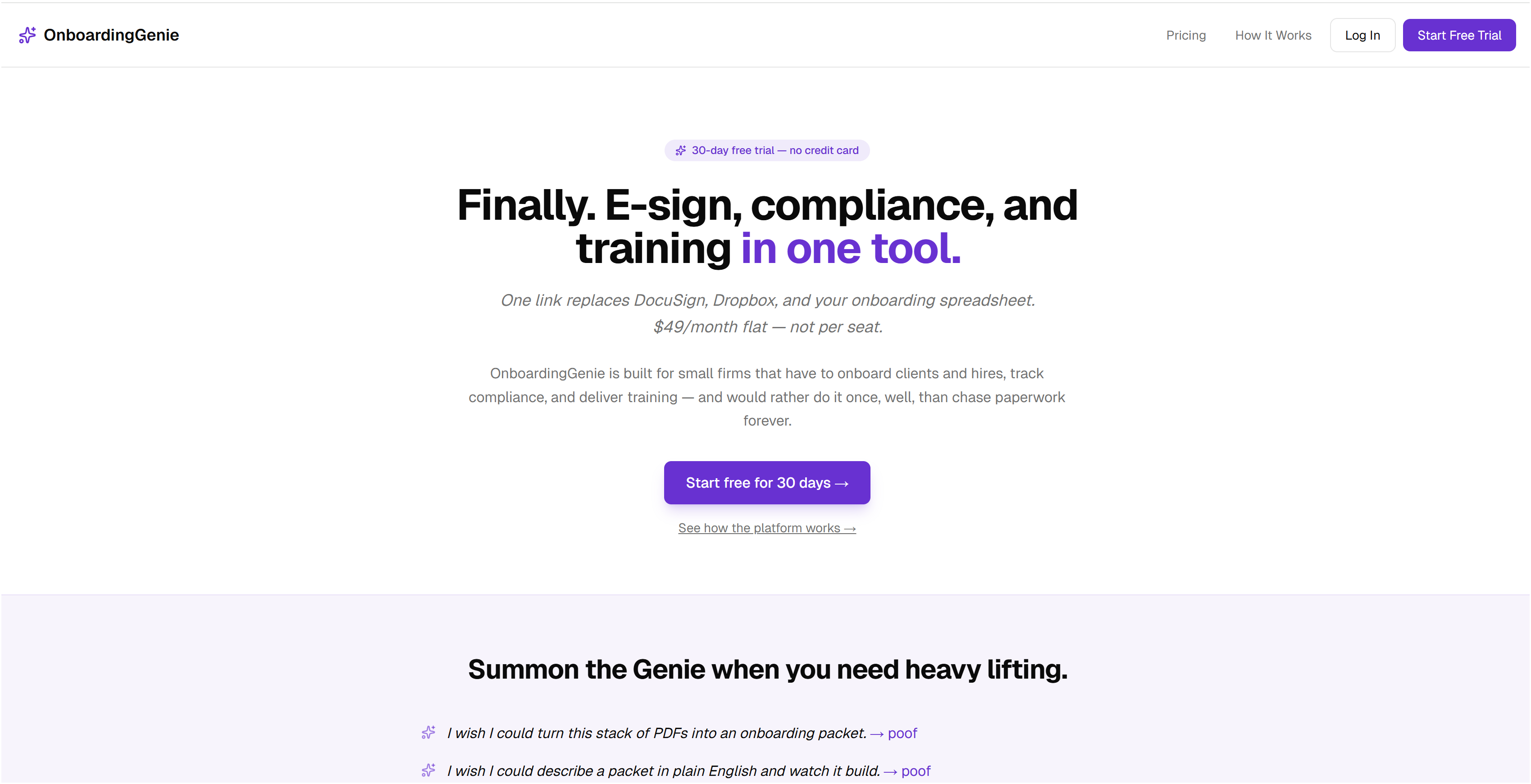
OnboardingGenie consolidates your training content, compliance tracking, and milestone verification into a single branded portal delivered through one link. No more chasing PDFs, managing disconnected spreadsheets, or manually tracking who signed what. You get clear visibility into every hire's progress, built-in feedback loops, and a system that scales without adding administrative overhead. Explore compliance management built directly into the onboarding flow, review available onboarding services for professional service firms, or start free today and see how much simpler structured training can actually be.
Frequently asked questions
What milestones should a consulting firm training program include?
You should include 30-, 60-, and 90-day benchmarks, each tied to measurable skills and formal feedback sessions so both managers and new hires stay aligned throughout.
How do I measure success in a training program?
Track time-to-productivity, milestone completion rates, and qualitative feedback from clients and managers, since faster onboarding correlates with stronger firm-wide performance outcomes.
What tools make onboarding and training easier for consulting firms?
Use central repositories and checklists alongside learning management tools and structured feedback mechanisms to eliminate guesswork and keep every hire on track.
Can I customize training for different consultant roles in one program?
Yes, you can combine standardized onboarding with role-specific paths by using a shared base with role-tailored content delivered through the appropriate mix of self-paced and live practice formats.
What causes most consulting firm training programs to fail?
Unstructured requirements and missing evidence at each milestone are the primary causes, not poor content quality, which is why process design matters more than course selection.