
TL;DR:
- HR onboarding compliance involves fulfilling legal and regulatory obligations such as Form I-9 completion, worker classification, data privacy, and jurisdiction-specific notices. Proper management ensures legal protection, reduces audit risks, and fosters a positive employee experience from day one. Small firms should adopt systematic, technology-enabled processes, map compliance duties proactively, and conduct regular self-audits to prevent costly violations.
HR compliance in onboarding is defined as the set of legal, regulatory, and policy obligations an employer must fulfill when integrating a new hire, covering everything from Form I-9 verification to wage classification and data privacy. For small to medium-sized firms, the role of HR compliance in onboarding is not optional paperwork. It is the operational foundation that determines whether a new hire's first week creates legal exposure or organizational confidence. USCIS, the Department of Labor, and state labor agencies each impose specific deadlines and documentation standards that apply from day one. Miss them, and the cost is rarely just a fine.
What key compliance requirements must HR address during employee onboarding?
Employee onboarding compliance begins with federal mandates and layers state and local obligations on top. For most small firms, four categories demand immediate attention.
-
Form I-9 completion. Section 1 must be completed on or before the employee's first day of work. The employer must complete Section 2 within 3 business days of the start date. USCIS counts business days strictly, so a Monday start means Section 2 is due by Thursday. Missing this window is one of the most common audit failures HR teams face.
-
Worker classification and wage documentation. The Department of Labor recovered over $259 million in back wages in fiscal year 2025 due to wage and hour violations, with the average back wage award reaching approximately $1,465 per affected employee. Many of these violations trace back to misclassification decisions made at the point of hire. Documenting classification rationale during onboarding creates a defensible record.
-
Data privacy and record retention. Employee records collected during onboarding, including Social Security numbers, bank details, and health information, are subject to federal and state privacy laws. Firms must define retention schedules and access controls before the first form is signed.
-
State and local law requirements. Wage transparency laws, pay equity disclosures, and anti-discrimination notices vary by jurisdiction. A firm with remote employees in California, New York, and Texas faces three distinct compliance frameworks simultaneously.
Pro Tip: Build a jurisdiction-specific compliance checklist before your first remote hire starts. Mapping your geographic footprint once saves hours of reactive research later.
How does compliance shape employee experience and reduce organizational risk?
Compliance is not just a legal necessity. It shapes the impression a new hire forms about your organization in the first 72 hours. A firm that hands a new employee a disorganized stack of forms, misses a required disclosure, or fails to explain a policy clearly signals operational dysfunction before the person has attended a single meeting.

I&D compliance, when treated as a strategic advantage rather than a checkbox, improves workforce integration and reduces early attrition. SHRM's research shows that embedding inclusion and diversity requirements into onboarding workflows, rather than delivering them as a separate legal briefing, produces measurably better engagement outcomes. This is the difference between compliance that protects the firm and compliance that also serves the employee.
The risks of getting this wrong are concrete:
- Audit exposure. An I-9 audit by Immigration and Customs Enforcement can result in fines ranging from $281 to $2,789 per paperwork violation for a first offense, with higher penalties for substantive violations.
- Back wage liability. Misclassification discovered during a Department of Labor investigation triggers back pay, penalties, and legal fees that dwarf the cost of proper classification at hire.
- Reputational damage. A discrimination claim arising from an inconsistent onboarding process, where some employees received required anti-harassment training and others did not, creates both legal and public exposure.
"Compliance should be treated as an ongoing discipline, not a one-time project, to protect people, reputation, and bottom line." — Kelly Services HR Compliance Checklist 2026
What challenges do small to medium firms face in managing onboarding compliance?
The gap between knowing compliance matters and actually executing it consistently is where most small firms struggle. 87% of HR leaders recognize that non-compliance poses significant business risk, yet only 67% prioritize it in their organizations. That 20-point gap represents real exposure sitting inside firms that believe they are covered.
The most common obstacles fall into three categories:
| Challenge | Why it happens | Practical consequence |
|---|---|---|
| Fragmented systems | Forms, signatures, and training live in separate tools | Incomplete records and missed deadlines |
| Geographic complexity | Remote hires trigger unfamiliar state and local laws | Unintentional violations in new jurisdictions |
| Inconsistent process ownership | HR and admin roles overlap without clear accountability | Duplicate effort or critical steps skipped |
| Deadline tracking gaps | No centralized view of I-9 timelines or reverification dates | Late completions that create audit risk |
Fragmented HR systems create "silent risk" in onboarding compliance, a term HR Magazine uses to describe inherited gaps that accumulate quietly until an audit or lawsuit surfaces them. For a 10-person accounting firm or a 30-person consulting practice, that silent risk is often invisible until it is expensive.
Multi-jurisdiction compliance has grown more complex as remote work normalized after 2020. A firm that hired its first out-of-state employee in 2021 may still be operating under the assumption that its home-state policies cover that person. They do not.
Pro Tip: Run a geographic audit of your current workforce once per year. List every state where you have employees and cross-reference against that state's current onboarding disclosure and wage transparency requirements.
Which best practices help HR leaders build a compliant onboarding process?
The firms that manage onboarding compliance well share one characteristic: they treat it as a system, not a series of individual tasks. Here is how to build that system.
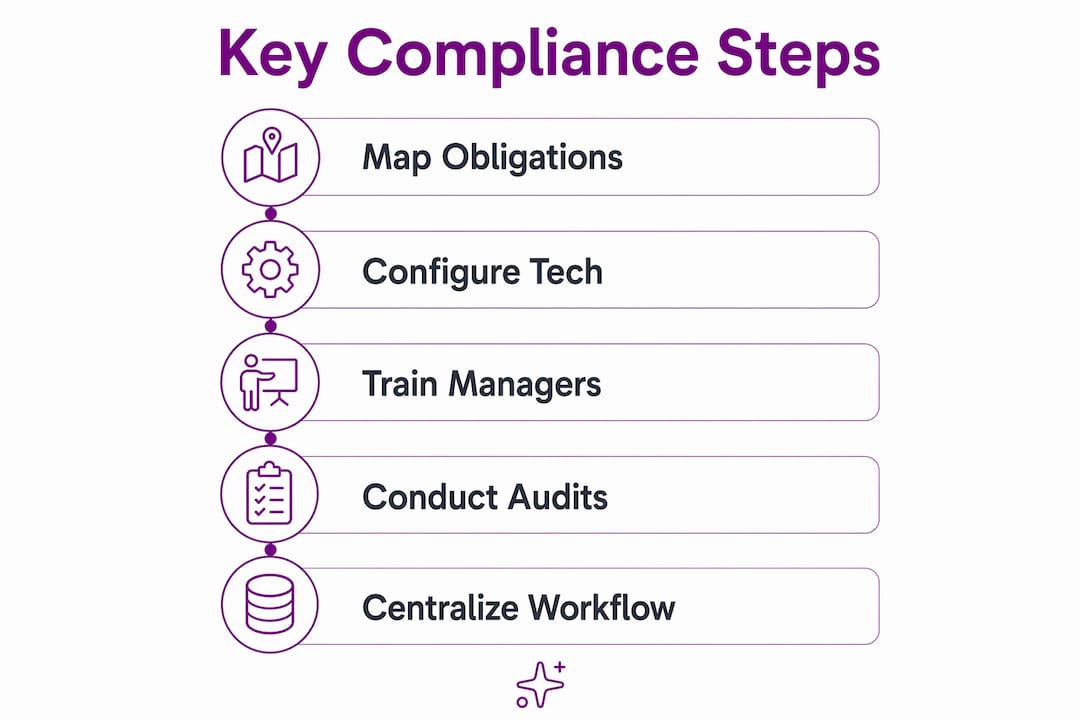
Map your compliance obligations before you hire
Proactive compliance programs start with geographic footprint mapping and risk assessment by jurisdiction. Before posting a role, confirm which state and local laws apply to that position. This takes 30 minutes per new jurisdiction and prevents months of remediation.
Configure your technology correctly
Role-based permissions and configurable compliance form triggers are critical for ensuring actual compliance rather than just enabled compliance features. A system that has an I-9 module but no deadline trigger or completion alert does not protect you. Misconfiguration is as dangerous as no configuration. When evaluating onboarding compliance tracking tools, confirm that the platform enforces deadlines rather than just storing forms.
Train hiring managers on legal interviewing and documentation
Most compliance failures in onboarding do not happen in HR. They happen in the hiring manager's first conversation with a new employee. Questions about medical history, family plans, or national origin asked informally during orientation create discrimination exposure. A 30-minute training session on legal interviewing, delivered before a manager conducts their first onboarding meeting, closes this gap at minimal cost.
Conduct regular self-audits
Schedule a quarterly I-9 self-audit and an annual wage and hour review. The complete small firm onboarding guide from OnboardingGenie's blog outlines a practical audit framework that takes less than two hours for firms under 50 employees. Self-audits surface errors while you can still correct them without penalty.
Centralize your onboarding workflow
A centralized platform that consolidates forms, signatures, policy acknowledgments, and compliance training into a single workflow eliminates the version control and deadline tracking problems that fragmented tools create. OnboardingGenie is built specifically for this use case in small professional service firms, replacing disconnected PDFs and spreadsheets with a single branded portal.
What specific compliance steps should firms prioritize in the first week?
The first week of employment carries the highest concentration of compliance deadlines. Missing any of these creates audit exposure that cannot be fully corrected after the fact.
- Day 1: New hire completes Form I-9 Section 1. Provide the list of acceptable documents. Do not specify which documents the employee must present.
- By Day 3: Employer completes Form I-9 Section 2 after physically or remotely examining original documents. Late completion must be documented with an explanation. Never backdate the form.
- Day 1 through Day 5: Deliver all required state and local notices. In California, this includes the Wage Theft Prevention Act notice. In New York, it includes a written wage notice under the Wage Theft Prevention Act as well.
- Within the first week: Collect signed acknowledgments for your employee handbook, anti-harassment policy, and any confidentiality agreements. Unsigned acknowledgments are unenforceable.
- Before the first paycheck: Confirm payroll classification, tax withholding elections via Form W-4, and direct deposit authorization. Payroll's connection to onboarding compliance is direct. A misclassified worker paid incorrectly from day one compounds the original error with every subsequent paycheck.
Including compliance training in onboarding reduces risk and supports a high-performing workforce culture from day one. Deliver required harassment prevention training within the timeframe your state mandates, and document completion with a dated attestation.
Pro Tip: Create a single onboarding compliance checklist that lists every required action, the responsible party, and the deadline. Review it after every new hire to catch process gaps before they become audit findings.
Key takeaways
HR compliance in onboarding requires completing Form I-9 within 3 business days, documenting worker classification, delivering jurisdiction-specific notices, and centralizing records before the first paycheck clears.
| Point | Details |
|---|---|
| Form I-9 timing is non-negotiable | Section 2 must be completed within 3 business days; late forms require documented explanations, never backdating. |
| Geographic complexity is underestimated | Remote employees trigger state and local obligations that differ significantly from your home-state requirements. |
| Fragmented systems create silent risk | Disconnected tools miss deadlines and produce incomplete records that fail audits even when the intent was compliant. |
| Compliance training belongs in week one | Delivering required training and collecting signed acknowledgments during onboarding creates a defensible record from day one. |
| Proactive programs cost less than reactive ones | Mapping compliance obligations before hiring is faster and cheaper than correcting violations after a Department of Labor investigation. |
Why I think most small firms are one audit away from a costly lesson
I built OnboardingGenie after watching small firms operate with genuine good intentions and genuinely broken processes. The owner of a 15-person consulting firm I worked with had no idea her remote hire in Colorado triggered a specific pay transparency disclosure requirement. She was not negligent. She was busy, and her tools gave her no signal that anything was missing.
The uncomfortable truth about HR compliance in onboarding is that most violations are not caused by firms that do not care. They are caused by firms that care but rely on memory, email threads, and static PDFs to manage time-sensitive legal obligations. That combination fails predictably.
What actually works is treating compliance as a workflow problem, not a knowledge problem. Most HR professionals in small firms know what Form I-9 is. The failure happens when there is no system that enforces the 3-day deadline, flags the reverification date, or confirms that the hiring manager actually collected the right documents. Technology that enforces process beats technology that merely stores documents.
The firms I respect most in this space run lean, human-led processes with clear ownership and deadline visibility. They are not using enterprise HRIS platforms with 200 features they will never configure. They are using focused tools that match their actual workflow. That is the design philosophy behind OnboardingGenie, and it is the right one for firms under 50 people.
— Chris
How OnboardingGenie handles compliance tracking for small firms
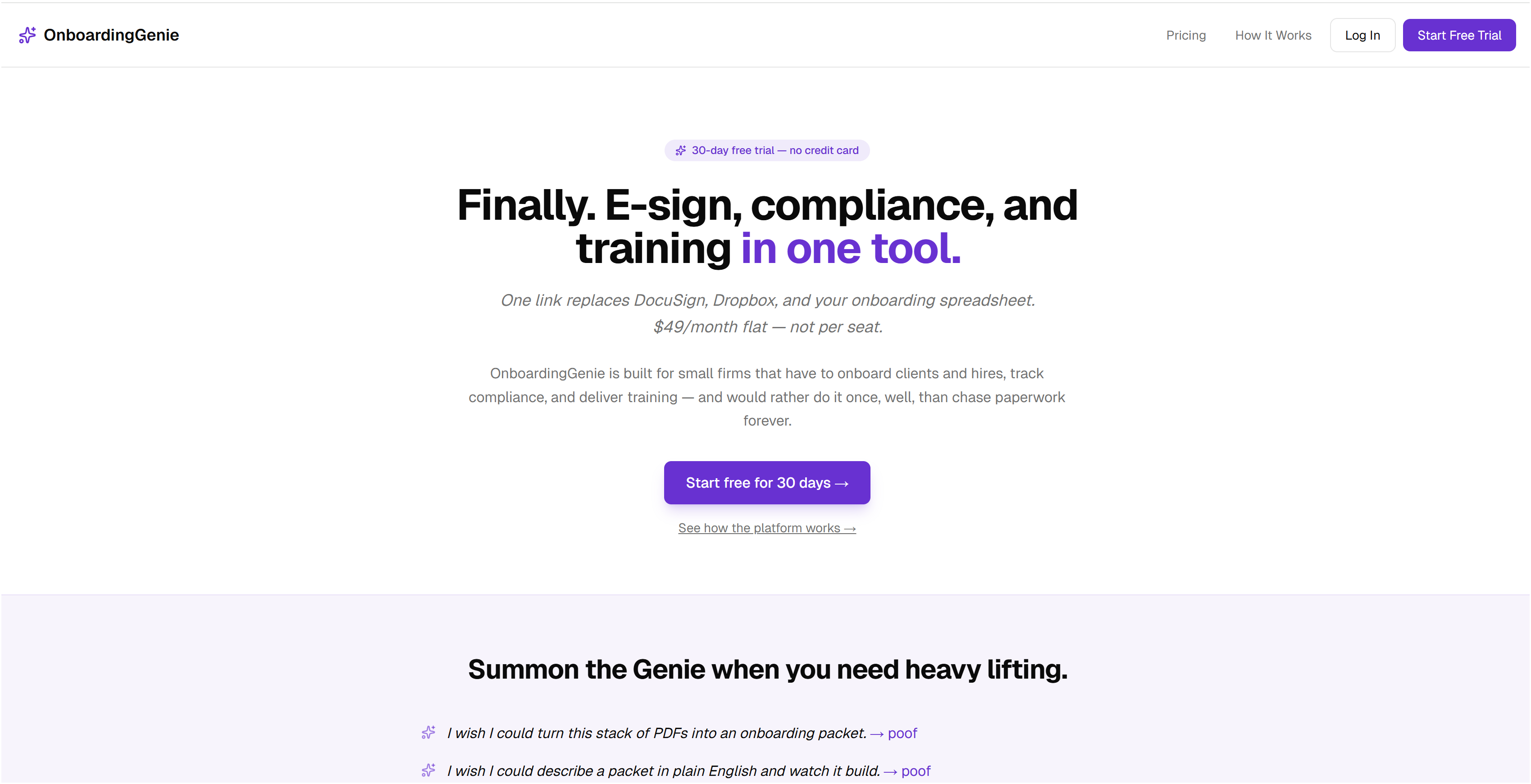
OnboardingGenie consolidates every compliance-critical step of employee onboarding into a single branded portal. Form collection, policy acknowledgments, compliance training delivery, and deadline tracking all live in one place, replacing the disconnected combination of PDFs, email reminders, and spreadsheet logs that most small firms currently rely on. The platform is built for firms that need accuracy and clear process ownership, not AI automation that requires a dedicated administrator to configure.
If you are managing onboarding compliance across multiple jurisdictions or preparing for a potential I-9 audit, the compliance management tools inside OnboardingGenie give you a real-time view of where every new hire stands. Explore the full onboarding and compliance services to see how it fits your firm's workflow.
FAQ
When must Form I-9 Section 2 be completed?
The employer must complete Form I-9 Section 2 within 3 business days of the employee's first day of work. If the job lasts fewer than 3 days, Section 2 must be completed on day one.
What happens if a small firm misses the I-9 deadline?
A late Form I-9 is a paperwork violation subject to fines ranging from $281 to $2,789 per violation for a first offense. The employer should document the actual completion date and the reason for the delay rather than backdating the form.
Do remote employees trigger different onboarding compliance requirements?
Yes. Remote employees are subject to the labor laws of the state where they perform their work, not the state where your firm is headquartered. This includes wage transparency disclosures, anti-discrimination notices, and harassment prevention training timelines that vary by state.
What is the difference between compliance training and policy acknowledgment in onboarding?
Compliance training delivers required instruction, such as harassment prevention, and must be completed within a state-mandated timeframe. Policy acknowledgment is a signed confirmation that the employee received and read a specific policy. Both are required, and both need dated documentation for audit defense.
How often should a small firm audit its onboarding compliance process?
A quarterly I-9 self-audit and an annual review of jurisdiction-specific requirements is the minimum for firms with remote employees or recent growth. HR onboarding best practices recommend reviewing your full compliance checklist after every new hire during the first year of a new process.