

TL;DR:
- A comprehensive HR training checklist integrates federal, state, and industry-specific compliance requirements, structured into layered, role-based modules. It establishes phased onboarding milestones and mandates documented confirmations to ensure legal defensibility and operational effectiveness. Using tools like OnboardingGenie centralizes records and simplifies audit readiness for small professional service firms.
An HR training program checklist is a structured roadmap that guides HR managers and business owners through every compliance, development, and onboarding step required to run a legally sound and operationally effective employee training program. For small professional service firms, this tool is the difference between a defensible training record and a compliance gap that surfaces during an audit. The industry term for this practice is a training management framework, and the checklist format is its most practical implementation. Done right, it integrates federal mandates like OSHA and EEOC requirements, state-specific rules, role-based onboarding phases, and training evaluation criteria into one repeatable process.
1. Core compliance training categories every checklist must include
Every US employer in 2026 must cover five core federal training categories: OSHA workplace safety, EEOC-aligned harassment prevention, HIPAA (if staff handle protected health information), FLSA wage-and-hour rules for supervisors, and ADA accommodation training. Missing any one of these exposes the firm to federal enforcement action, not just internal policy violations.
State law adds another layer that most federal-only checklists miss. California mandates harassment prevention training every two years, with one hour required for non-supervisors and two hours for supervisors, including content on abusive conduct and gender identity. New York requires annual interactive harassment training for all employees. A firm operating in either state that relies on a generic federal checklist is already out of compliance.
Industry-specific requirements compound this further. Healthcare firms add HIPAA security rule training and bloodborne pathogen protocols. Financial services firms add FINRA-related ethics and anti-money laundering modules. Transportation firms add DOT drug and alcohol awareness. The practical solution is a layered checklist that separates federal baseline items from state-specific add-ons and industry-specific modules, each tagged by role and location.
Pro Tip: Build your compliance checklist in tiers: Tier 1 for all employees (federal baseline), Tier 2 for state-specific requirements by work location, and Tier 3 for role-specific or industry-specific mandates. This structure makes audits faster and gap analysis straightforward.
You can find a deeper breakdown of how to apply these layers in practice in this guide on HR compliance training for small firms.
2. Structuring onboarding and role-based training phases
A 30-day onboarding training plan works best when organized into four phases: Days 1 through 3 cover orientation and firm culture; Week 1 focuses on core role tasks; Week 2 addresses workflow standards and tool proficiency; Week 3 moves to supervised independence; and Week 4 closes with structured performance feedback. Each phase should have a named milestone and a recordable confirmation before the employee advances.

The checklist must separate compliance training from operational training. Compliance items, such as harassment acknowledgment and safety briefings, belong in the first three days and require a signed attestation. Operational items, such as client intake procedures or billing workflows, belong in Weeks 2 and 3 and require a manager sign-off or a skills demonstration. Mixing the two creates ambiguity about what has been completed and why.
Role readiness milestones at Day 7, Day 30, and Day 60 give HR managers concrete checkpoints to assess whether training is translating into actual job performance. Day 7 confirms the employee understands firm policies and their core responsibilities. Day 30 confirms they can execute standard tasks without supervision. Day 60 confirms they are meeting performance expectations. Each milestone should produce a documented record, not just a verbal confirmation.
For frontline or deskless employees, paper-based or device-neutral confirmation steps are necessary. A manager signature on a printed checklist, timestamped and filed, carries the same legal weight as a digital acknowledgment and is often more practical in field environments.
Pro Tip: Write each checklist item as a specific, observable task rather than a vague category. "Employee has completed OSHA 10 module and signed acknowledgment form" is auditable. "Safety training done" is not.
3. Conducting a training needs analysis before building the checklist
A training needs analysis is the diagnostic step that prevents firms from building checklists around assumptions rather than actual skill gaps. Training needs assessments should be conducted annually or whenever a major operational change occurs, such as a new software rollout, a regulatory update, or significant staff turnover.
The five-step process works as follows:
- Define desired outcomes. What does the firm need employees to do differently or better? Tie this to a business result, such as reducing billing errors by 20% or cutting onboarding time from 60 days to 30.
- Identify performance gaps. Compare current employee performance against the desired outcome using performance reviews, manager observations, or error logs.
- Map required skills. List the specific knowledge or behaviors employees need to close each gap. This becomes the raw material for checklist items.
- Prioritize with an urgency-impact grid. High-urgency, high-impact gaps (compliance failures, safety risks) go first. Low-urgency, low-impact gaps (optional software features) go last or get deferred.
- Select delivery methods. Match each training need to the most effective format: in-person for complex procedural skills, live virtual for interactive compliance modules, on-demand for reference material, and blended for multi-week role development.
Regular needs assessment keeps training programs aligned to evolving business goals and prevents firms from spending time on training that no longer addresses real gaps. A 10-person accounting firm that runs the same onboarding checklist for three years without reassessment is almost certainly training people on outdated procedures.
4. Evaluating training effectiveness with proven models
The Kirkpatrick Model remains the industry standard for training program evaluation, covering four levels: Reaction (did employees find the training useful?), Learning (did they acquire the intended knowledge?), Behavior (are they applying it on the job?), and Results (did it produce a measurable business outcome?). Used since 1959, it provides the foundation for linking training activity to performance change.
The Phillips ROI Model extends Kirkpatrick by adding a fifth level: financial return. It calculates ROI as (Net Training Benefits divided by Training Costs) multiplied by 100. This matters for small firms where every training dollar is visible and every hour of staff time has a direct cost. A firm that spends $2,000 on a compliance training program and avoids a $15,000 EEOC penalty has a calculable return.
Modern evaluation frameworks from AIHR and models like LTEM (Learning-Transfer Evaluation Model) go further by measuring learning value, defined as the actual application and behavioral change that occurs in the workplace after training ends. Measuring learning value over activity completion is the shift that separates firms with effective training programs from those that simply track completion rates.
"Manager reinforcement can improve employee performance by up to 35%." This finding from Gartner research, cited by AIHR, confirms that checklist items requiring manager engagement after training are not administrative overhead. They are the mechanism that makes training stick.
360-degree feedback and quarterly performance reviews are the most practical tools for measuring Kirkpatrick Level 3 (Behavior) in small firms. They do not require a dedicated L&D team. They require a structured question set and a consistent schedule.
5. Choosing delivery methods and tailoring the checklist for your workforce
Delivery method selection belongs in the checklist itself, not as an afterthought. Each training item should specify how it will be delivered, who delivers it, and what confirmation is required. This table covers the most common options and their trade-offs for small professional service firms:
| Delivery method | Best use case | Confirmation type | Trade-off |
|---|---|---|---|
| In-person instructor-led | Complex procedures, safety drills | Manager sign-off, skills check | High cost per session, scheduling friction |
| Live virtual (Zoom, Teams) | Interactive compliance modules | Attendance log, quiz score | Requires scheduling, tech access needed |
| On-demand video/LMS | Reference material, policy review | Completion timestamp, attestation | Low engagement without accountability |
| Blended (on-demand + debrief) | Multi-week role development | Module completion plus manager debrief | Requires coordination but highest retention |
| Onsite group training | Frontline teams, safety protocols | Group sign-off sheet, timestamped log | Difficult to individualize |
Frontline and deskless employees require checklists built with manager sign-offs and timestamped logs rather than self-paced checkboxes alone. A warehouse associate or field technician who completes a safety module on a shared tablet needs a manager validation to confirm the training was understood, not just clicked through.
For small firms with limited HR resources, the most practical approach is a phased checklist that front-loads compliance items in the first week and distributes operational training across the first 60 days. This prevents the common mistake of overwhelming new hires with 40 checklist items on Day 1 while leaving critical role-specific training until Week 6.
Pro Tip: Build a standard checklist template for all employees, then add a role-specific extension for each position. The standard template covers compliance and orientation. The extension covers the tools, workflows, and performance standards unique to that role. This keeps the checklist manageable without sacrificing specificity.
For practical guidance on delivering training modules to small and frontline teams, the HR training module delivery guide from OnboardingGenie covers the mechanics in detail.
Key takeaways
A well-structured HR training program checklist combines federal and state compliance requirements, phased onboarding milestones, a documented training needs analysis, and a defined evaluation framework to produce a training program that is both legally defensible and operationally effective.
| Point | Details |
|---|---|
| Layer compliance requirements | Separate federal, state, and industry-specific training items by role and location to avoid gaps. |
| Phase onboarding milestones | Use Day 7, Day 30, and Day 60 checkpoints with documented confirmations to track role readiness. |
| Run a needs analysis annually | A five-step training needs analysis prevents wasted spend and keeps training tied to real performance gaps. |
| Evaluate beyond completion rates | Apply the Kirkpatrick Model and Phillips ROI formula to measure behavioral change and financial return. |
| Match delivery to workforce type | Frontline employees need manager sign-offs and timestamped logs; remote staff need LMS completion records. |
Why most HR training checklists fail before the first audit
The most common failure I see is a checklist built around what HR thinks is required rather than what the law and the role actually demand. A firm in California that uses a federal-only harassment training template is not just incomplete. It is exposed. The same goes for a checklist that lists "safety training" as a single line item without specifying the module, the delivery date, the employee acknowledgment, and the manager confirmation.
The second failure is treating the checklist as a one-time document. Laws change. New York updated its harassment training requirements. OSHA issues new guidance. State wage-and-hour rules shift. A checklist that was accurate in 2023 may have three compliance gaps by 2026. The firms that stay clean are the ones that schedule an annual checklist review the same way they schedule a financial audit.
The third failure is underestimating manager involvement. Gartner's finding that manager reinforcement improves performance by up to 35% is not a soft metric. It is the clearest evidence that training without manager follow-through produces minimal behavioral change. Every checklist item that involves a skill or behavior should have a corresponding manager confirmation step, not just an employee self-attestation.
The practical fix is straightforward: separate your checklist into three columns. What the employee must complete. What the manager must confirm. What HR must document and retain. That structure alone eliminates most of the ambiguity that causes compliance failures.
— Chris
How OnboardingGenie handles your training checklist in one place
Running a training program checklist across spreadsheets, email threads, and PDF sign-off sheets creates the exact documentation gaps that surface during audits.
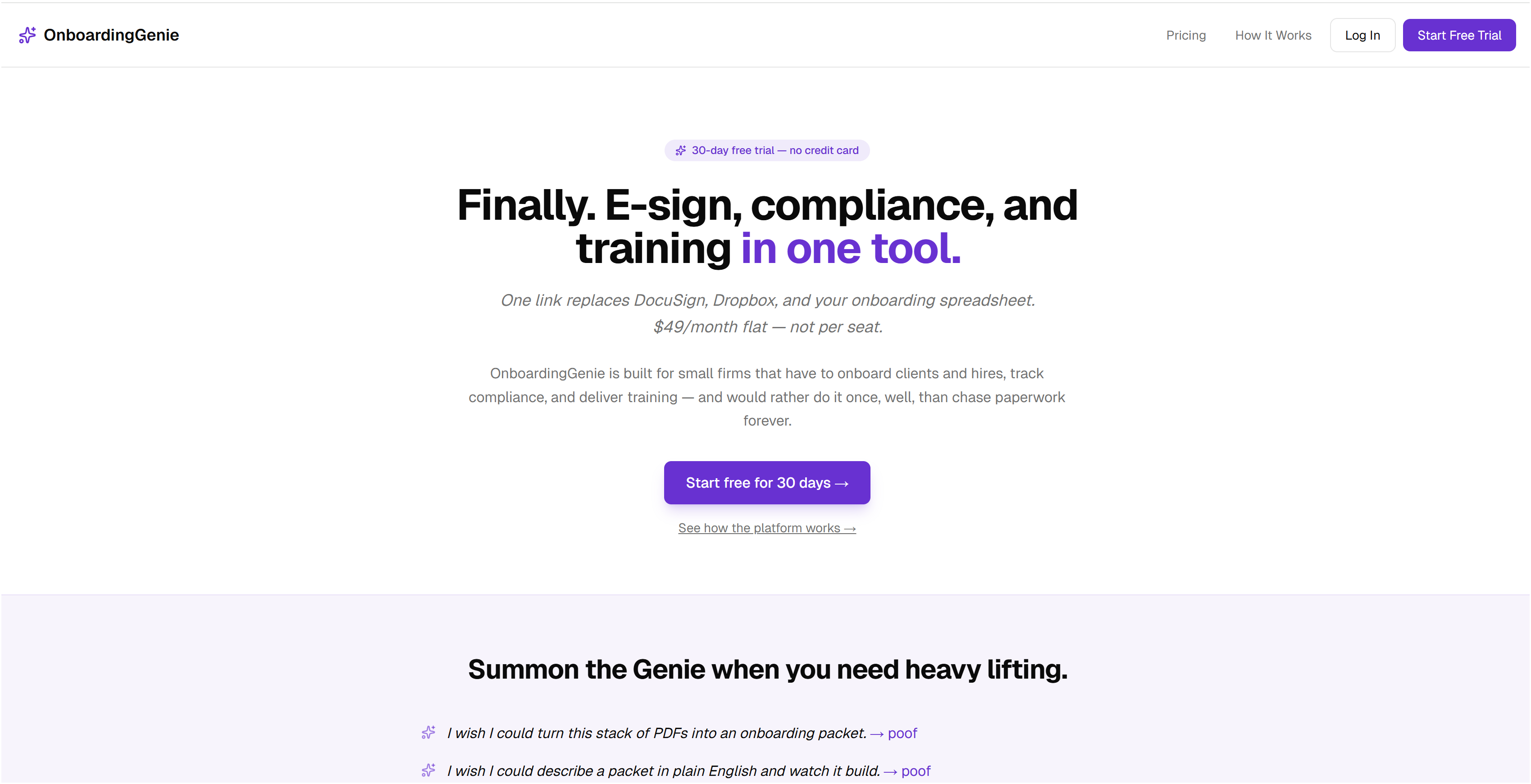
OnboardingGenie consolidates your compliance and training workflows into a single branded portal where employees complete acknowledgments, managers confirm training milestones, and HR retains timestamped records without chasing anyone down. The platform is built specifically for small professional service firms that need audit-ready documentation without the cost or complexity of enterprise HR software. Every checklist item, from OSHA attestations to role-specific onboarding steps, lives in one place with a clear completion status. See how it works for your firm.
FAQ
What must an HR training program checklist include?
An HR training program checklist must include federal compliance categories (OSHA, EEOC, HIPAA where applicable, FLSA, ADA), state-specific training requirements by work location, role-based onboarding milestones, and documented confirmation steps for each item.
How often should a training needs analysis be conducted?
Training needs assessments should be conducted annually and whenever a major change occurs, such as a regulatory update, new software adoption, or significant changes in staff composition.
What is the Kirkpatrick Model and why does it matter?
The Kirkpatrick Model is the industry-standard framework for evaluating training programs across four levels: Reaction, Learning, Behavior, and Results. It matters because it connects training activity to measurable performance outcomes rather than tracking completion alone.
Do frontline employees need a different training checklist?
Yes. Frontline and deskless employees require checklists that include manager sign-offs and timestamped logs because self-paced digital checkboxes alone do not provide sufficient confirmation of understanding or compliance.
How does a small firm with no dedicated L&D team manage training evaluation?
Small firms can apply Kirkpatrick Level 3 and Level 4 evaluation through quarterly performance reviews and structured manager feedback forms, without a dedicated learning and development function. The key is a consistent question set and a scheduled review cadence.