
TL;DR:
- Effective business compliance tracking is an ongoing process that involves documenting obligations, assigning ownership, and maintaining evidence to prove compliance. Small firms should develop a structured compliance register, link obligations to controls, and implement regular review cadences to prevent compliance drift. Purpose-built software enhances this process by providing automated alerts, reliable evidence management, and audit-ready traceability, ensuring ongoing regulatory adherence.
Most business owners first think about compliance when something goes wrong. A missed filing deadline, an audit request with no documentation to support it, an employee who completed a required training but left no record of it. What is business compliance tracking explained properly looks nothing like that reactive picture. It is a structured, ongoing practice of documenting your regulatory obligations, assigning ownership over each one, mapping controls to meet them, and maintaining evidence that proves you did. Get that foundation right, and audits become administrative rather than terrifying.
Key takeaways
| Point | Details |
|---|---|
| Compliance tracking is ongoing | It is a continuous monitoring process, not a one-time project or annual checkbox. |
| Obligations register is the foundation | Every firm needs a single list of regulatory requirements mapped to owners and controls. |
| Evidence trails determine audit success | Tracking obligations without linked evidence leaves you unable to prove compliance when it counts. |
| Manual tools create drift risk | Spreadsheets without scheduled reviews degrade quickly and produce no reliable audit trail. |
| Software integrates what spreadsheets cannot | Purpose-built tools connect obligations, controls, evidence, and alerts in one place. |
What business compliance tracking actually means
The formal term for this practice is compliance management, and compliance tracking is the operational layer within it. Specifically, it is the ongoing process of confirming that your company is following applicable laws, regulations, and internal policies, and keeping records that demonstrate that fact. The two parts matter equally. Doing the right thing is not enough if you cannot show an auditor or regulator that you did it.

For a 12-person consulting firm, the obligation list might include annual state business registration renewals, employee I-9 records, data privacy notice requirements under applicable state laws, and mandatory continuing education for licensed staff. For a 20-person law firm, add trust account reconciliation schedules, bar admission renewals, and client conflict-of-interest checks. Each of those obligations needs an owner, a control (the specific process that satisfies the requirement), and evidence (the document or system record proving the control was executed).
That structure, obligations mapped to controls and owners with supporting evidence, is the business compliance tracking definition most compliance professionals work from. It is also what distinguishes a functioning compliance program from a folder full of PDFs that nobody reviews.
Core components of a compliance management system
A compliance management system (CMS) centralizes all of this in one place: your regulatory obligations, the controls that address them, assigned ownership, and an audit trail of activity and changes. For small firms, that does not mean a sprawling enterprise platform. It means having a structured approach rather than scattered documents and ad hoc reminders.
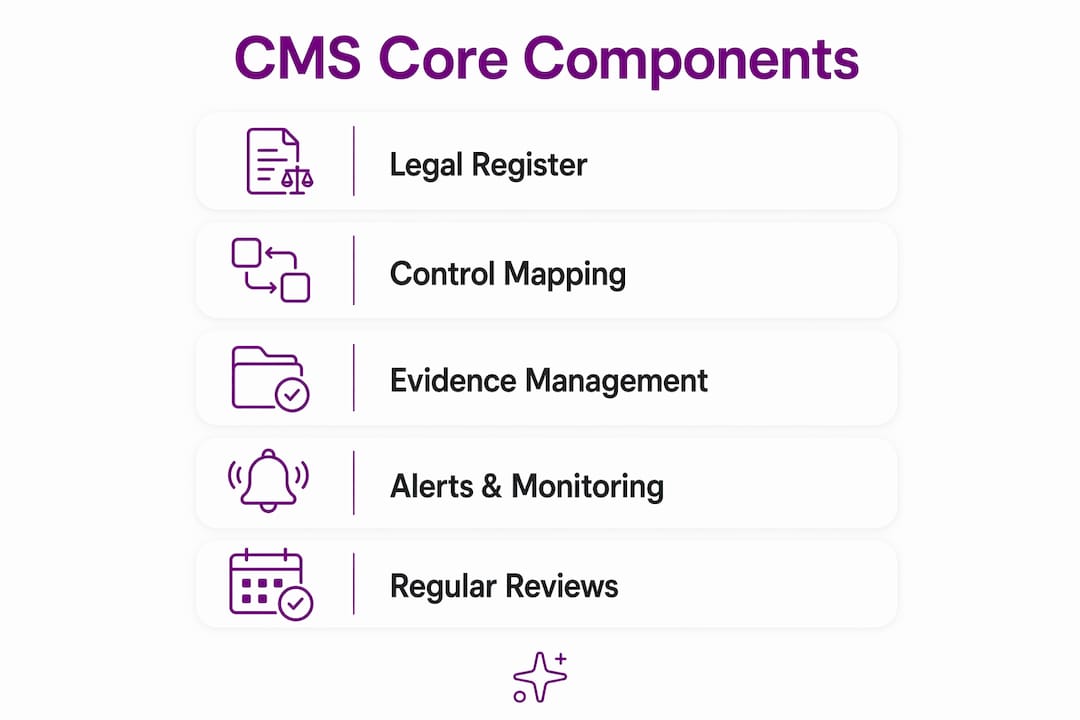
The foundational artifact is the legal compliance register. Think of it as your firm's master list of every regulatory requirement that applies to your operations. A legal compliance register serves one primary purpose: to maintain a single, audit-friendly record of obligations and the evidence that satisfies each one. Without it, compliance lives in people's heads, which is a serious operational risk whenever someone leaves or a role changes.
The next layer is control mapping. Each obligation gets linked to a specific process that addresses it. If the obligation is "file quarterly payroll tax returns," the control is "controller reviews payroll records and submits Form 941 by the applicable due date." That mapping tells you who is responsible, what they need to do, and when. Linking obligations to controls and assigning clear ownership is where accountability actually lives in a CMS.
Evidence management is where most small firms fall short. Completing the task is not enough. Someone needs to attach the filed form, the signed acknowledgment, the completed checklist, or whatever artifact confirms the control ran. The real bottleneck is building dependable evidence linking obligations, owners, and controls, because without that trail, teams cannot quickly prove compliance during inspections or audits.
Finally, a functional CMS includes alerts and monitoring cadence. Regulations change. Due dates shift. A CMS that does not surface those changes will fall behind quickly.
Pro Tip: Set a recurring calendar block, quarterly at minimum, to review each item in your compliance register for regulatory changes. The U.S. SBA notes that compliance monitoring must adapt as rules and operations change, so build the review time in before you need it.
Manual vs. software-assisted tracking
Understanding where manual approaches break down helps clarify what to look for in purpose-built tools. Here is a practical comparison for firms deciding how to approach their compliance setup.
| Factor | Manual (spreadsheets, folders) | Software-assisted |
|---|---|---|
| Audit trail | None by default; changes are invisible | Automatic, timestamped activity logs |
| Regulatory change alerts | Requires manual monitoring | Automated alerts for rule changes |
| Evidence linkage | Files stored separately, easily missed | Evidence attached directly to each obligation |
| Ownership visibility | Column in a spreadsheet, easy to ignore | Assigned roles with notification workflows |
| Scalability | Degrades as firm grows or regulations expand | Scales with regulatory complexity |
| Cost to maintain | Low upfront, high in staff time and error risk | Predictable subscription cost |
Small and mid-sized firms that start with spreadsheets are not wrong to do so, but spreadsheets create a specific failure mode called compliance drift. Nobody updates the register when a regulation changes. Completed tasks go undocumented. A key person leaves and takes institutional knowledge with them. The spreadsheet becomes a historical artifact rather than a live tracking tool.
Software solves this by automating audits, incident tracking, and training acknowledgments while keeping everything linkable and traceable. When evaluating tools, prioritize these features:
- Change alerts tied to specific regulatory sources
- Evidence attachment at the obligation or control level
- Role-based ownership with notification on due dates
- Audit trail showing who did what and when
- Workflow automation for recurring tasks like annual reviews
Tools that lack these features, regardless of their marketing, will reproduce the same gaps that spreadsheets create. The difference is that you'll have paid more for them.
Implementing compliance tracking in your firm
You do not need to build a perfect system in week one. Most successful compliance programs in small firms are built incrementally, starting with the highest-risk obligations and expanding from there.
-
Identify your applicable regulations. Start by listing every external regulatory requirement that applies to your firm: federal, state, and local filing obligations, licensing requirements, employment law mandates, and any industry-specific rules. A 14-person accounting firm in California, for example, would include quarterly estimated tax filings, PTIN renewals, CPE tracking, and Cal/OSHA record-keeping alongside general business requirements.
-
Add internal policies. Compliance programs should map regulations to specific controls and schedule annual reviews. That scope includes your internal policies too: conflict-of-interest checks, data retention schedules, client privacy notices, and mandatory training completion.
-
Build your compliance register. Consolidate your obligation list into a single reference document or system. For each item, record the regulatory source, the due date or frequency, the assigned owner, and the control that satisfies it.
-
Attach evidence systematically. Decide upfront what constitutes acceptable evidence for each obligation: a filed form, a signed attestation, a system screenshot, a training completion certificate. Attach that evidence at the point of completion, not weeks later.
-
Set your monitoring cadence. Monthly reviews for high-frequency obligations, quarterly reviews for mid-tier items, and annual governance reviews for the full register. Periodic governance reviews maintain agility as laws and internal policies evolve.
-
Use a platform that connects these layers. Whether you choose a dedicated compliance tool or a broader practice management platform, the system needs to link obligations, owners, controls, and evidence in one place. Read the case of how one small law firm stopped managing this in a spreadsheet for a realistic picture of what that transition looks like.
Pro Tip: Do not assign compliance ownership to a job title. Assign it to a named person. When someone leaves and their title gets absorbed into another role, title-based ownership silently disappears from your register.
How monitoring and auditing work together
Ongoing monitoring and independent audits are not the same thing, and treating them as interchangeable is a common source of compliance gaps. Monitoring reviews daily operations; audits review compliance independently for governance purposes. Both are necessary, and they feed each other.
Day-to-day monitoring means your team is confirming that controls are running on schedule, evidence is being collected, and no obligations have slipped past a due date. This is operational compliance assurance. It does not require an outside party. It requires discipline, good tooling, and someone accountable for maintaining the register.
Independent audits work at a governance level. They verify that your monitoring program itself is working, not just that individual tasks got completed. A compliance audit will typically cover:
- Scope confirmation: which regulations and internal policies were in scope
- Transaction sampling: reviewing a subset of evidence to confirm controls operated as documented
- Findings and gaps: identified instances where controls failed or evidence was missing
- Corrective action plans: documented timelines and owners for remediating gaps
"Audits provide scope, findings, transaction sampling, and corrective action plans to leadership. Internal monitoring and independent audits complement each other for robust compliance." — Holland & Knight
The connection between the two is your compliance register and evidence trail. Auditors work faster and find fewer gaps when your evidence is organized, linked to obligations, and time-stamped. The firms that struggle in audits are usually the ones whose records exist but are scattered across email threads, shared drives, and individual hard drives. The ongoing compliance work after initial onboarding is where that organizational habit either holds or breaks down.
My honest take on where small firms go wrong
I have spent years building compliance tools specifically for firms like yours, and the pattern I see most often is this: a firm sets up a compliance register, feels good about it for about three months, and then quietly stops maintaining it. Not out of negligence, but because no one built in the review cadence and no one owns the overall system.
The second failure is treating evidence as optional. I have talked to firm managers who could describe every compliance control their firm runs but could not produce a single document to prove any of them operated. That gap turns a clean compliance program into a liability the moment an auditor asks for documentation.
What actually works is connecting three things: a live obligations register, named ownership, and required evidence attached at completion. Every time I see a firm where compliance is genuinely working, those three elements are present and someone reviews the register at a fixed schedule. The uncomfortable truth is that business regulatory compliance is not a project with a finish line. It is an ongoing operating discipline, and the firms that treat it that way stop dreading audits and start passing them.
— Chris
How OnboardingGenie supports compliance tracking for small firms
If you manage compliance across a small professional services firm, the challenge is less about understanding what to track and more about having a system that makes it practical to do consistently.
OnboardingGenie is built specifically for firms in that position. The platform connects obligations tracking, evidence collection, and training acknowledgments in a single portal rather than spreading them across separate tools. When a staff member completes a required training, the completion is logged automatically and linked to the relevant obligation in your compliance register. When a client attestation is needed, it goes out as part of a structured workflow with signature capture and a timestamped record. No separate PDF. No email chase.
The compliance management tools inside OnboardingGenie are designed for firms with 5 to 50 people who need structure without enterprise pricing. You get a centralized register, control mapping, evidence attachment, and deadline alerts on a flat monthly fee that does not scale against headcount or document volume. For professional services firms that have outgrown spreadsheets but cannot justify a six-figure compliance platform, that makes the operational case straightforward.
FAQ
What is the difference between compliance tracking and compliance management?
Compliance management is the overall program covering policies, controls, and governance. Compliance tracking is the operational layer within it, focused on confirming that specific obligations are being met and that evidence exists to prove it.
What does a compliance register include?
A compliance register lists each regulatory or internal obligation, the applicable law or policy source, the due date or frequency, the assigned owner, the control that addresses it, and the evidence document that confirms the control ran.
Can small firms use spreadsheets for compliance tracking?
Spreadsheets can work as a starting point, but they create compliance drift without scheduled reviews and do not produce the audit trails that regulators expect. Most firms outgrow them faster than expected.
How often should a compliance register be reviewed?
High-frequency obligations should be reviewed monthly, mid-tier items quarterly, and the full register at least annually. Annual governance reviews of controls and policies keep programs current as regulations change.
What makes compliance software worth the cost for a small firm?
Purpose-built tools provide audit-ready traceability by linking obligations, controls, owners, and evidence with timestamps. That traceability is what spreadsheets cannot replicate, and it is exactly what auditors look for.