
TL;DR:
- Manual compliance tracking with spreadsheets often leads to errors and gaps that threaten regulatory adherence. Centralized and automated systems significantly reduce missed deadlines, improve accountability, and provide continuous, audit-ready evidence. Implementing proper compliance management turns it into a strategic asset that enhances firm reputation and operational resilience.
Compliance tracking often gets filed under "administrative burden" at accounting firms, right next to renewing software licenses and updating the employee handbook. That framing is expensive. When you miss a regulatory deadline, fail to document a control, or walk into an audit without evidence of ongoing oversight, the consequences reach far beyond inconvenience. Understanding why accounting firms need compliance tracking, and what happens without it, is the starting point for protecting your firm's reputation, finances, and client relationships.
Table of Contents
- Key takeaways
- What compliance requirements accounting firms must track
- Why manual compliance tracking fails accounting firms
- Benefits of centralized and automated compliance tracking
- Linking compliance tracking to risk, IT controls, and vendors
- How to build or improve compliance tracking at your firm
- My take on compliance tracking as a strategic asset
- How Onboardinggenie helps your firm track compliance
- FAQ
Key takeaways
| Point | Details |
|---|---|
| Penalties are severe and specific | The FTC Safeguards Rule carries penalties up to $46,517 per violation per day for non-compliant firms. |
| Spreadsheets are not a compliance system | 94% of spreadsheets contain material errors, making them unreliable for audit-ready documentation. |
| Automation cuts missed deadlines significantly | Centralized tracking with automated reminders reduces compliance-related delays by up to 50% versus manual processes. |
| Compliance must be continuous, not periodic | Auditors expect evidence of controls operating throughout an observation period, not just at the moment of review. |
| Small firms are not exempt | No size threshold exempts an accounting firm from maintaining a Written Information Security Plan and core Safeguards Rule obligations. |
What compliance requirements accounting firms must track
Accounting firms handle some of the most sensitive financial data in the country. That reality puts them squarely in the crosshairs of regulators, and the rulebook is more specific than most partners realize.
The FTC Safeguards Rule applies directly to tax preparers and accounting firms that receive consumer financial information. It requires firms to implement a written information security program, conduct regular risk assessments, oversee service providers contractually, and notify regulators within 30 days of a security breach affecting 500 or more consumers. The penalty exposure here reaches $46,517 per violation per day. That is not a rounding error.
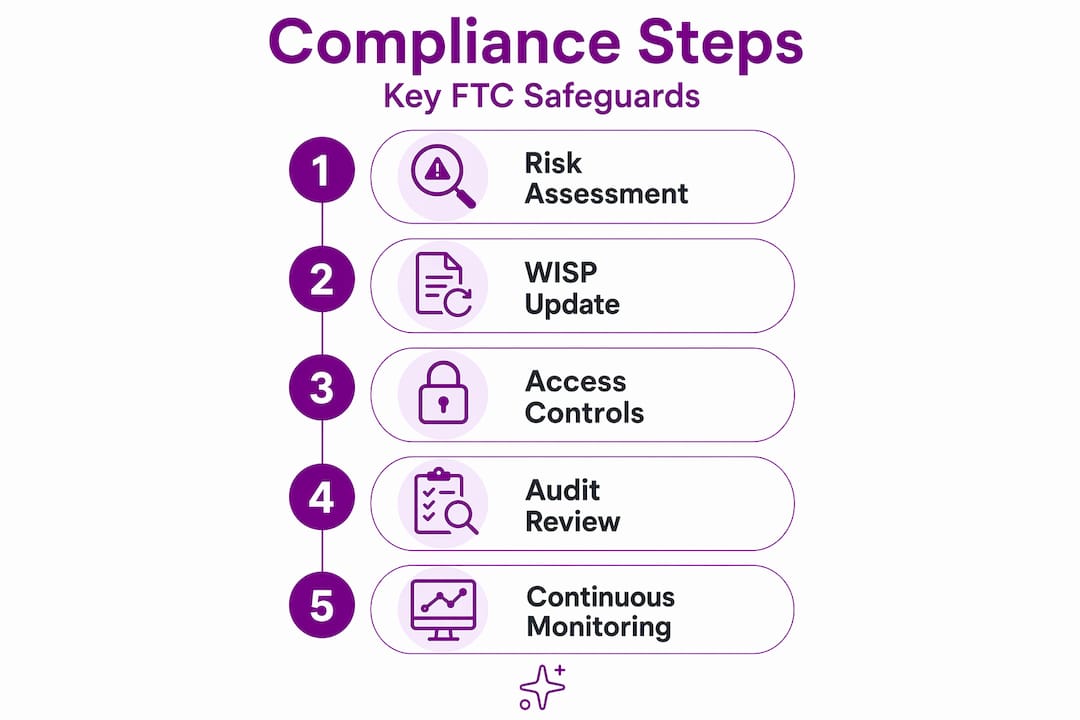
Alongside the Safeguards Rule, IRS Publication 4557 lays out data security guidance specifically for tax professionals, including the requirement to maintain a Written Information Security Plan, known as a WISP. The WISP must document how the firm identifies risks, what controls are in place, how staff are trained, and how incidents are handled. It is a living document, not a one-time exercise. Even small firms are not exempt from these obligations, a misconception that catches many sole practitioners and small partnerships off guard.
Here is what firms must actively track across these frameworks:
- WISP review and update cycles (at least annually, or after material changes)
- Staff security training completion and attestation records
- Vendor and service provider contract reviews confirming appropriate data handling clauses
- Multi-factor authentication status across firm systems
- Incident response plan testing and documentation
- Risk assessment completion dates and findings
Missing any of these is not a technicality. It is a documented gap that surfaces immediately when regulators or auditors come looking.
Why manual compliance tracking fails accounting firms
Most small accounting firms track compliance the same way they tracked their first client list: a spreadsheet, maybe a shared folder, and collective memory. That approach worked when the regulatory environment was simpler. It does not work now.

94% of spreadsheets used for business decision-making contain material errors. When those spreadsheets are your compliance record, a missed formula or overwritten cell can mean you have no documentation of a control that was actually operating. Auditors do not accept "we did it, we just didn't record it." As one audit framework makes clear, firms most often fail audits not because controls were absent but because documentation of the control lifecycle was never maintained.
Employee turnover makes this worse. When the person managing the compliance tracker leaves, their institutional knowledge walks out with them. A new hire inherits a spreadsheet with no context, no version history, and no explanation of what "done" means for each item. The firm operates with a false sense of coverage.
"The real compliance crisis is not technology. It is poor governance over data, processes, and discipline." — Forbes
Remote and distributed teams compound the problem further. Scattered environments make it genuinely difficult to confirm who completed training, who reviewed a policy, and whether a vendor contract was renewed on schedule. No one is lying. The system just has no mechanism to surface the gap until an auditor asks the question.
The accounting firm compliance challenge here is not motivation. Most partners care about doing things right. The problem is that manual systems are structurally incapable of providing the visibility, accountability, or audit trail that regulators now expect.
For a concrete example of what this looks like in practice, a 14-person law firm running compliance in a spreadsheet found that three renewal deadlines had been missed across a 12-month period, none of which anyone had noticed until an internal review. The situations that allow accounting firms to fall into the same pattern are identical.
Benefits of centralized and automated compliance tracking
Shifting from manual to centralized compliance tracking is not about adding complexity. It is about replacing invisible risk with visible control. The operational and regulatory benefits of compliance tracking, done well, are concrete.
- Fewer missed deadlines. Automated regulatory tracking cuts compliance-related delays by up to 50% compared to manual processes. Deadline-aware reminders that escalate automatically when not acknowledged are what make this possible.
- Clear ownership. Role-based reminder structures assign accountability at the task level and escalate unacknowledged alerts to supervisors. When everyone knows who owns what, renewal rates improve and gaps close faster.
- Audit-ready evidence at all times. Continuous evidence collection reduces audit preparation burden by 60 to 80% compared to manual collection. When your compliance record is built into daily workflows, you walk into any audit with documentation already organized.
- Stronger client and bank relationships. Strong internal controls and documented compliance posture reduce perceived risk to banks and clients alike, which matters during onboarding approvals and credit reviews.
- Reduced total cost of compliance. Organizations without strong compliance programs pay 2.7 times more in related costs. $14.82 million annually versus $5.47 million is a gap that scales down meaningfully even for smaller firms.
Here is how manual tracking compares to centralized tracking across key metrics:
| Metric | Manual tracking | Centralized tracking |
|---|---|---|
| Missed deadline rate | High (no automated alerts) | Low (escalating reminders) |
| Audit preparation time | 200 to 400 hours per cycle | Reduced by 60 to 80% |
| Ownership clarity | Depends on individual memory | Role-assigned, documented |
| Evidence availability | Assembled at audit time | Continuously collected |
| Turnover impact | Knowledge loss is immediate | Records persist and transfer |
Pro Tip: Don't wait for an audit to find out what your compliance record looks like. Run an internal review against your WISP requirements and FTC Safeguards Rule checklist at least twice a year. You will find gaps that look minor on paper but significant in front of an auditor.
Linking compliance tracking to risk, IT controls, and vendors
Effective compliance tracking for accounting firms does not stop at deadline management. It connects to the full operational and technical environment the firm runs on.
The FTC Safeguards Rule is explicit: firms must assess risks across all areas where customer information is received, stored, processed, or transmitted. That means your compliance tracking program needs to map obligations to specific data sets, workflows, and systems. If your firm uses cloud storage for client tax files, that vendor relationship is a compliance element. Failing to maintain vendor oversight contracts is one of the most common and preventable compliance gaps in accounting firms.
IT controls are compliance controls. Multi-factor authentication, encryption at rest, and access logging are not IT department concerns in isolation. They are documented requirements under the Safeguards Rule, and their status needs to appear in your compliance tracking system alongside training records and policy reviews.
Continuous compliance monitoring, which means building review cycles into operational workflows rather than treating compliance as a quarterly event, is becoming the industry standard over reactive, audit-driven approaches. Firms that operate this way respond faster when regulations change and avoid the scramble that comes with surprise reviews.
The table below shows where compliance obligations connect to operational areas most accounting firms already manage:
| Compliance obligation | Operational area | Tracking element |
|---|---|---|
| WISP maintenance | IT and operations | Annual review date, version log |
| Staff training | HR and people ops | Completion records, attestations |
| Vendor contracts | Procurement and finance | Renewal dates, contract terms |
| MFA and access controls | IT security | Implementation status, audit logs |
| Risk assessments | Management | Assessment dates, findings documented |
| Incident response testing | IT and operations | Test dates, outcomes recorded |
How to build or improve compliance tracking at your firm
Knowing the importance of compliance tracking is one thing. Getting it working inside a real firm, with real constraints, is another. Here is a practical path forward.
- Assess your current compliance gaps. Pull every regulatory obligation your firm carries, including FTC Safeguards Rule, IRS WISP requirements, and any state-level data protection rules. Map what you have documented versus what is just assumed.
- Assign a compliance lead. The Safeguards Rule requires a Qualified Individual to oversee the information security program. That person needs authority, not just a title. Small firms often designate a managing partner or senior operations lead.
- Select a tool that centralizes tracking. Choose a platform that consolidates reminders, document storage, training records, and task ownership in one place. Integrating compliance and training management is the difference between fragmented records and a defensible compliance posture.
- Create and maintain a living WISP. Your WISP should be updated whenever the firm adds a new vendor, changes IT infrastructure, hires significantly, or experiences a security incident. Date-stamp every revision. Treat it as a working document, not an annual filing.
- Train staff and document it. Training that is not recorded did not happen from a regulatory standpoint. Staff need to complete security awareness training at least annually, and those completion records need to be stored and accessible.
- Schedule regular compliance reviews. Firms that treat compliance as ongoing discipline, rather than periodic exercises, avoid crises and respond faster to regulatory changes. Build quarterly check-ins into the calendar as standing items, not optional meetings.
Pro Tip: When you assign compliance tasks, include a clear definition of what "complete" looks like before the task goes live. Vague assignments generate vague records. An auditor asking for evidence of a vendor review needs a dated document, not a team member's recollection.
For guidance on how to approach compliance documentation at the task level, particularly for firms that are formalizing their programs for the first time, a structured guide tailored to small professional service firms can save significant setup time.
My take on compliance tracking as a strategic asset
I built OnboardingGenie because I kept watching small professional service firms, including accounting firms, treat compliance as something you deal with when forced to. You handle it because an audit is coming, or because a client asked a pointed question about your data security practices. That reactive posture is exhausting and, frankly, avoidable.
What I've seen consistently is that the firms doing well with compliance are not the ones with the biggest budgets or the most sophisticated tools. They are the ones that made compliance part of how they operate daily, not a separate track they jump onto when something goes wrong. One firm I worked with, a seven-person CPA practice, had been managing their WISP documentation in a shared drive with no clear owner and no renewal tracking. When a prospective enterprise client asked for their security documentation as part of onboarding, it took three days and two late nights to pull together something defensible. That is time that should never have been spent in that mode.
The shift I've seen matter most is from audit-driven compliance to continuous monitoring. When you track obligations daily and assign them to specific people with clear deadlines, compliance stops feeling like a fire drill. You walk into client conversations with confidence. Banks and regulators see organized documentation and move faster. That is a competitive advantage, not just a risk reduction measure.
The firms that get this right also find that their internal culture around accountability improves. When people see that compliance tasks are tracked, visible, and followed up on, they take them more seriously. That discipline compounds over time.
— Chris
How Onboardinggenie helps your firm track compliance
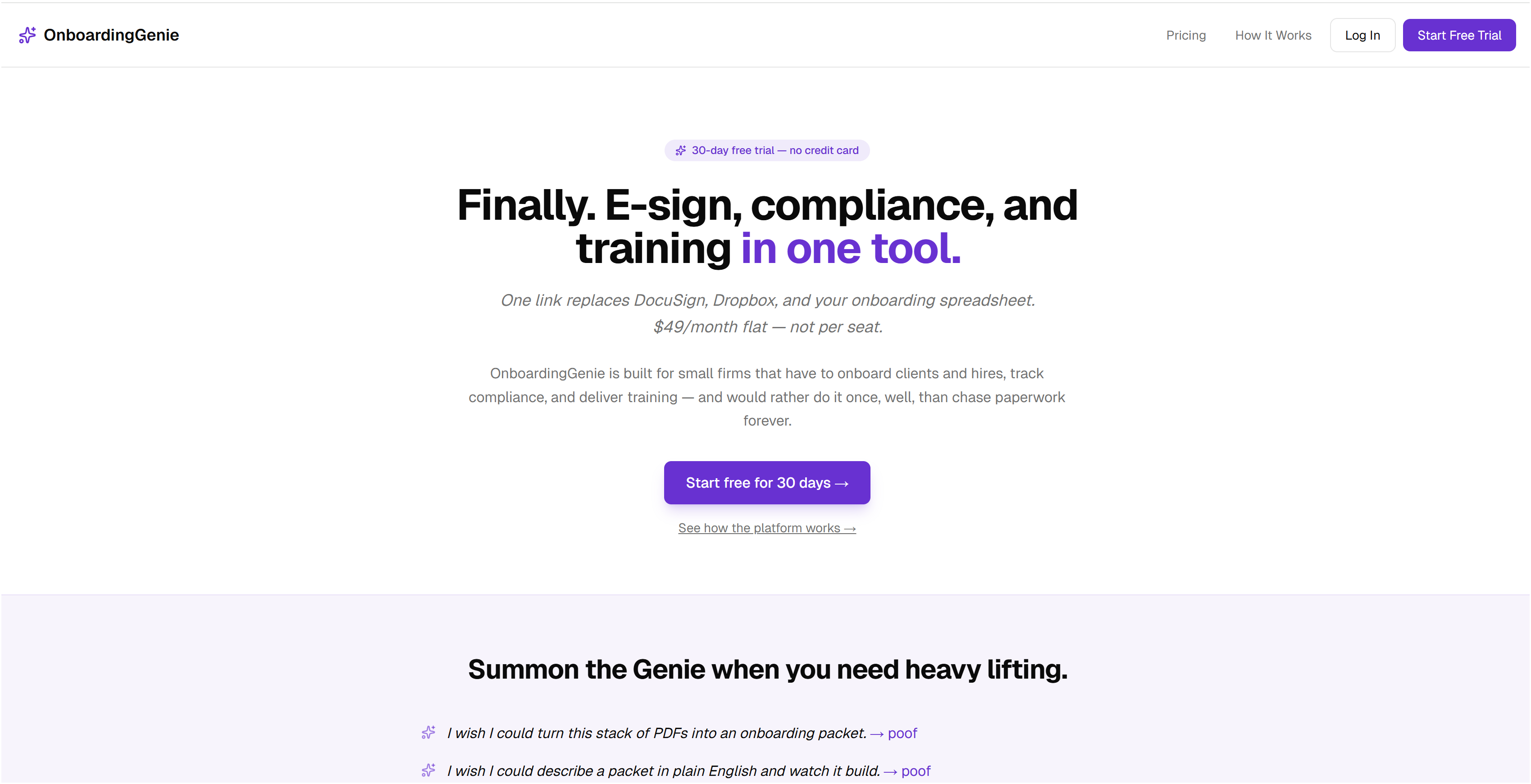
Onboardinggenie was built specifically for small professional service firms that need real compliance control without enterprise pricing or complexity. For accounting firms managing FTC Safeguards Rule obligations, IRS WISP requirements, and staff training records, the platform centralizes everything in one place: task ownership, deadline reminders, document storage, and training completions.
You can assign compliance items to specific team members, set escalating reminders so nothing falls through, and generate an audit-ready record at any point. Training and compliance tracking sit in the same system, which means your staff attestations and policy acknowledgments are documented alongside the controls they support.
If your firm is ready to replace disconnected spreadsheets and shared folders with a purpose-built compliance management system, Onboardinggenie offers a flat monthly fee with no hidden costs. You can start free today and have your first compliance workflow running within the hour.
FAQ
What is the FTC Safeguards Rule for accounting firms?
The FTC Safeguards Rule requires accounting and tax preparation firms to implement a written information security program, conduct risk assessments, oversee vendors contractually, and report qualifying breaches within 30 days. Penalties for violations can reach $46,517 per violation per day.
Why is spreadsheet-based compliance tracking risky?
Research shows that 94% of spreadsheets contain material errors. For compliance purposes, this means your documentation may show controls as complete when they were missed, or miss entries entirely, leaving you without defensible evidence during an audit.
How often should an accounting firm update its WISP?
A firm's Written Information Security Plan should be reviewed at least annually and updated whenever material changes occur, such as adding a new vendor, changing IT infrastructure, or experiencing a security incident. Every revision should be date-stamped and retained.
Do small accounting firms need to comply with the Safeguards Rule?
Yes. There is no size exemption. Even sole practitioners and small partnerships that handle consumer financial information are required to maintain a WISP and meet core Safeguards Rule obligations under FTC guidelines.
How does automated compliance tracking reduce audit risk?
Centralized tracking builds a continuous evidence record throughout the year rather than assembling documentation only when an audit is triggered. This approach reduces audit preparation time by 60 to 80% and ensures auditors see evidence of controls operating over time, not just at the moment of review.
Recommended
- How a 14-Person Law Firm Stopped Managing Annual Compliance in a Spreadsheet — OnboardingGenie
- Training Once Is Not Enough. I Learned That Before I Wrote a Line of Code. — OnboardingGenie
- Onboarding Ends on Day One. Compliance Doesn't. Here's Why They Need the Same Tool. — OnboardingGenie
- Ongoing Compliance for Small Firms: What Happens After the Onboarding Is Done — OnboardingGenie