
TL;DR:
- A structured onboarding checklist is essential for accounting firms to ensure compliance, role-specific training, and system mastery within a 90-day framework. Building role-based pathways, embedding training into workflows, and assigning clear ownership reduce errors and accelerate competency. Implementing a centralized platform like OnboardingGenie enhances visibility, control, and continuous improvement of the onboarding process.
An accounting firm training process checklist is a structured sequence of onboarding steps that moves a new hire from orientation through systems mastery, compliance verification, and role-specific competency within a defined timeframe. The industry term for this framework is a structured onboarding program, and the checklist is its operational backbone. Standardized checklists improve team cohesion and productivity by setting clear expectations from day one. Without one, firms lose weeks to repeated questions, inconsistent training, and payroll errors that surface at the worst possible moment. This guide covers every component your accounting staff onboarding checklist needs, from W-4 collection to workflow-integrated learning.

1. What to include in an accounting firm training process checklist
Every effective accounting firm training process checklist covers six distinct categories: orientation and culture, role responsibilities, systems and tools, compliance and ethics, standard operating procedures, and measurable milestones. Skipping any one of these creates gaps that show up later as rework, missed deadlines, or compliance exposure.
Orientation and culture immersion sets the tone. New hires need to understand the firm's service model, client communication standards, and internal hierarchy before they touch a single file. A pre-loaded first-week schedule signals that the firm values the employee's time and is organizationally ready. Careful pre-loading of the first week communicates organizational readiness and respects the new hire's time.
Systems and tools mastery is where most firms underinvest. New hires need documented walkthroughs of every platform they will use daily, whether that is QuickBooks, Sage Intacct, Microsoft Excel, or a business intelligence tool like Power BI. Expecting staff to figure out firm-specific configurations on their own adds weeks to the learning curve.
Compliance and ethics training is non-negotiable. This includes AICPA Code of Professional Conduct attestation, data privacy policies, and any state-specific CPA licensing requirements. Document completion of each item with a signature or digital attestation so you have an audit trail.
Pro Tip: Build your checklist around a 30-60-90 day milestone framework. At day 30, the hire should understand all systems. At day 60, they apply them independently. At day 90, they own their assigned workflows. Structured 30-60-90 day plans clarify expectations and accelerate competence in measurable, trackable stages.
- Firm culture, values, and service standards overview
- IT setup: email, VPN, file access, and software licenses
- Role-specific responsibilities and reporting lines
- Systems walkthroughs: ERP, Excel, tax software, document management
- AICPA ethics attestation and data privacy acknowledgment
- SOP library access and walkthrough assignments
- 30-60-90 day milestone definitions and assessment criteria
2. How to structure a role-based training program for different accounting positions
Generic training programs fail accounting firms because a junior accountant, a payroll specialist, and a client services manager need entirely different competencies on day one. Role-based training pathways improve measurable growth by tailoring training to specific job functions rather than applying a one-size-fits-all curriculum.
Here is how to structure role-specific tracks for three common positions:
-
Junior accountant. Focus the first two weeks on reconciliation procedures, chart of accounts structure, and the firm's month-end close checklist. Assign a senior accountant as a shadow mentor for the first five client files. Milestone: complete three supervised reconciliations with zero reopen flags by day 30.
-
Payroll specialist. Prioritize W-4, I-9, and state withholding form collection procedures in week one. Cover the firm's payroll software configuration, pay period schedules, and garnishment processing rules by week two. Milestone: process one full payroll cycle independently under review by day 45.
-
Client services manager. Begin with the firm's client intake process, engagement letter templates, and CRM workflow. Cover billing procedures, scope change protocols, and escalation paths by week three. Milestone: manage two client onboarding packets from intake to signed engagement by day 60.
The key distinction across all three tracks is that milestones are tied to actual work outputs, not just module completion. Shadowing and hands-on application in live workflows accelerate competence far faster than watching recorded training videos. A new hire who processes a real payroll run under supervision retains the procedure. One who watches a walkthrough video often does not.
For firms with fewer than 20 staff, cross-training is also worth building into the checklist. A payroll specialist who understands basic reconciliation procedures can cover gaps during peak season. Document these secondary competencies as optional milestones at the 90-day mark.
3. Best practices for integrating training into daily accounting workflows
Training that lives in a separate learning management system, disconnected from actual client work, produces staff who know the theory but stumble on the practice. Embedding training into daily workflows reduces rework and improves accuracy compared to isolated learning modules.
The most practical framework for this is the "Four Lanes" model, which organizes firm work into four sequential stages: intake, production, review, and delivery. Checklist gating in the Four Lanes framework keeps partners free from daily production while ensuring readiness and quality at each stage. A new hire cannot move a file from intake to production until they have completed the intake checklist items. They cannot submit work for review until the production checklist is signed off. This is not bureaucracy. It is quality control built directly into the workflow.
The comparison below shows the difference between isolated training and workflow-integrated training in practice:
| Training approach | How it works | Typical outcome |
|---|---|---|
| Isolated module | Staff complete training videos and quizzes separately from client work | Knowledge fades quickly; errors appear when applying skills under pressure |
| Workflow-integrated | Checklist gates require demonstrated competency before advancing a file | Skills are reinforced through repetition on real work; errors are caught at the gate |
Centralizing questions and approvals in a system rather than email reduces bottlenecks and surfaces process weaknesses through reopen rate tracking. When a new hire emails a question, it disappears into an inbox. When they log it in a centralized system, the firm can see which steps generate the most questions and fix the SOP accordingly.
Pro Tip: Track reopen rates by checklist item during the first 90 days of a new hire's tenure. A high reopen rate on a specific step is a signal that the SOP needs clarification, not that the employee is underperforming. This data turns your onboarding compliance tracking into a continuous improvement tool.
4. How to ensure compliance and accuracy during onboarding with checklist verification
Compliance verification is the step most firms rush, and it is the one that creates the most expensive problems. Missing data fields like SSN or state withholding forms cause errors before the first payroll run. A completeness check by day five prevents legal exposure and administrative friction that is far harder to unwind after the fact.
Your accounting staff onboarding checklist should include these compliance verification steps:
- HRIS profile completeness. Verify that all required fields are populated before the first payroll cycle: legal name, SSN, address, tax filing status, direct deposit details, and benefits elections. Proper HRIS setup is critical to avoid payroll errors and compliance penalties.
- Form collection. Collect and verify Form W-4 (federal withholding), Form I-9 (employment eligibility), and any applicable state withholding forms. Assign a named owner for each form's verification step so accountability is clear.
- Payroll setup audit. Run a completeness audit before the first pay period closes. Check pay rate, classification (exempt vs. non-exempt), pay frequency, and any deductions or garnishments.
- Audit trail documentation. Every completed checklist item should carry a timestamp and the name of the person who verified it. This is your defense in a Department of Labor audit or a state agency inquiry.
- Ethics and policy attestation. Collect signed acknowledgments for the employee handbook, data privacy policy, and AICPA ethics standards. Store these in a centralized location, not a shared drive folder that gets reorganized every tax season.
The ownership question matters more than most firms acknowledge. When "someone" is responsible for HRIS data accuracy, no one is. Assign a specific staff member, typically an office manager or HR coordinator, as the named owner of each compliance checklist category. That person's name goes on the checklist item. This single change reduces the rate of missed forms significantly in firms that implement it.
For firms managing payroll compliance across multiple states, the checklist needs a state-specific section that captures each state's withholding form requirements and any local tax registrations. Do not rely on memory or a generic template for this.
Key takeaways
A structured, role-based accounting firm training process checklist is the single most effective tool for reducing onboarding errors, accelerating competency, and maintaining compliance from day one.
| Point | Details |
|---|---|
| Start with compliance verification | Collect W-4, I-9, and state withholding forms and run an HRIS completeness check before the first payroll cycle. |
| Build role-specific tracks | Junior accountants, payroll specialists, and managers need different milestone sequences tied to actual work outputs. |
| Gate progress with checklists | Use the Four Lanes model to require checklist sign-off before a file advances between intake, production, review, and delivery. |
| Integrate training into workflows | Workflow-integrated training produces faster competency than isolated learning modules or recorded video libraries. |
| Assign named owners | Every compliance checklist item needs a specific person responsible for verification, not a shared team responsibility. |
Why most accounting firm training checklists fail before week three
Most training checklists I have seen at small accounting firms are either too generic or too ambitious. They list 40 items with no sequencing, no ownership, and no connection to actual client work. The new hire checks boxes. The manager assumes competency. The errors show up at month-end close.
The firms that get this right do one thing differently: they treat the checklist as a workflow gate, not a to-do list. When a checklist item is incomplete, work does not advance. That sounds strict, but it is actually a relief for everyone involved. The new hire knows exactly what is expected. The manager does not have to guess what was covered. The partner does not get pulled into production problems that should have been caught earlier.
I also think small firms underestimate the value of pre-loading the first week. Walking in on day one to a fully scheduled week, with named contacts, system access already provisioned, and a clear sequence of training steps, tells a new hire that this firm has its act together. That impression sticks. It affects how seriously they take the training, how quickly they engage with clients, and whether they stay past the first year.
The technology question comes up often. My honest view is that the tool matters less than the structure. A well-designed checklist in a centralized platform beats a chaotic process in an expensive enterprise system every time. Small firms do not need AI-driven learning paths. They need clear steps, named owners, and a place where completion is tracked and visible to the right people.
— Chris
How OnboardingGenie makes your training checklist actually work
Running a training program for accountants across disconnected PDFs, email threads, and shared drives creates exactly the kind of gaps this article describes. OnboardingGenie consolidates your training checklists, compliance forms, and attestation steps into a single branded portal that every new hire accesses through one link.
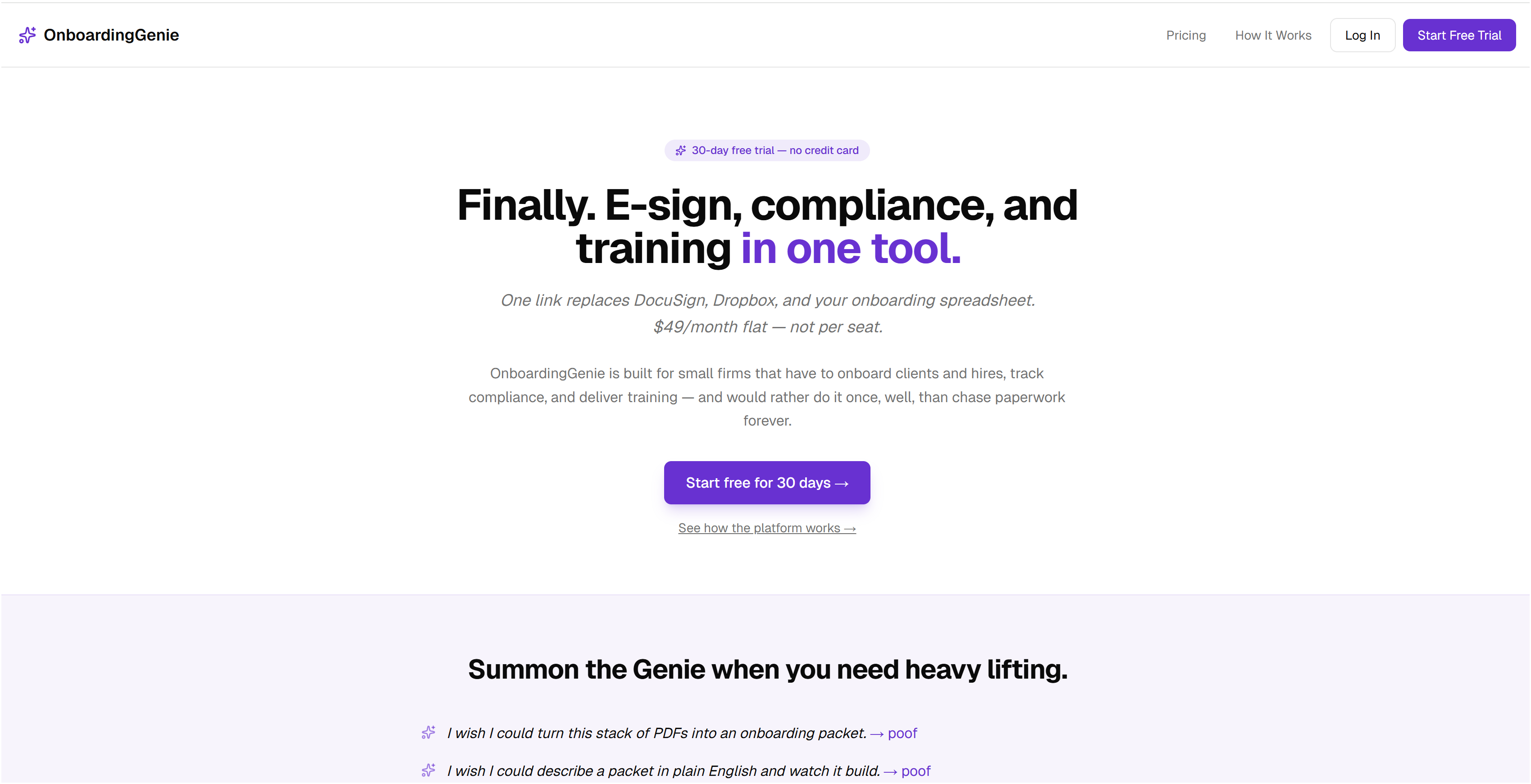
The platform is built specifically for small to mid-size professional service firms that need clarity and control without paying enterprise prices. You can build role-specific onboarding packets for junior accountants, payroll specialists, and managers, assign named owners to compliance steps, and track completion in a pipeline view that shows exactly where each hire stands. Signatures, forms, documents, and training materials live in one place. No more chasing W-4s over email or wondering whether the ethics attestation was collected. Explore employee training management built directly into your onboarding workflow.
FAQ
What should be on a new hire training checklist for an accounting firm?
An accounting firm new hire training checklist should cover orientation and culture, IT and systems setup, role-specific responsibilities, compliance form collection (W-4, I-9, state withholding), SOP walkthroughs, and 30-60-90 day milestones tied to actual work outputs.
How long should accounting firm onboarding take?
Most accounting firms structure onboarding across 90 days. The first 30 days cover systems and culture, days 31-60 focus on supervised application of skills, and days 61-90 transition the hire to independent ownership of their assigned workflows.
What is the difference between a checklist and an SOP in accounting firm training?
A checklist tracks task completion and gates progress between workflow stages. An SOP defines the specific steps and the definition of done for each task. Distinguishing checklists from SOPs improves training clarity and workflow quality in accounting firms.
Which compliance forms must be collected during accounting staff onboarding?
At minimum, collect Form W-4 (federal tax withholding), Form I-9 (employment eligibility verification), and any applicable state withholding forms. Run an HRIS completeness audit before the first payroll cycle to catch missing fields before they cause errors.
How do you tailor a training program for different accounting roles?
Assign each role a dedicated training track with milestones tied to specific work outputs. A junior accountant's 30-day milestone might be three supervised reconciliations. A payroll specialist's 45-day milestone might be one independently processed payroll cycle. Role-based training pathways produce measurable growth by matching training content to actual job functions.