
Choosing onboarding and compliance software that delivers predictable pricing without surprises and fits a small professional service firm's workflow is harder than most owners expect. Many solutions demand enterprise pricing, hide costs behind sales calls, or assume you need bulk automation and advanced features that smaller teams rarely use. This comparison details pricing, scope, and workflow fit across six onboarding and compliance platforms so you can pick one that matches your actual headcount and day to day oversight.
Table of Contents
OnboardingGenie
At a Glance
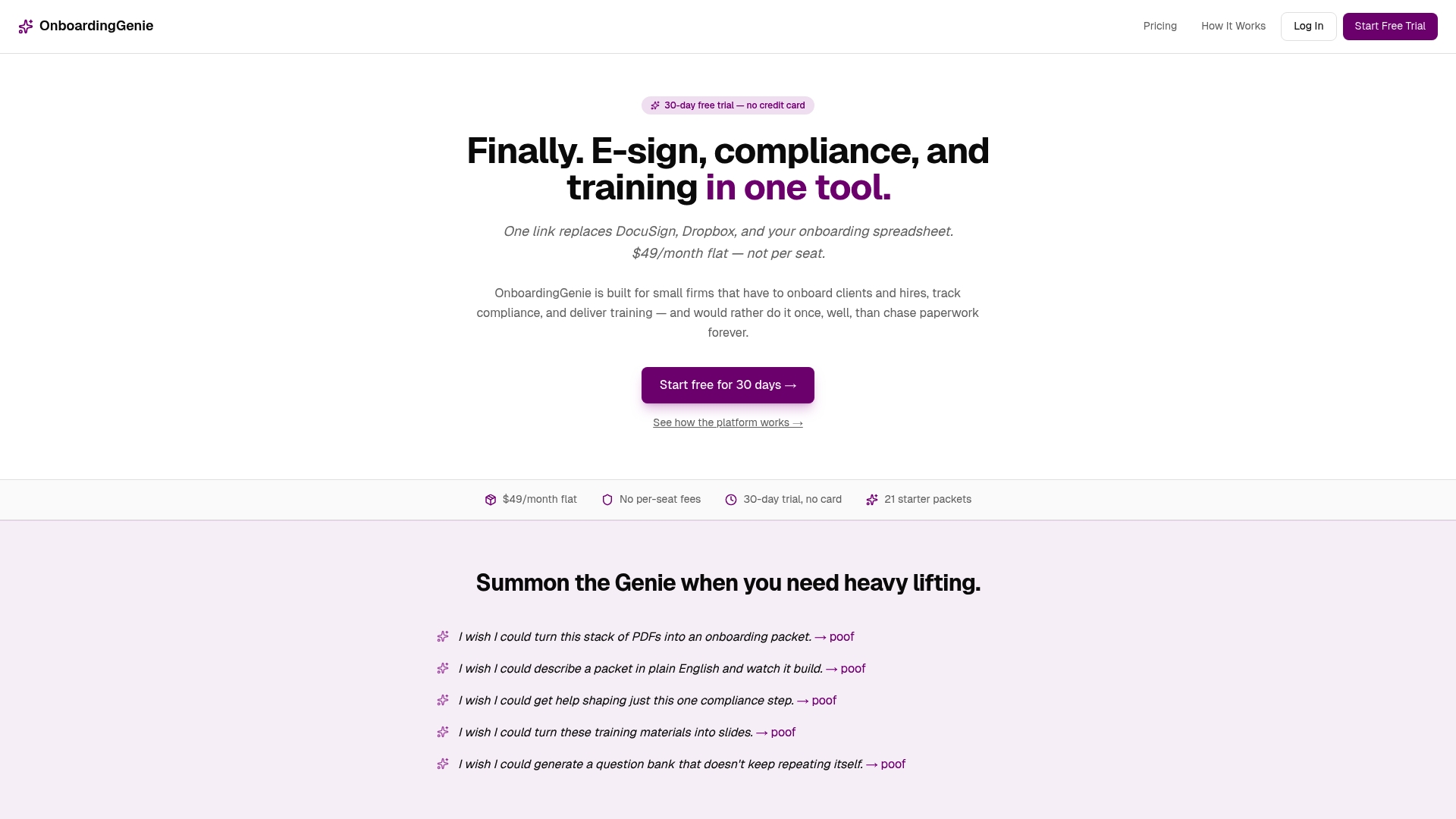
Flat $49/month with no per-seat or envelope fees and unlimited packets and recipients is the standout detail here. The product packages onboarding, compliance tracking, and training into a single subscription aimed at small firms.
Core Features
OnboardingGenie replaces multiple point tools with one branded portal and a single link for new hires or clients. It focuses on forms, signatures, document uploads, and basic training delivery.
- One branded link that consolidates signatures, uploads, forms, and training steps into a single access point.
- AI document import to convert existing PDFs into onboarding packets and extract structured fields like W-9 data.
- Training modules with slides, videos, quizzes, and completion certificates on Pro+ plans.
- Compliance dashboards for tracking renewals, certifications, and policy acknowledgments; unlimited packets and recipients included.
Key Differentiator
The product’s defining feature is the flat $49/month price with no per-seat or envelope fees, which makes per-hire budgeting predictable for small firms. That pricing removes per-user math from growth and simplifies vendor selection.
Pros
-
Affordable flat-rate. For firms under 50 employees the single monthly fee removes per-seat surprises during hiring spikes.
-
Replaces several tools. Moving signatures, file collection, and form data off email into one branded portal reduces administrative friction.
-
No envelope limits. Unlimited packets and recipients lets you run client and employee onboarding workflows without counting transactions.
-
Data-friendly exports. Structured export of form data such as W-9 fields helps hand off information to accounting or payroll systems.
-
Built for human oversight. The app favors clear workflows and human checkpoints over complex automation, which fits professional service firms that need accuracy.
Cons
- Some third-party reviews report limited support for advanced learning standards like SCORM and for multi-step learning paths, making the platform less suitable for complex corporate training programs.
Who It's For
Small businesses and professional service firms with 1–50 employees that want an affordable, all-in-one onboarding and compliance tool without per-user fees. Best for teams that prefer clear human-reviewed processes over heavy automation.
Unique Value Proposition
A single branded portal that replaces DocuSign, Dropbox, and spreadsheets for onboarding changes how an operation runs day to day. Instead of stitching emails and drives together, you hand people one link and get auditable records, forms, and certificates in one place.
Real World Use Case
A small legal practice uses OnboardingGenie to onboard clients and new staff. They replace email attachments and a signature tool with a single packet link, maintain auditable records, and track expirations for certifications and conflict checks.
Pricing
Flat $49/month with no per-seat fees and a 30-day free trial. The model is per-account rather than per-user, so growth by headcount does not change the monthly bill.
Website: https://onboardinggenie.com
Mitratech Syntrio
At a Glance
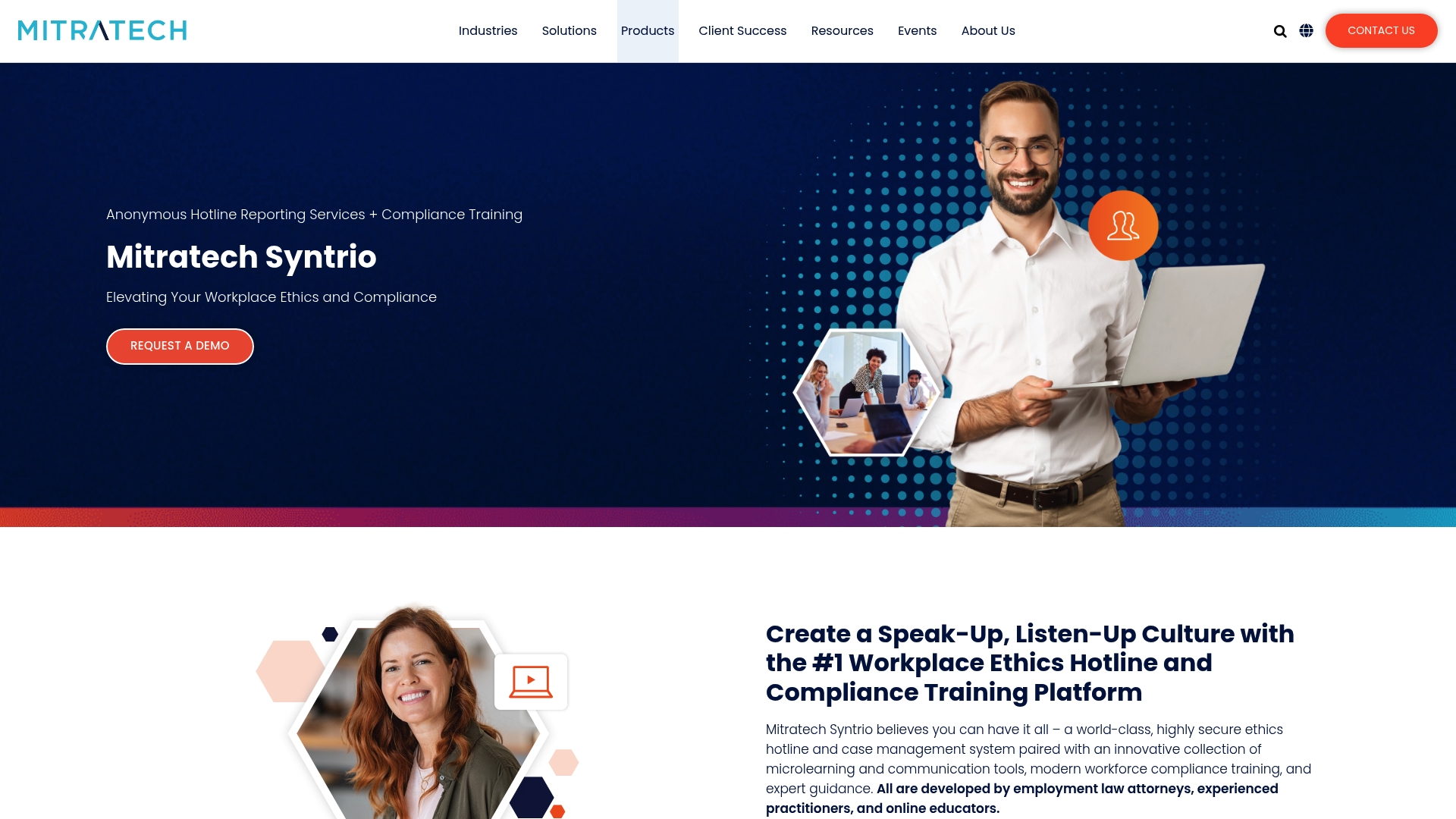
Mitratech Syntrio's marketing materials note multiple awards for its e-learning and compliance course offerings, a claim the vendor promotes when selling the training library.
The product pairs an anonymous hotline with training and case handling aimed at reinforcing a speak-up culture across mid to large organizations.
Core Features
The platform centers on complaint intake and follow up through an anonymous hotline and case management workflow that tracks reports from submission to resolution.
- Modern, customizable training libraries covering harassment, cybersecurity, DEI, ethics, and business skills.
- Microlearning modules and communications tools designed to encourage reporting and retention of key topics.
- Digital pulse surveys to measure program effectiveness and guide follow-up training.
Key Differentiator
The most distinct element is the packaged combination of secure reporting plus an extensive training library assembled by employment law and education specialists.
That mix is sold as a unified program rather than two separate point tools, which simplifies governance for compliance and HR teams managing both incidents and preventive education.
Pros
- The vendor advertises broad organizational adoption for its reporting and training, which supports an enterprise sales posture and established support processes.
- Customizable training lets you align lessons and policies to local laws and internal handbooks without rebuilding content from scratch.
- The anonymous intake plus tracked case workflow reduces the administrative friction of moving a report into investigation and resolution.
- Pulse surveys provide quantitative feedback so program managers can spot weak spots in training or policy uptake.
- Built with input from employment law attorneys and educators, the content aims to be legally informed and pedagogically sound.
Cons
- Public, third-party reviews specific to the Syntrio module are limited, which makes it harder to verify deployment experiences independently.
- Extensive customization options can lengthen implementation time and require more IT or project management overhead.
- The platform is positioned for larger organizations, so smaller firms may find the feature set and onboarding effort disproportionate to their needs.
When It May Not Fit
If your IT team is small and you want a plug-and-play product, Syntrio’s customization depth may lead to long rollouts and hidden project costs.
Also, the software depends on genuine organizational commitment to training and culture change; without leadership buy-in, features like pulse surveys and microlearning will not produce meaningful results.
Who It's For
Compliance and HR leaders at mid-sized to large organizations that need a secure, auditable speak-up channel and a library of adaptable training. Legal teams running global programs will appreciate the legal and instructional design input.
Real World Use Case
A multinational uses Syntrio to deliver harassment and discrimination training across jurisdictions while routing anonymous reports to a central investigation team. Local HR receives case summaries and uses pulse survey data to target refresher sessions in higher-risk regions.
Pricing
Pricing is not published. The vendor requires prospective customers to request a demo or a quote, consistent with enterprise licensing and implementation models.
Website: https://mitratech.com/products/syntrio
Iona.ai
At a Glance
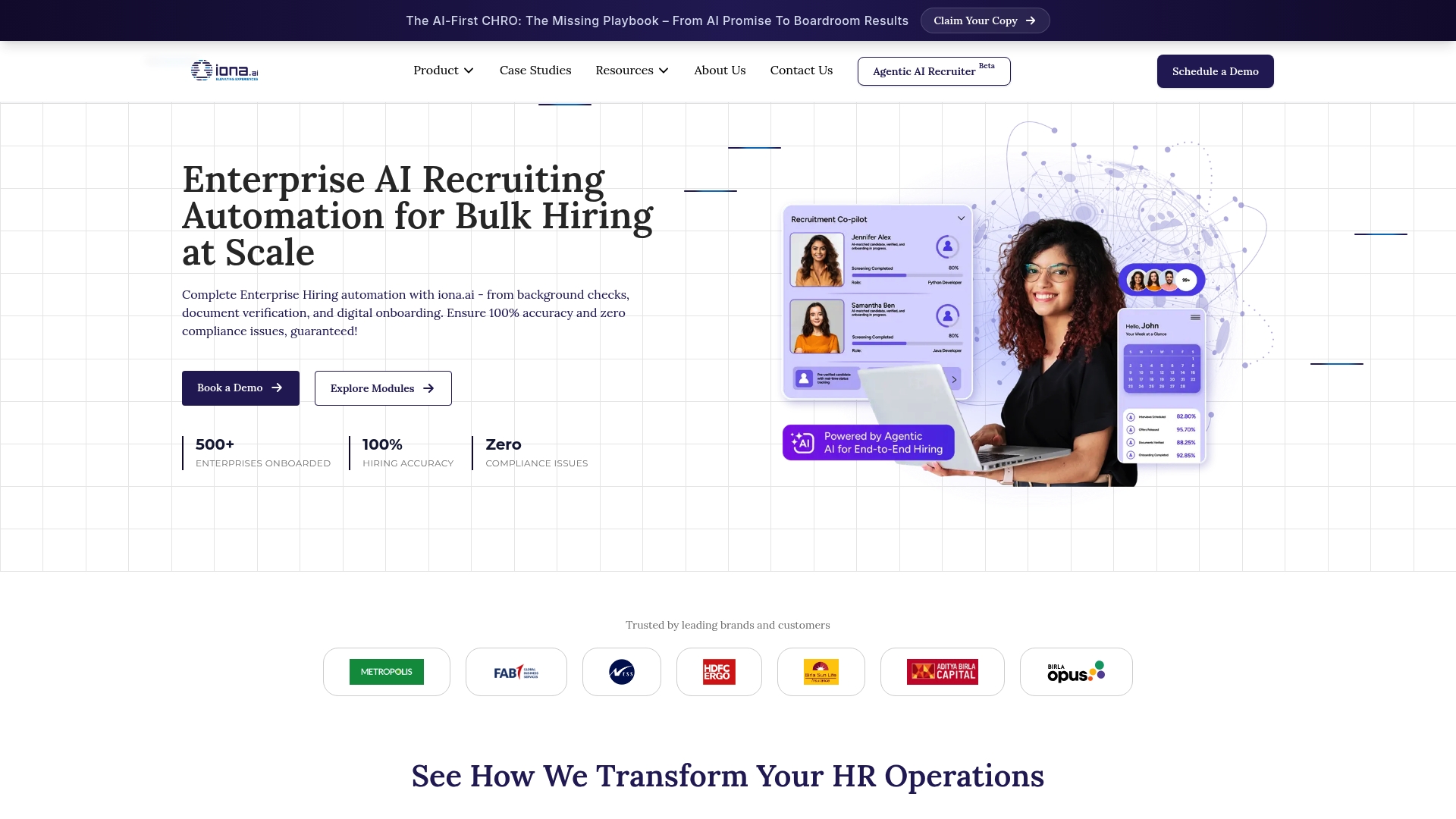
The vendor advertises a guarantee of 100% hiring accuracy and zero compliance issues for large-scale campaigns, a striking claim for enterprise HR teams. The company also reports onboarding 500+ enterprises, a vendor figure that should be treated as self-reported.
Core Features
- End-to-end automated hiring workflow covering sourcing, screening, and applicant tracking.
- AI-driven background verification and document automation for high volume candidate pools.
- Real-time dashboards for headcount planning and campaign monitoring, plus WhatsApp support for candidate engagement.
Key Differentiator
Iona.ai’s standout claim is complete automation that the vendor says produces error-free documentation and compliance at scale. That positioning targets teams running hundreds of hires per campaign and that want to replace manual verification and paperwork with automated checks.
Pros
- Automates repetitive HR tasks so recruiters spend less time on paperwork and more on selection. The vendor advertises reductions in time and cost up to 90%, a self-reported figure that suggests significant operational savings if realized.
- The platform groups sourcing, screening, verification, onboarding, and engagement in one flow which simplifies large campaigns and reduces handoffs.
- Certification credentials such as ISO 27001 and GDPR compliance are listed in the product data, which supports an enterprise security posture.
- Built to scale: the modules for headcount planning and bulk onboarding are designed to run many parallel campaigns without per-candidate manual steps.
Cons
- Independent user reviews and case studies are limited publicly, which makes external validation harder for buyers who require peer references.
- Several detailed feature pages appear missing or inaccessible in the product materials, which complicates side-by-side evaluation against incumbent HR systems.
- Bold platform guarantees rest on vendor claims rather than widely published third-party audits in the available data.
When It May Not Fit
If your HR team needs independently audited proof points or detailed public case studies before contracting, this offering may feel thin on external validation. Small teams hiring in single digits per month will overpay for enterprise automation designed for bulk campaigns.
Who It Fits Best
Large enterprise HR operations and recruiting centers of excellence that run high-volume hiring drives and already use ATS or HRIS platforms and need a layer that automates verification and onboarding at scale. Best where compliance processes are complex and volume justifies bespoke integration.
Real World Use Case
The vendor describes an insurance company that used Iona.ai to automate background checks and onboarding during a mass hiring push, reporting faster onboarding and zero compliance incidents. That example aligns with the platform’s bulk hiring focus and the accuracy claim above.
Pricing
Pricing is not published; the product data indicates enterprise custom pricing. Expect contract negotiations, implementation fees for integrations, and volume-based licensing rather than per-seat plans.
Website: https://iona.ai
QuixoHR
At a Glance
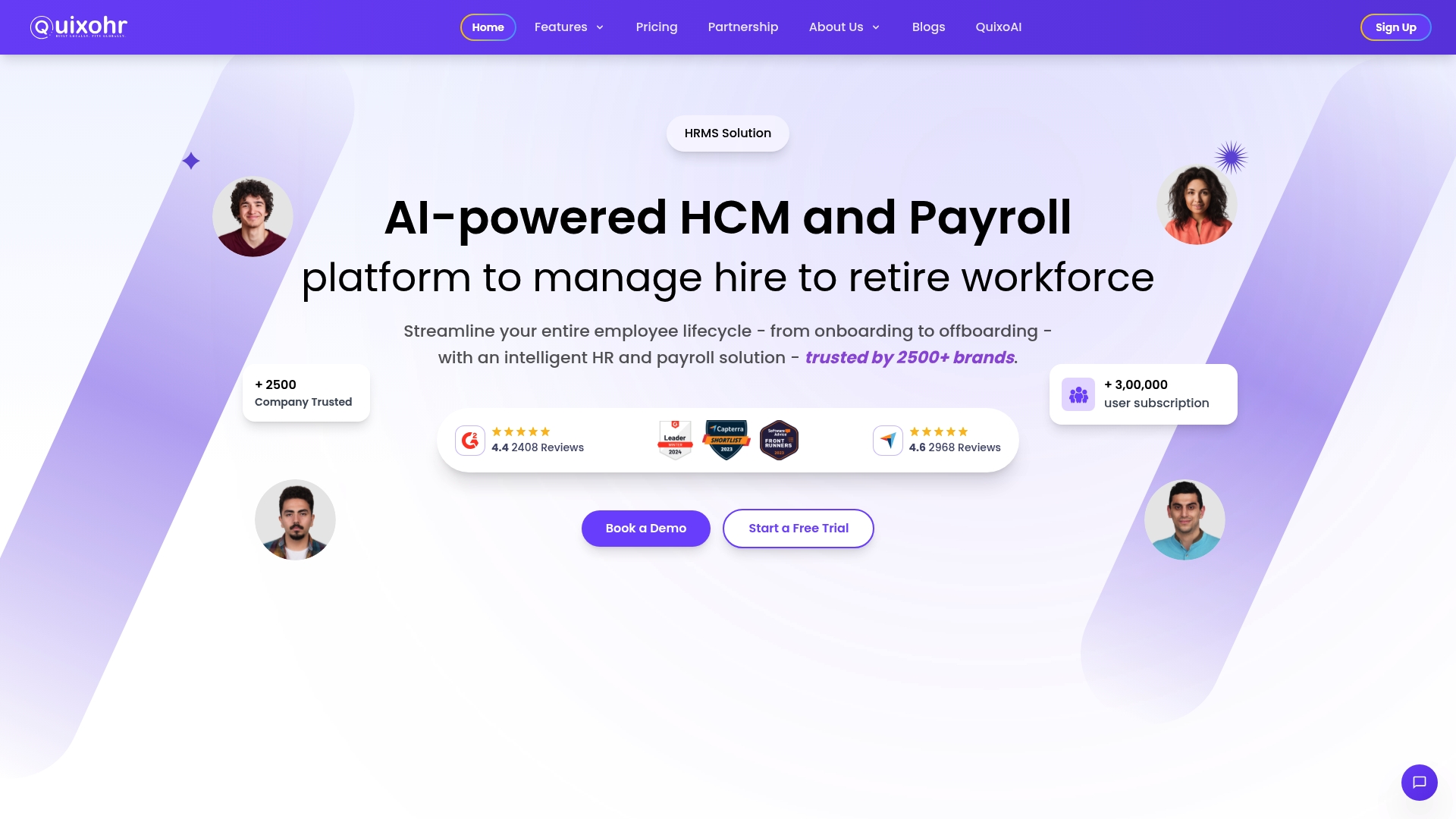
QuixoHR's marketing materials claim 99.9% payroll accuracy and a 60% reduction in payroll processing time, figures the vendor highlights as core outcomes. The company also reports being used by over 2,500 brands and more than 300,000 users.
QuixoHR presents itself as an AI-forward HRMS built to cover the full employee lifecycle rather than a point tool for one HR function.
Core Features
Core HR, attendance, payroll, performance, engagement, project management, and helpdesk sit under one admin console. The platform pairs those modules with an analytics layer for headcount, attrition, and engagement metrics.
AI-driven capabilities include recruitment assistance, onboarding automation, sentiment analysis, and attrition prediction. The automation toolkit promises fewer manual approvals and routine data entry.
Key Differentiator
QuixoHR combines broad HR coverage with an emphasis on automated intelligence and reporting. The product aims to make forecasting and attrition signals actionable by feeding AI outputs into workflows and payroll routines.
That focus on feeding analytics directly into processes separates it from suites that only deliver dashboards.
Pros
-
The payroll accuracy and speed claims above make QuixoHR attractive for organizations where payroll errors carry financial or compliance risk. Faster runs reduce month-end overhead.
-
The platform covers end-to-end HR needs in one place so teams do not maintain separate point products for hiring, payroll, and performance.
-
Workforce analytics dashboard provides live visibility into headcount, attrition trends, and engagement scores which helps HR prioritize interventions.
-
A broad integration list for recruitment and collaboration reduces manual CSV imports and keeps candidate and employee data synchronized.
Cons
-
Independent third-party user reviews are limited. The vendor-supplied satisfaction ratings and adoption numbers noted above are self-reported and not widely corroborated on public review sites.
-
Public documentation about customization and scalability is sparse. Larger organizations should expect to validate fit through a pilot or demo rather than public specs alone.
-
The feature set appears enterprise-oriented, which may add complexity for HR teams that want a minimal or human-led onboarding workflow.
When It May Not Fit
If you run a 1 to 50 person professional services firm focused on simple, human-led onboarding with minimal automation, QuixoHR is likely overpowered. The platform targets medium to large organizations and assumes centralized HR operations and technical capacity for integration work.
If independent user references and in-depth customization docs are a procurement requirement, this vendor will require extra diligence.
Notable Integrations
- Naukri
- Google Meet
- Slack
- Zoom
- Teams
- SendGrid
- Notion
These connectors support recruitment sourcing, interview scheduling, communications, and notification flows without manual exports.
Who It's For
HR managers at medium to large organizations that need an integrated HRMS with automation, payroll accuracy, and analytics. Best for teams with centralized HR operations and a willingness to adopt AI-augmented processes.
Real World Use Case
A multisite organization used QuixoHR to replace separate payroll and ATS systems. They automated candidate handoffs, cut payroll cycle time, and used attrition predictions to plan retention interventions across locations.
Pricing
The vendor does not publish standard pricing. QuixoHR appears positioned for enterprise deployments and typically requires direct sales engagement for quotes, implementation scope, and licensing details.
Website: https://quixohr.com
TraineryHCM
At a Glance
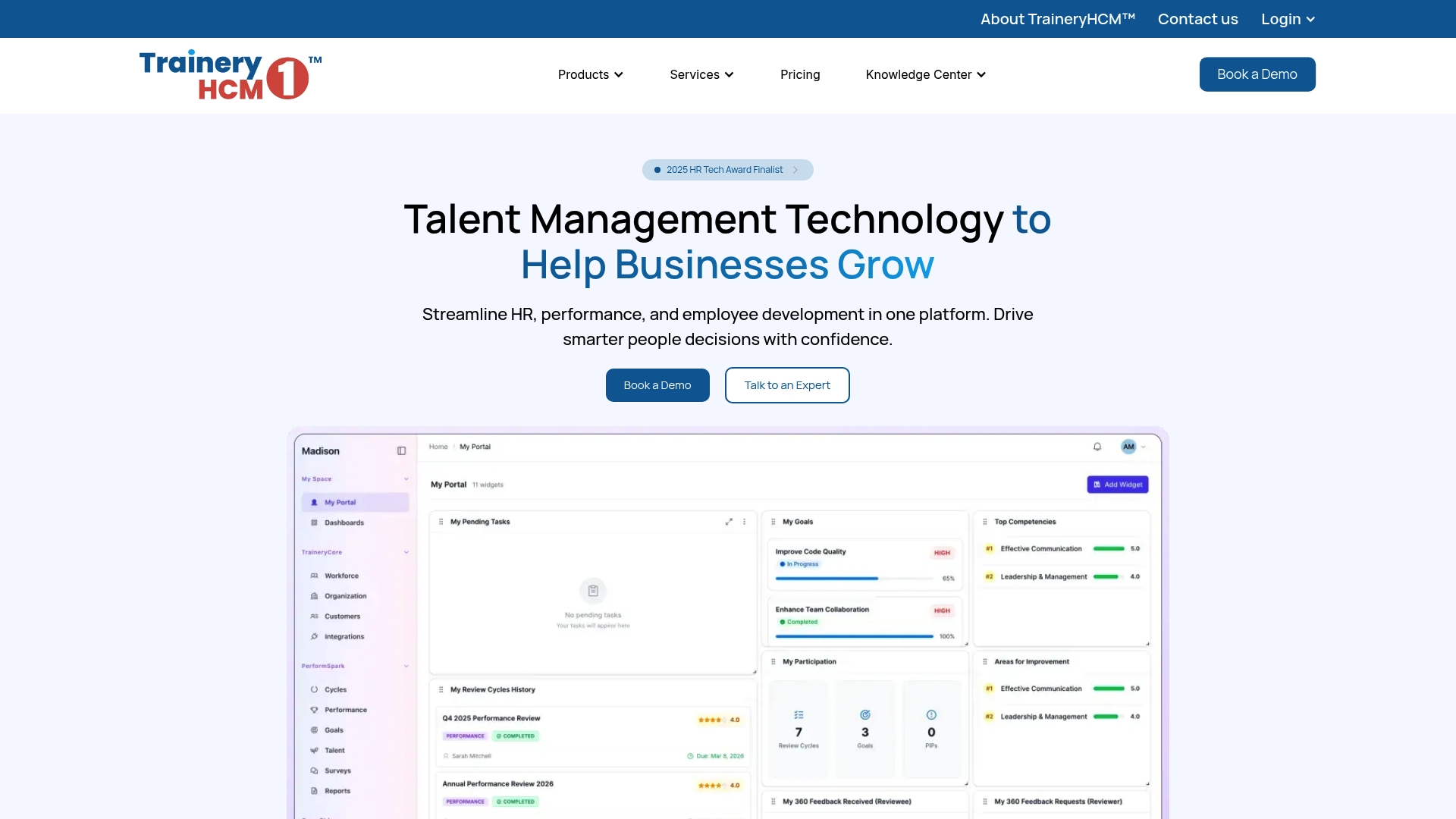
All core HR, performance, learning, and compensation modules are natively integrated within a single platform, so the same employee record flows through reviews, pay planning, and learning assignments without manual exports. The vendor advertises industry recognition, including a 2025 HR Tech Award Finalist placement and Brandon Hall Preferred Solution Provider status for 2025 to 2026.
Core Features
The product groups HR data, performance reviews, learning management, and compensation planning under one roof. Modular deployment lets you add only the modules you need and map them to existing HR processes.
- Automated workflows to reduce repetitive HR tasks and approvals.
- Training management and learning paths tied to performance goals.
- Compensation analysis tools that reference actual performance and headcount data.
- API support for custom integrations and connectors to common HRIS systems.
Key Differentiator
The platform’s architecture treats performance, learning, and pay as a single dataset rather than separate applications that sync intermittently. That design reduces reconciliation work and makes cross-functional reporting simpler for HR and finance teams.
Pros
- Consolidation reduces duplicate records and reconciliation between systems which saves time during quarter close and compensation cycles.
- The modular model lets you phase implementations so you do performance first, then add learning or compensation without ripping out earlier work.
- Built-in AI labeled TrAI provides workforce insights and flags trends in performance or learning engagement to inform decisions.
- Strong connector set includes major HR systems which lowers integration lift for organizations that already use ADP or BambooHR.
- Vendor recognition lends some external validation when you need to brief procurement or justify an HR tech refresh.
Cons
- Public, independent user reviews are sparse which makes objective assessment of day to day usability harder for buyers.
- Pricing is provided only via direct quote which slows initial budget comparisons and vendor shortlisting.
- The feature set is deep which increases implementation complexity and training time for HR teams with limited project resources.
- Some scheduled and unscheduled maintenance windows are noted which could affect availability during critical payroll or review deadlines.
When It May Not Fit
If you run a 1 to 50 person professional services firm with simple review cycles and limited HR staff, the implementation overhead and custom configuration may outweigh the benefits. If you require fixed transparent per-seat pricing before vendor conversations, TraineryHCM’s quote model will slow procurement.
Notable Integrations
TraineryHCM lists connectors to a broad HR and collaboration stack which reduces integration projects. Key named integrations include ADP, Gusto, and Salesforce alongside Slack, Outlook, Zoom, Microsoft Teams, and BambooHR.
Who It's For
HR, payroll, and talent leaders at mid-sized to large organizations that need a scalable system to unify learning, performance, and pay. Best when you have an implementation resource or partner and internal sponsors in HR and Finance.
Real World Use Case
A multinational consolidates separate learning, LMS, and review systems onto TraineryHCM to eliminate duplicate employee records. The company automates promotion workflows and ties learning completions to performance calibration, cutting manual data handoffs during annual reviews.
Pricing
TraineryHCM requires you to contact sales for a tailored quote based on modules, user counts, and integration scope. Expect licensing and implementation to vary by the number of modules and the level of customization required.
Website: https://trainery.one
Deel
At a Glance
Supports payroll in 150+ currencies, including crypto, and the vendor advertises it has processed over $20 billion in payroll while reporting adoption by more than 40,000 companies. That marketing claim is the clearest signal Deel aims at truly global payroll complexity.
The product bundles payroll, HR, benefits, IT, and mobility into a single platform and layers AI plus local experts to handle compliance across jurisdictions.
Core Features
- Global payroll in 150+ currencies, with options for crypto payouts where available.
- AI-driven automation for onboarding flows, tax calculations, and payroll scheduling to reduce manual steps.
- In-house compliance logic backed by a network of over 2,000 local experts who advise on country rules.
- Consolidated HR functions: contractor and employee contracts, benefits administration, and mobility support on one platform.
Key Differentiator
Deel runs on proprietary infrastructure with a unified payroll engine that the vendor positions as able to handle complex cross-border pay rules at scale. That technical stack combined with embedded local expertise and automation is what the product uses to differentiate itself from simple payroll providers.
Pros
-
Comprehensive international support. For teams that hire across many countries, the combination of local experts and centralized payroll reduces the number of country-specific vendors to manage.
-
Single-vendor approach. Housing payroll, HR, benefits, and mobility in one product removes integration points and reduces reconciliation work across separate systems.
-
Automation for repetitive tasks. AI-driven workflows speed routine operations like contractor setup and recurring payroll runs, which frees HR staff to focus on exceptions.
-
Designed for scale. The platform and its infrastructure are built to handle large, multi-country payroll volumes according to the vendor's materials.
Cons
-
Pricing is not published. The vendor requires contact for quotes, which makes side-by-side budget comparison during vendor selection harder for smaller buyers.
-
Setup complexity. Extensive global configurations and local compliance rules can create a heavier implementation lift than simple domestic payroll services.
-
Limited independent validation. The product data lists large usage and payroll volume figures, but third-party reviews and audits were not provided in the supplied materials.
When It May Not Fit
If your firm runs payroll only in one country and prefers transparent per-employee pricing, Deel's multi-jurisdiction capabilities and bespoke quote model may be more complexity and cost than you need. Small professional firms with simple domestic payrolls often find single-country providers cheaper and faster to deploy.
Who It's For
Mid to large organizations that hire employees and contractors across numerous countries and need a single vendor to manage payroll, compliance, and benefits. It fits teams that accept a longer implementation for the benefit of global consistency and centralized reporting.
Real World Use Case
A multinational startup used Deel to onboard remote employees in 20 countries, centralize payroll runs, and apply local tax logic without retaining separate payroll vendors in each market. AI workflows handled repetitive paperwork while local experts advised on country-specific rules during setup.
Pricing
Pricing is not publicly specified and appears to be custom or enterprise-based. Expect to request a quote and to be offered tiered pricing based on number of employees, jurisdictions covered, and add-on services like benefits or mobility support.
Website: https://letsdeel.com
Comparative Analysis
The selection of software for onboarding and compliance reflects critical operational and budgetary considerations. Analyzing the options highlighted in this article reveals distinct advantages and tradeoffs among the reviewed platforms, ensuring informed decision-making for small professional firms.
Cost Predictability versus Variable Licensing Structures
OnboardingGenie stands out with its transparent flat-rate subscription model of $49/month. Compared to competitors like Mitratech Syntrio and Deel, which base pricing on custom quotes, this certainty aids in pre-planning for firms with fixed budgets. However, for organizations demanding global compliance or enterprise-scale integrations, Deel and Iona.ai provide broader scoped solutions at tailored rates, albeit with potential higher overall costs due to configuration and scaling.
Specialized Features for Unique Organizational Needs
Mitratech Syntrio excels in cases where anonymous reporting paired with a customizable training library champions a 'compliance culture’ approach, ideal for larger organizations. Conversely, OnboardingGenie prioritizes simplicity, offering a unified portal linking forms, training, and document workflows, which directly appeals to firms with fewer employees requiring straightforward processes. Meanwhile, platforms like QuixoHR feature functionalities (e.g., payroll and performance analytics) better aligned with mid-size enterprise operational needs.
Implementation Scale and Complexity
When evaluating usability, OnboardingGenie’s single-link, branding-ready onboarding interface reduces the implementation learning curve significantly compared to the modular approaches of TraineryHCM or complex integrations seen with Iona.ai. Though the latter systems offer depth in analytical insights or volume-driven automation, smaller firms may find their offerings misaligned with operational simplicity expectations.
Best Fit Recommendations
- For firms seeking a cost-effective, all-in-one onboarding tool, OnboardingGenie offers simplicity and ease of access.
- For organizations prioritizing secure compliance reporting and advanced training customization, Mitratech Syntrio addresses these priorities comprehensively.
- For recruitment-heavy enterprises requiring AI-driven automation in applicant verification, Iona.ai matches needs efficiently.
Our Pick: OnboardingGenie
OnboardingGenie is the recommended choice for small-scale firms needing a yet uncomplicated onboarding system. Its cost predictability and focused tools on human oversight address the essential requirements of the primary reader without unnecessary complexity. However, firms with explicit, large-scale compliance training needs may find alternatives like Mitratech Syntrio to provide better alignment with those specific goals.
Comparison of Onboarding and Compliance Software
This table provides a concise comparison of leading solutions for onboarding and compliance to help you choose the best option for your firm's needs.
| Product | Best For | Pricing | Key Differentiator | Notable Limitation |
|---|---|---|---|---|
| OnboardingGenie | Small firms with 1-50 employees | $49/month flat | Unlimited onboarding packets without per-seat or envelope fees | Limited support for advanced training standards |
| Mitratech Syntrio | Mid to large organizations needing incident oversight | Not disclosed | Combines secure reporting and training into compliant speak-up channels | Customization depth may lead to extended implementation times |
| Iona.ai | Enterprise HR teams running bulk hiring campaigns | Not disclosed | Claims automation for zero compliance errors during high-volume hiring operations | Limited third-party reviews and public feature transparency |
| QuixoHR | Medium to large organizations needing HRMS | Not disclosed | Offers payroll, hiring, engagement, and analytics as one unified platform | Self-reported data without extensive independent validation |
| TraineryHCM | Organizations unifying learning, pay, and reviews | Not disclosed | Integrates performance and compensation analysis tied directly to human resource processes | Higher implementation complexity for small HR teams |
| Deel | Companies managing global payroll | Not disclosed | Proprietary global payroll engine handling multi-currency and jurisdiction requirements | Requires bespoke configuration and lacks transparent per-employee pricing for smaller firms |
Choosing the Right Onboarding Solution for Small Professional Firms
When evaluating remote.com alternatives, small professional service firms often face the challenge of balancing cost control with comprehensive onboarding and compliance needs. Managing multiple tools for signatures, forms, and training can increase administrative overhead and reduce visibility. Onboardinggenie addresses this pain point with a flat-rate pricing model that eliminates per-seat fees, simplifying your budget no matter how many hires you onboard. Its single branded portal combines document collection, e-signatures, and training materials into one clear workflow focused on accuracy and human oversight.
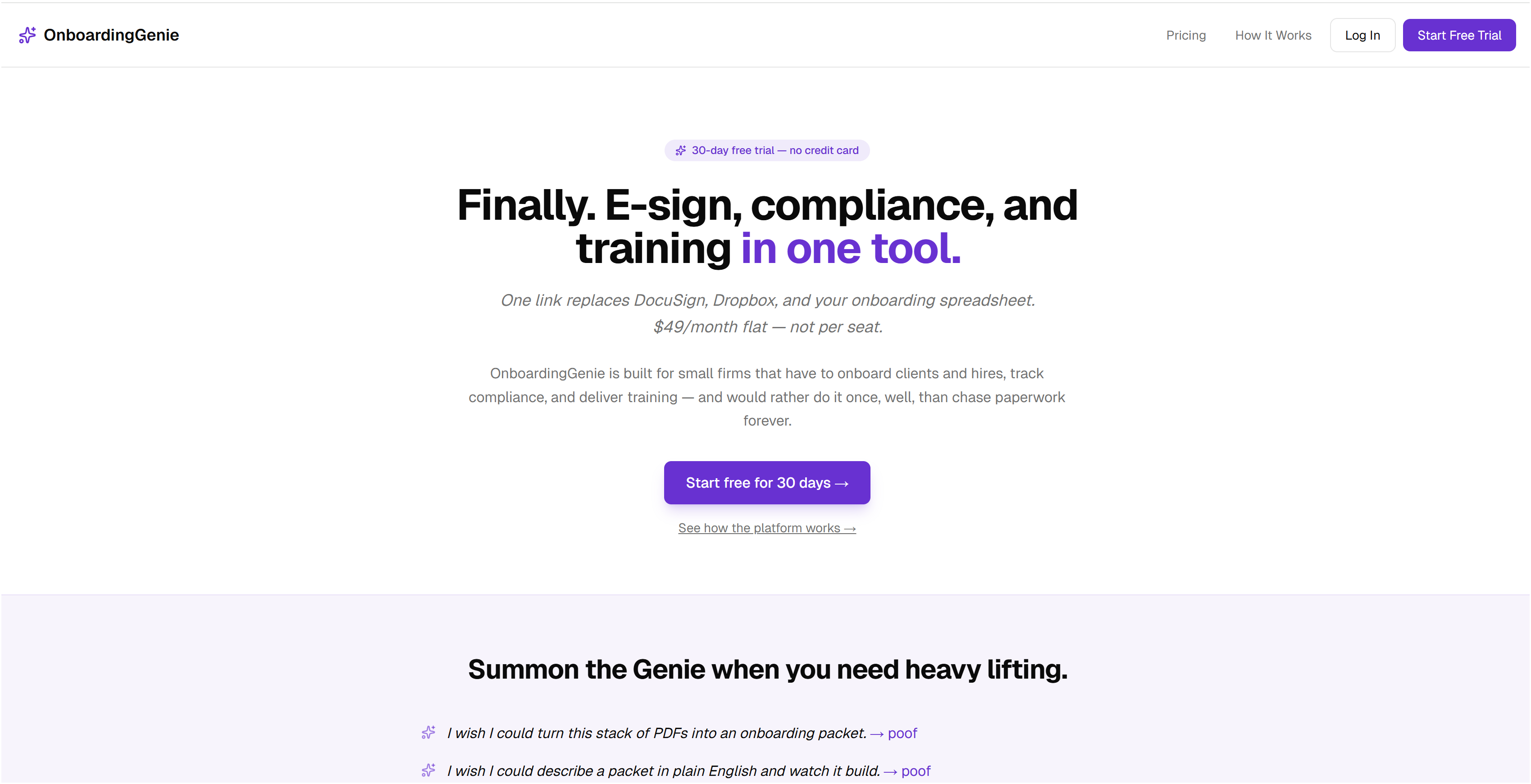
If your practice needs a straightforward, affordable platform designed for 1–50 employee firms, explore how Onboardinggenie can replace disconnected systems and reduce onboarding complexity. Visit Onboardinggenie to learn how you can streamline your onboarding packets and compliance tracking without unexpected costs. Start now by requesting a 30-day free trial and experience consolidating new hire processes under one simple link.
Frequently Asked Questions
What is the pricing structure of Onboardinggenie?
Onboardinggenie charges a flat rate of $49/month with no per-seat fees, making budgeting straightforward for small firms. This pricing model allows firms to onboard new hires or clients without worrying about additional fees as they grow. Consider this flat-rate structure when evaluating your onboarding options.
How does Onboardinggenie compare with Mitratech Syntrio for training features?
Mitratech Syntrio offers a customizable training library that aligns with local laws and policies, which is particularly useful for compliance-driven organizations. In contrast, Onboardinggenie provides basic training delivery through slides, videos, and quizzes only on its Pro+ plans, which may not meet the needs of complex corporate environments. Small firms focused primarily on onboarding might find Onboardinggenie to be more suited to their needs.
Which platform offers better compliance tracking capabilities?
Mitratech Syntrio is designed with advanced compliance tracking via case management workflows that systematically follow up on reports. Onboardinggenie, while it does provide compliance dashboards, is more oriented towards forms and document management without the intricate follow-up processes, making it a less suitable choice for larger organizations focused on compliance. If your firm has basic compliance needs, Onboardinggenie can still be effective.
Can I use Onboardinggenie for multi-step training processes?
Onboardinggenie has limitations in supporting multi-step training processes compared to more comprehensive platforms like Mitratech Syntrio, which can handle complex learning paths. For small firms looking for straightforward onboarding, Onboardinggenie remains a solid option, but consider your training complexities when choosing.
How does Onboardinggenie's one-branded link feature benefit new hires?
Onboardinggenie provides a single branded link for new hires that consolidates signatures, uploads, forms, and training steps into one access point. This simplifies the onboarding experience by eliminating the need for multiple documents and processes, reducing administrative friction. This foundational convenience can significantly enhance the onboarding process for small teams.