

TL;DR:
- Confidentiality compliance onboarding involves signing agreements, role-specific training, and documented acknowledgments before system access. Proper sequencing, with agreements signed prior to access, is crucial for enforceability and legal protection. Implementing digital workflows and storing records centrally ensures audit readiness and reduces compliance risks.
Confidentiality compliance onboarding is the process of formally integrating new hires with signed confidentiality agreements, role-specific compliance training, and written acknowledgments before granting access to sensitive company data or systems. Known in HR and legal circles as "compliance-integrated onboarding," this process protects trade secrets, regulated data, and client information from the moment an employee joins the firm. For compliance officers at professional service firms in law, accounting, consulting, and healthcare, getting this sequence right is not optional. Confidentiality agreements and NDAs are foundational controls in any defensible onboarding program, and the order in which they are executed determines whether they hold up in court or in a regulatory audit.
What is confidentiality compliance onboarding and what does it include?
Confidentiality compliance onboarding is defined by three interlocking components: signed confidentiality obligations, compliance training for confidentiality, and documented acknowledgments. Each element serves a distinct legal and operational purpose. Together, they create a chain of evidence that proves a new hire understood their obligations before touching sensitive information.

The confidentiality agreement, typically a non-disclosure agreement (NDA) or a firm-specific confidentiality policy, establishes the legal boundary. Compliance training for confidentiality covers what information is protected, how to handle it, and what the consequences of a breach are. The acknowledgment, often a signed form or LMS completion record, confirms the employee received and understood both.
A well-structured confidentiality onboarding process also includes role-based content. A paralegal at a 10-person law firm needs different training than a billing coordinator. Sending both the same generic module wastes time and leaves gaps. Platforms like HRCloud and Accountable HQ build role-specific training tracks directly into their onboarding workflows, which is the right approach for firms that handle regulated data across multiple job functions.
Pro Tip: Prepare a pre-boarding packet that includes the NDA and confidentiality policy at least 48 hours before Day 1. This gives the new hire time to read carefully, ask questions, and sign before they ever log into a system.
What are the key components of a confidentiality onboarding process?
A defensible confidentiality onboarding process has five components that must all be present and sequenced correctly.
- Confidentiality agreement or NDA. This is the legal instrument. It should specify what information is covered, the duration of the obligation, and the remedies for breach. Have legal counsel review the template annually.
- Role-specific compliance training. Generic training is a compliance gap. Training content should map to the actual data the employee will access. A healthcare billing specialist needs HIPAA-specific modules; a financial analyst needs modules covering client data and securities regulations.
- Policy review and acknowledgment. The employee reads the firm's confidentiality policies and signs a dated acknowledgment. This document is your first line of defense in a dispute.
- Sequenced access provisioning. System credentials and data access are not issued until the agreement is signed and training is completed. This is the gating control that makes the whole process legally meaningful.
- Secure document storage. Signed agreements and training certificates must be stored in a retrievable format. A folder on someone's desktop does not qualify. Signed documents stored accessibly and reviewed annually maintain legal currency.
The small firm version of this process does not need to be complicated. A structured packet delivered before Day 1, a short training module with a completion timestamp, and a signed acknowledgment stored in a central system covers the core requirements for most professional service firms.
How does timing and sequencing impact confidentiality compliance during onboarding?
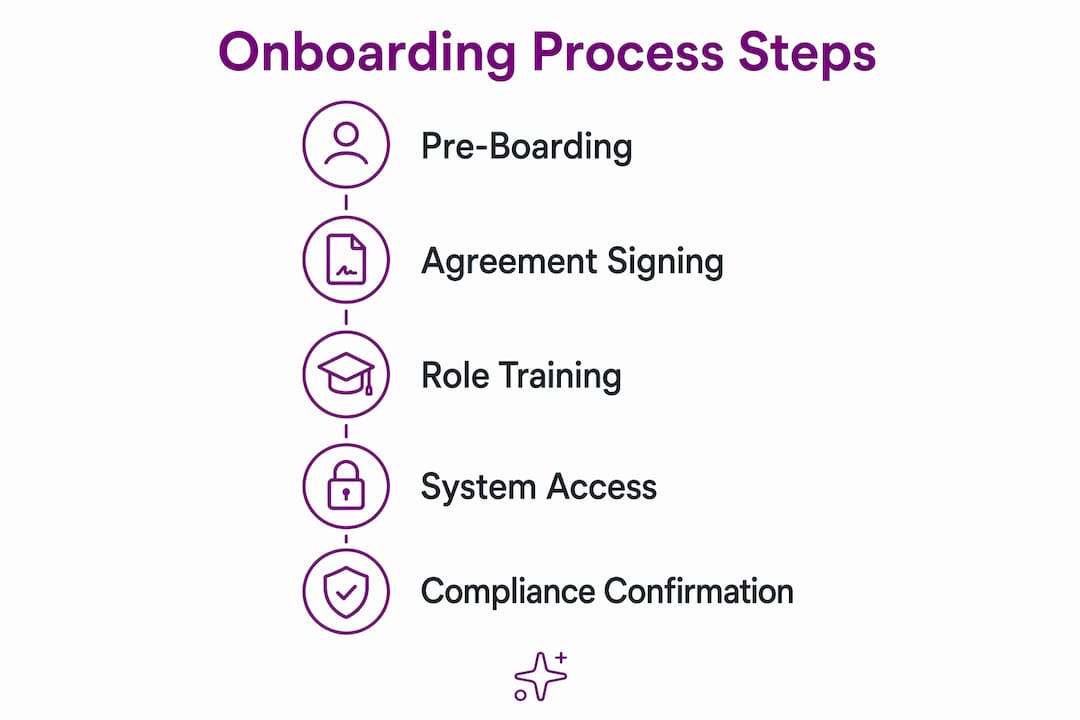
Timing is the most legally consequential variable in the entire confidentiality onboarding process. Courts treat the moment of signature as the moment the obligation begins. If a new hire accesses client files on Monday and signs the NDA on Wednesday, the agreement offers no protection for anything that happened in those two days.
The best practice, supported by HR and legal guidance from HRCloud, is to have the confidentiality agreement signed before or on Day 1, before any system access is granted. This sequencing is not just a best practice. It is the control that makes the agreement enforceable. Compliance teams treat it as a gating requirement because timing often determines legal outcomes in disputes.
Here is the sequencing workflow that protects the firm:
- Send the pre-boarding packet, including the NDA and confidentiality policy, at least 48 hours before the start date.
- Confirm receipt and collect the signed agreement before or on Day 1, before credentials are issued.
- Assign role-specific compliance training in the LMS and set a completion deadline of Day 1 or Day 2.
- Verify training completion with a timestamp and acknowledgment record.
- Provision system access only after steps 2 and 4 are confirmed and documented.
- File all signed documents and training certificates in a secure, retrievable location.
This sequence is not bureaucratic overhead. It is the operational structure that converts a paper agreement into a legally defensible control. Firms that skip or reorder these steps often discover the gap only when they need the documentation most, during a breach investigation or a regulatory audit.
How does confidentiality compliance onboarding vary across regulated industries?
The core structure of confidentiality compliance onboarding is consistent across industries, but the specific requirements differ significantly depending on the regulatory environment. The two most distinct contexts are healthcare and the federal government workforce.
| Industry | Key Requirement | Gating Control | Documentation Standard |
|---|---|---|---|
| Healthcare (HIPAA) | Workforce training before PHI access | LMS completion + signed acknowledgment | Training certificates, signed agreements, audit logs |
| Federal government | OPM-standardized NDA with whistleblower protections | Signed NDA before security clearance or system access | Standardized NDA template, acknowledgment records |
| Legal and accounting | Firm-specific NDA covering client data and trade secrets | Signed NDA before file access | Signed NDA, policy acknowledgment, annual review |
| General professional services | Confidentiality policy + NDA | Signed agreement before onboarding completion | Signed NDA, training completion record |
In healthcare, HIPAA onboarding requires that workforce training precede PHI access. Granting access before training completion is a direct HIPAA violation with audit and civil penalty implications. Accountable HQ and similar platforms operationalize this by using LMS timestamps and signed acknowledgments as audit artifacts, which is exactly what the Office for Civil Rights looks for during an investigation.
In the federal workforce, the Office of Personnel Management has proposed a standardized NDA template for federal employees that balances confidentiality obligations with whistleblower protections. This standardization reflects a broader trend toward formalized, auditable confidentiality onboarding across regulated sectors.
For law and accounting firms, the regulatory driver is client confidentiality under professional ethics rules rather than a single federal statute. The practical implication is the same: agreements must be signed, training must be completed, and both must be documented before access is granted.
Pro Tip: If your firm operates across multiple regulated contexts, for example, a consulting firm that serves both healthcare and legal clients, build separate onboarding tracks for each client type. One generic NDA will not cover the specific obligations in each regulatory environment.
What are practical steps to implement a defensible confidentiality onboarding process?
Building a confidentiality onboarding process that holds up under scrutiny requires more than a template NDA and a checkbox. It requires a workflow where each step is tied to the next and every action is documented.
- Prepare the pre-boarding packet early. The packet should include the NDA, the firm's confidentiality policy, and any role-specific acknowledgment forms. Deliver it digitally at least 48 hours before the start date. Early delivery reduces the pressure of Day 1 and gives the new hire time to read carefully.
- Use digital signatures, not paper. Paper agreements get lost, misfiled, or signed with the wrong date. Digital signature tools create a timestamped, tamper-evident record. For small firms, this does not require an enterprise contract. Purpose-built tools for small firms handle this at a fraction of the cost of enterprise platforms.
- Tie access provisioning to completion. The single most effective control is a workflow rule that prevents credential issuance until the signed agreement and training completion record are both on file. Preventing system access before signed agreements exist is the control that makes the entire process legally meaningful.
- Store documents in a central, searchable system. Signed NDAs, training certificates, and acknowledgments should live in one place. When an auditor or attorney asks for them, you need to produce them in minutes, not days.
- Schedule annual reviews. Confidentiality obligations do not end at onboarding. Annual refresher training and re-acknowledgment of updated policies keep the compliance record current and reinforce the firm's expectations.
The documentation standard for audit readiness is specific. Packaging compliance evidence means archiving training certificates, signed agreements, acknowledgments, and any vendor attestations in a chain that runs from the offer letter to the date of first system access. That chain is what regulators and courts examine.
For small professional service firms, the employee onboarding process does not need to be managed across five separate tools. Consolidating signatures, training tracking, and document storage into one workflow eliminates the gaps that create compliance exposure.
What common pitfalls threaten confidentiality compliance in onboarding?
Most confidentiality compliance failures in small firms are not caused by bad intentions. They are caused by process gaps that compound over time.
- NDA signed after access is granted. This is the most common and most damaging failure. Day 1 confidentiality onboarding often fails when HR issues the NDA after the new hire has already logged into systems. The agreement still has value going forward, but it offers no protection for the period before signing.
- Missing or misfiled agreements. A signed NDA that cannot be located is legally equivalent to no NDA. Firms that rely on email attachments or shared drives without a naming convention regularly discover missing agreements during audits.
- Generic training that does not match the role. A compliance training module that covers data protection in general terms does not satisfy HIPAA's requirement for workforce-specific training. Role-based content is a regulatory requirement in healthcare and a best practice everywhere else.
- No documentation of training completion. Telling a new hire about confidentiality obligations verbally is not a compliance record. LMS timestamps, signed acknowledgments, and training certificates are the artifacts that matter.
- Outdated NDA templates. An NDA drafted in 2018 may not reflect current trade secret law, state-specific requirements, or the firm's current data environment. Legal review of the template should happen at least annually.
Pro Tip: Build a compliance checklist into your onboarding workflow that requires a manager or HR coordinator to confirm each step before the next one begins. A simple checklist with named sign-offs creates accountability and a paper trail without adding significant time to the process.
For firms managing compliance tracking across professional services, the pattern is consistent: the firms with the fewest compliance gaps are the ones with the most structured workflows, not necessarily the most sophisticated technology.
Key takeaways
Confidentiality compliance onboarding requires signed agreements, role-specific training, and documented acknowledgments completed before system access is granted, in that order, every time.
| Point | Details |
|---|---|
| Sequence is legally binding | Agreements and training must precede system access to be enforceable in court or audit. |
| Role-specific training is required | Generic modules leave regulatory gaps; healthcare, legal, and federal roles each have distinct requirements. |
| Documentation creates the audit trail | Training certificates, signed NDAs, and acknowledgments must be stored together and retrievable on demand. |
| Annual review maintains compliance | Refresher training and updated policy acknowledgments keep the compliance record current beyond Day 1. |
| Digital workflows close the gaps | Paper-based processes create missing signatures and misfiled documents; digital systems with gating controls prevent both. |
Why the sequence matters more than the paperwork
I have seen a lot of small firms treat confidentiality onboarding as a paperwork exercise. They hand the new hire a stack of documents on Day 1, get a signature somewhere in the pile, and consider it done. The problem is that "somewhere in the pile" is not a compliance record. It is a liability.
The firms that get this right do not necessarily have better documents. They have a better sequence. The NDA goes out before Day 1. Training is assigned with a hard deadline. Access is not provisioned until both are confirmed. That three-step gate is what separates a defensible process from a paper trail that falls apart under scrutiny.
What I find most useful to tell compliance officers at small firms is this: the goal is not to create more paperwork. The goal is to create a chain of evidence that proves the employee knew their obligations before they ever touched a sensitive file. Everything else, the NDA template, the training module, the acknowledgment form, is just the material. The sequence is the structure that makes it mean something.
Small firms often assume they cannot afford the kind of compliance infrastructure that larger organizations use. That assumption is wrong. The tools available in 2026 for managing digital signatures, LMS tracking, and document storage are accessible at flat monthly rates that fit a 5-person firm's budget. The barrier is not cost. It is knowing what the workflow needs to look like and having the discipline to follow it every time.
— Chris
How OnboardingGenie handles confidentiality compliance for small firms
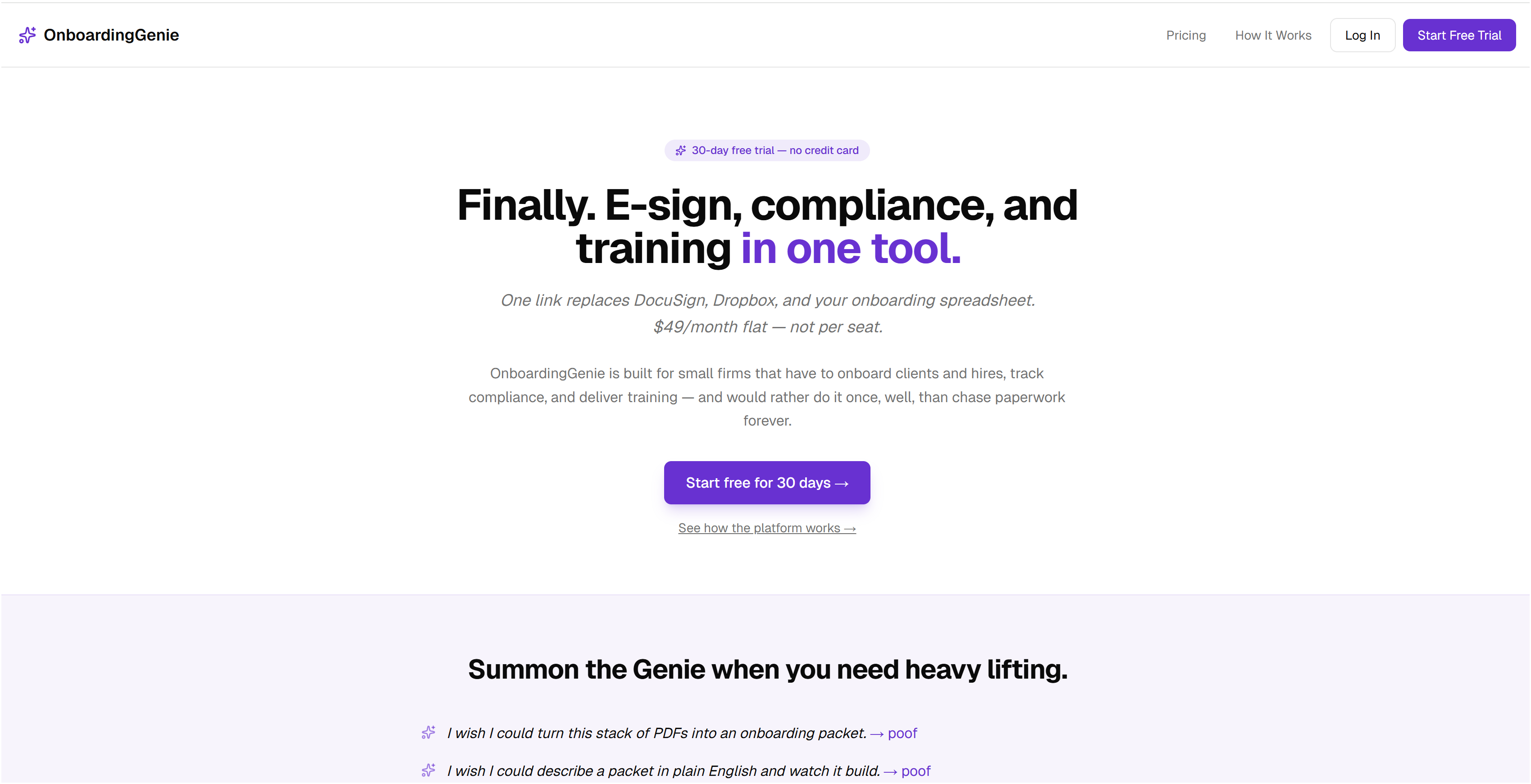
OnboardingGenie was built specifically for small professional service firms that need a structured confidentiality compliance onboarding process without the overhead of enterprise software. The platform consolidates digital signatures, compliance training tracking, and document storage into a single branded portal delivered through one link.
For firms managing confidentiality agreements, policy acknowledgments, and role-specific training, OnboardingGenie replaces the disconnected combination of PDFs, email threads, and spreadsheets with a single workflow where each step gates the next. Signed agreements are stored automatically. Training completion is timestamped. Access to the next step in the onboarding packet is controlled by completion of the previous one.
See how OnboardingGenie works for compliance-focused onboarding, or explore the digital signing capabilities built for small firms that need a practical alternative to enterprise contract tools.
FAQ
What is the difference between an NDA and a confidentiality agreement in onboarding?
An NDA (non-disclosure agreement) and a confidentiality agreement are functionally the same instrument in most onboarding contexts. Both legally bind the new hire to protect specified information; the terminology varies by firm and jurisdiction.
When should a new hire sign a confidentiality agreement?
The agreement should be signed before or on Day 1, before the employee is granted access to any systems or sensitive data. Signing after access is granted weakens the agreement's enforceability for the period before execution.
Does HIPAA require a specific confidentiality agreement for new employees?
HIPAA does not mandate a specific NDA form, but it does require that workforce training and acknowledgments be completed before employees access protected health information (PHI). Training certificates and signed acknowledgments serve as the required audit artifacts.
How long should signed confidentiality agreements be retained?
Retention requirements vary by state and industry, but the general best practice is to retain signed confidentiality agreements for the duration of employment plus a minimum of three to five years after separation. Healthcare and federal contexts may require longer retention periods.
What counts as proof of compliance training completion?
An LMS timestamp showing the date and time of completion, combined with a signed acknowledgment form, constitutes a compliance training record. Verbal confirmation or an email from the employee does not meet the documentation standard required for regulatory audits.