
TL;DR:
- AML compliance onboarding verifies client identity, assesses risk, and applies due diligence before starting a relationship. Proper implementation involves documented procedures, risk-based approaches, screening, ongoing monitoring, and integrated technology to ensure consistency and regulatory adherence. This structured process protects firms from audit vulnerabilities, reputational damage, and regulatory penalties.
AML compliance onboarding explained simply means verifying who your client is, understanding what they do, and assessing their risk before you begin working together. But if you think that sounds like a checklist, you're missing the full picture. For small and mid-sized professional service firms, anti-money laundering (AML) onboarding is a structured compliance function that touches every new client relationship and carries real regulatory weight. Done poorly, it creates audit vulnerabilities and reputational risk. Done well, it protects your firm and your clients. This guide breaks down every essential component so you can move from confusion to a clear, workable process.
Table of Contents
- Understanding AML compliance onboarding: Core components and regulatory context
- Operational challenges and common pitfalls in AML onboarding procedures
- Applying a risk-based approach and enhanced due diligence effectively
- Incorporating beneficial ownership verification and screening into onboarding
- Managing ongoing monitoring and compliance lifecycle after onboarding
- A practitioner's perspective: Why detailed procedures and technology matter more than ever
- Streamline your AML compliance onboarding with OnboardingGenie
- Frequently asked questions
Key Takeaways
| Point | Details |
|---|---|
| AML onboarding complexity | It involves multiple steps beyond identity checks, including risk assessment, screening, and ongoing monitoring. |
| Risk-based due diligence | Allocating effort based on client risk ensures efficient and compliant AML processes. |
| Operational detail matters | Practical guidance and clear procedures help staff execute AML onboarding consistently. |
| Beneficial ownership flexibility | FinCEN’s 2026 relief allows risk-based beneficial ownership verification to reduce compliance burden. |
| Continuous monitoring | AML compliance requires ongoing review and escalation beyond initial onboarding to manage emerging risks. |
Understanding AML compliance onboarding: Core components and regulatory context
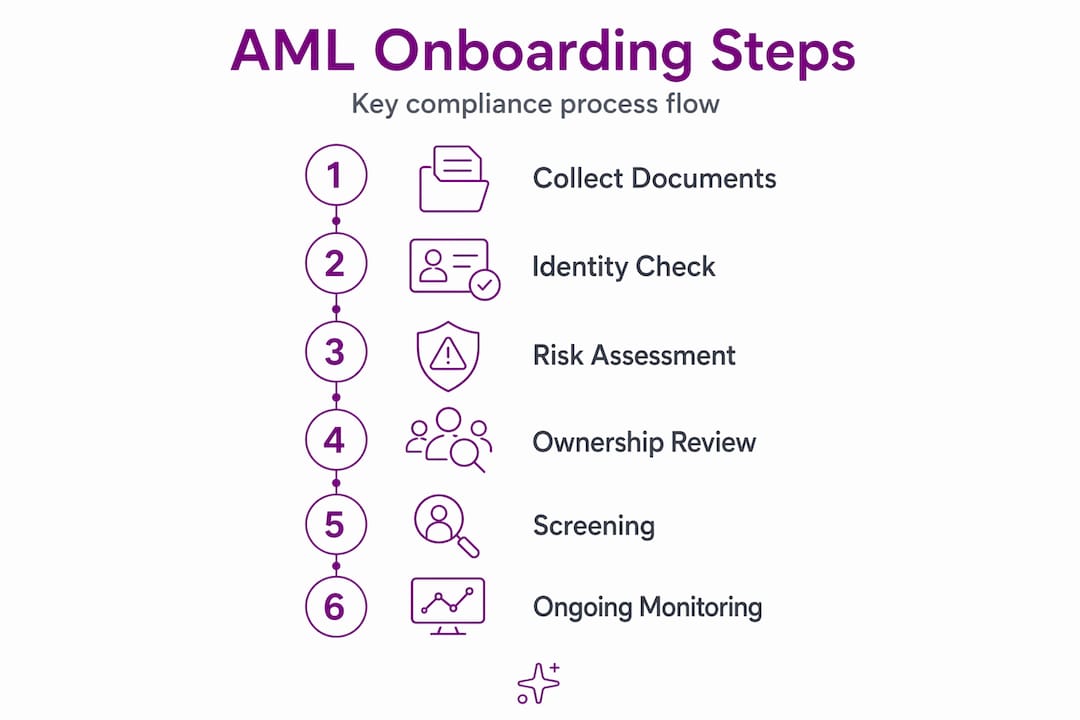
AML compliance onboarding is the process of verifying a new client's identity, assessing their financial crime risk, and determining the level of due diligence your firm must apply before the relationship begins. It is not optional, and it is not a single form. According to AML onboarding best practices, the process includes identity verification, customer due diligence (CDD), enhanced due diligence (EDD), beneficial ownership checks, sanctions screening, risk scoring, and setting up ongoing monitoring. That is six distinct functions, each requiring documented evidence.
The regulatory foundations are clear. Global standards from the Financial Action Task Force (FATF) require firms to apply a risk-based approach, meaning the depth of your due diligence should match the risk profile of the client. National regulations, including the Bank Secrecy Act (BSA) in the U.S. and the Money Laundering Regulations in the UK, translate these standards into enforceable obligations. For firms operating across jurisdictions, this means knowing which ruleset applies and documenting your reasoning when they overlap.
Here is what AML compliance onboarding actually covers in practice:
- Customer identification: Collecting and verifying government-issued ID, business registration documents, and proof of address.
- CDD (Customer Due Diligence): Understanding the nature of the client's business, their expected transactions, and their ownership structure.
- EDD (Enhanced Due Diligence): A deeper layer applied to high-risk clients, including source of funds and source of wealth verification.
- Beneficial ownership verification: Identifying any individual who owns 25% or more of a legal entity, or who otherwise exercises control.
- Sanctions, PEP, and adverse media screening: Checking clients against global watchlists, politically exposed persons (PEP) databases, and news sources for red flags.
- Risk scoring: Assigning a risk tier (typically low, medium, or high) based on the factors above.
- Ongoing monitoring: Flagging future transactions or behavioral changes that may alter the original risk assessment.
You can explore the AML onboarding steps overview in more detail, but these components form the baseline that every professional service firm must address. With this foundational understanding, we can drill down into the practical operational challenges firms face when implementing these components.
Operational challenges and common pitfalls in AML onboarding procedures
Knowing what AML onboarding requires and actually executing it consistently are two different things. Most firms know they need detailed onboarding procedures, but the gap between policy and practice is where compliance breaks down. The FCA's CDD compliance findings reveal that while most firms have documented identity verification policies, they lack sufficient practical guidance for staff, leading to inconsistent execution and audit issues.

What does "insufficient practical guidance" look like in reality? It means your policy says "collect proof of identity" without specifying which documents are acceptable, what happens when a client can't produce a passport, or who signs off when a case is unclear. Staff fill in the gaps themselves, and suddenly you have five employees running five different versions of your compliance process.
Common pitfalls to watch for include:
- Missing escalation guidelines: If a client's address doesn't match their documents, staff need to know exactly what to do next. Without written escalation steps, cases either stall or get waved through.
- Weak document version control: Using outdated policy versions is a common audit finding. Senior management approval records are often absent altogether.
- Underbuilt EDD documentation: High-risk client files frequently lack evidence that enhanced measures were actually applied, not just noted as required.
- Neglected alternative ID methods: Not every client has a driver's license or standard passport. Policies rarely address what to do when standard documents aren't available.
- Speed over substance: Smaller firms under pressure to onboard quickly often cut corners on diligence quality. This is the compliance failure regulators flag most often.
- Gaps in ongoing training: AML regulations change. Staff trained two years ago may be applying outdated rules without anyone noticing.
Pro Tip: Build a one-page quick-reference card for your front-line staff that covers the five most common onboarding scenarios: individual client, sole trader, limited company, trust, and high-risk referral. It does not replace your full policy but drastically reduces inconsistency in day-to-day decisions.
Recognizing these pitfalls helps clarify why strong procedural detail and governance are essential components of an effective AML onboarding program.
Applying a risk-based approach and enhanced due diligence effectively
The risk-based approach is not just a phrase regulators use. It is the practical framework that tells you how much effort to apply to each client. A risk-based CDD framework requires standard CDD for low-to-medium risk customers and EDD for high-risk customers, with senior management approval and additional scrutiny for the latter.
In practice, your risk scoring model should consider several factors. Here is a clear operational workflow:
- Collect client information: Gather identity documents, business purpose, ownership structure, and expected transaction types.
- Apply risk scoring criteria: Score the client based on geography (are they based in a high-risk jurisdiction?), industry (is the sector prone to cash-intensive activity?), transaction volume and complexity, and PEP or adverse media hits.
- Assign a risk tier: Low, medium, or high, with documented rationale for each assignment.
- Select the appropriate due diligence path: Low and medium risk clients follow your standard CDD checklist. High-risk clients move to EDD immediately.
- Apply EDD: Obtain source of funds documentation, verify the ultimate beneficial ownership chain, conduct adverse media searches, and record senior management sign-off.
- Set monitoring frequency: High-risk clients require shorter review cycles. A low-risk individual consultant might be reviewed every two years. A high-risk trust structure may need quarterly review.
Here is how CDD and EDD differ at the operational level:
| Factor | Standard CDD | Enhanced due diligence (EDD) |
|---|---|---|
| Identity verification | Government ID, address proof | Same, plus additional corroboration |
| Business relationship | Purpose and nature | Detailed rationale and full business profile |
| Source of funds | Not typically required | Mandatory documentation |
| Beneficial ownership | 25% threshold check | Full ownership chain verification |
| Senior management approval | Not required | Required before relationship begins |
| Review frequency | Risk-based (annual/biennial) | More frequent, often quarterly |
| Adverse media screening | Standard check | Deep search with documented results |
Pro Tip: If a client's risk score sits right on the boundary between medium and high, default to EDD. The extra documentation effort is far smaller than the cost of a regulatory enforcement action for insufficient diligence on what turns out to be a high-risk relationship.
With risk-based and enhanced approaches understood, let's explore how screening and beneficial ownership verification fit into this framework.
Incorporating beneficial ownership verification and screening into onboarding
Beneficial ownership verification is often the most administratively demanding part of AML onboarding, especially when clients use layered corporate structures. The goal is to identify any individual who ultimately owns or controls the entity you are onboarding, not just the named directors or signatories.
A useful development for firms managing multiple accounts for the same client entity: FinCEN's 2026 relief order allows beneficial ownership verification to be risk-based and trigger-driven, reducing repetitive checks when reliable prior data exists and the customer confirms continued accuracy. This is a meaningful practical shift. You no longer need to re-verify the same beneficial owner every time the same entity opens a new account, provided you have documented certifications of continued accuracy and no risk triggers have appeared.
Screening elements to integrate at onboarding include:
- Sanctions screening: Check all clients and their beneficial owners against OFAC, UN, EU, and relevant national sanctions lists. This is not a one-time check. Sanctions lists change.
- PEP screening: Politically exposed persons carry higher risk due to their access to public funds. Screen for current and former political roles, as well as immediate family members and close associates.
- Adverse media screening: Search for negative news coverage linked to financial crime, fraud, or regulatory enforcement. Automated tools can run broad searches, but a human reviewer should assess relevance before flagging a result.
Here is a quick reference for screening categories and their risk implications:
| Screening type | What it checks | Risk action if flagged |
|---|---|---|
| Sanctions | Global watchlists | Immediate halt, legal review |
| PEP | Political exposure | Trigger EDD, senior approval |
| Adverse media | Negative news | Assess context, document findings |
| Beneficial ownership | Control/ownership chain | Verify and document all layers |
Understanding key verification and screening elements leads us naturally to how ongoing monitoring extends AML compliance beyond onboarding.
Managing ongoing monitoring and compliance lifecycle after onboarding
Here is a reality many small firms miss: completing onboarding does not complete your AML obligation. According to ongoing AML compliance requirements, AML compliance requires ongoing monitoring including transaction reviews, periodic KYC refreshes, risk rating updates, event-driven reviews, and escalation protocols for suspicious activity throughout the full customer lifecycle.
Ongoing monitoring in practice involves:
- Transaction monitoring: Review client activity for patterns inconsistent with the original risk assessment. A client profiled as a small sole trader suddenly routing large international payments is a trigger.
- Periodic KYC (Know Your Customer) refreshes: Schedule formal reviews based on risk tier. High-risk clients annually, medium-risk every two years, low-risk every three years.
- Event-driven reviews: When adverse media hits, a beneficial owner changes, or the client discloses a new business activity, run a fresh review immediately, regardless of where the client sits in their scheduled cycle.
- Risk rating updates: Circumstances change. A low-risk client who expands into a high-risk jurisdiction must be re-scored and, if necessary, elevated to EDD.
- Escalation and reporting: Have documented steps for when and how to file a Suspicious Activity Report (SAR), who in the firm approves the decision, and what happens to the client relationship after a report is filed.
Strong ongoing monitoring also feeds back into your onboarding process. Patterns you detect during monitoring often reveal gaps in the original risk scoring model, giving you the data to improve future onboarding decisions. That feedback loop is what separates a static compliance program from a genuinely effective one.
You can find more detail on ongoing AML compliance processes that connect onboarding to lifecycle management for professional service firms.
A practitioner's perspective: Why detailed procedures and technology matter more than ever
The most common mistake small firms make with AML compliance is treating policy documentation as the finish line. It is not. The FCA's published findings make this explicit: lack of practical operational detail in onboarding documentation is a primary weak link that undermines compliance accuracy and auditability. Having a policy binder does not protect you. Having staff who know exactly what to do in each scenario does.
What changes when you get this right? First, your audit trail becomes defensible. Every decision has a documented rationale, every escalation has a named approver, and every screening result has a recorded outcome. Regulators are not looking for perfect clients. They are looking for evidence that you ran a proper process.
Second, technology integration reduces the burden significantly. Automated screening tools catch sanctions updates in real time. Risk scoring models applied through your onboarding workflow prevent human bias from influencing tier assignments. When a client file is incomplete, the system flags it before the relationship opens, not after.
Third, and this is the point most practitioners underestimate: integrating compliance with onboarding tools removes the friction that causes staff to shortcut procedures. When the compliance steps are embedded in the same workflow as the client intake form, there is no separate process to skip. The onboarding and the compliance happen together, which is exactly how it should work.
The firms that struggle most are not those with bad intentions. They are the ones running compliance on spreadsheets and email threads while trying to serve clients efficiently. The solution is not more policy documents. It is better systems with human oversight built in.
Streamline your AML compliance onboarding with OnboardingGenie
If this guide has made one thing clear, it is that effective AML onboarding is not a checklist. It is a structured workflow that needs to be consistent, documented, and repeatable across every client, every time. That is exactly what OnboardingGenie is built to support.

OnboardingGenie brings identity verification steps, risk scoring workflows, CDD and EDD documentation, and training materials into a single branded portal. Your staff work through the same process every time, with alerts for incomplete steps and audit-ready records built in automatically. No more scattered PDFs, version control headaches, or compliance steps buried in email chains. You can explore the compliance management solutions designed specifically for small professional service firms, see how OnboardingGenie works in practice, or start a free trial and experience the difference a structured onboarding portal makes for your firm.
Frequently asked questions
What are the key steps in an effective AML compliance onboarding process?
Effective AML onboarding includes identity verification, risk-based CDD and EDD procedures, beneficial ownership checks, sanctions and PEP screening, risk scoring, and establishing ongoing monitoring from the start of the client relationship.
How does enhanced due diligence differ from standard customer due diligence?
Standard CDD applies to most clients and covers identity and basic risk checks, while EDD for high-risk clients requires source of funds documentation, full ownership chain verification, and formal senior management approval before the relationship can proceed.
What recent changes has FinCEN made regarding beneficial ownership verification?
FinCEN's 2026 exceptive relief order allows beneficial ownership verification to be conducted at account opening and only revisited upon specific risk triggers, removing the requirement for repetitive checks when prior data is reliable and customer confirmation is documented.
Why is ongoing monitoring important after AML onboarding is completed?
Ongoing monitoring detects changes in client behavior and risk profile, ensuring that suspicious activity is identified and reported promptly, and that the firm's compliance obligations across the lifecycle remain current and defensible throughout the entire client relationship.