
Most small firm owners work hard on compliance, sometimes 11 to 20 hours each month, yet audits still fail. The reason almost never comes down to effort. It comes down to evidence. Firms fill folders with policy templates, signed agreements, and internal memos, then discover during an audit that none of it maps to the actual controls a regulator needs to verify. This guide cuts through that confusion. It walks through what compliance documentation actually means, how to build a lifecycle that keeps documents audit-ready, and which mechanics protect you when reviewers start asking hard questions.
Table of Contents
- What is compliance documentation? (And why 'evidence' is the key)
- The modern compliance documentation lifecycle: From creation to audit-ready
- Critical components: Registers, retention, and sampling for onboarding
- Proof, ownership, and export: Versioning and acknowledgment mechanics
- Handling nuances: Edge cases, risk mapping, and standardized onboarding
- What most small firms get wrong about compliance documentation
- Streamline compliance documentation with a purpose-built platform
- Frequently asked questions
Key Takeaways
| Point | Details |
|---|---|
| Evidence is everything | Only documentation that can be directly verified will pass regulatory audits. |
| Lifecycle beats static files | A living documentation system with version control and acknowledgment is critical for staying audit-ready. |
| Registers and retention matter | Centralized registers and properly enforced retention policies protect your firm from regulatory risk. |
| Nuance prevents audit failures | Documenting exceptions, edge cases, and traceability avoids costly audit surprises. |
| Automation helps, but governance rules | Automation reduces workload but requires proof mapping and oversight to be reliable. |
What is compliance documentation? (And why 'evidence' is the key)
Compliance documentation is the organized, traceable body of records that proves your firm follows applicable laws, regulations, and internal policies. That definition sounds simple enough. The trouble is that many small firms treat it as a filing exercise, printing out policy statements and storing them in a shared folder, hoping that volume signals effort.

An auditor does not care about volume. They care about evidence. As one regulatory writing guide puts it, compliance documents must map controls to verifiable proof before they mean anything in an audit setting. The difference between a generic statement and an audit-ready record is traceability. Can you point to the exact moment a control was applied, who applied it, and what the outcome was? If not, the document is decoration.
Here is what inadequate documentation looks like in practice. A firm writes a data privacy policy and posts it on its intranet. Employees can read it any time they want. But when an auditor asks who acknowledged the policy, on what date, and under which version, the firm has nothing to show. Contrast that with a firm that sends the same policy through a tracked workflow, collects a time-stamped acknowledgment from each employee, and stores the export alongside the policy version that was active at that time. Both firms have a "policy." Only one has evidence.
The key characteristics of truly audit-proof documentation include:
- A clear link between each requirement and the control designed to meet it
- Verifiable proof that the control was actually performed
- Named ownership so accountability is never ambiguous
- Version history that shows how documents evolved over time
- Secure, retrievable storage that survives personnel changes
Without these elements, even well-intentioned documentation creates costly compliance failures that show up at the worst possible moments.
"Good compliance documentation does not just describe what you plan to do. It proves what you actually did, when you did it, and who was responsible."
The modern compliance documentation lifecycle: From creation to audit-ready
With a working definition in hand, it is essential to understand how documentation flows from creation through to audit-readiness in daily firm operations.
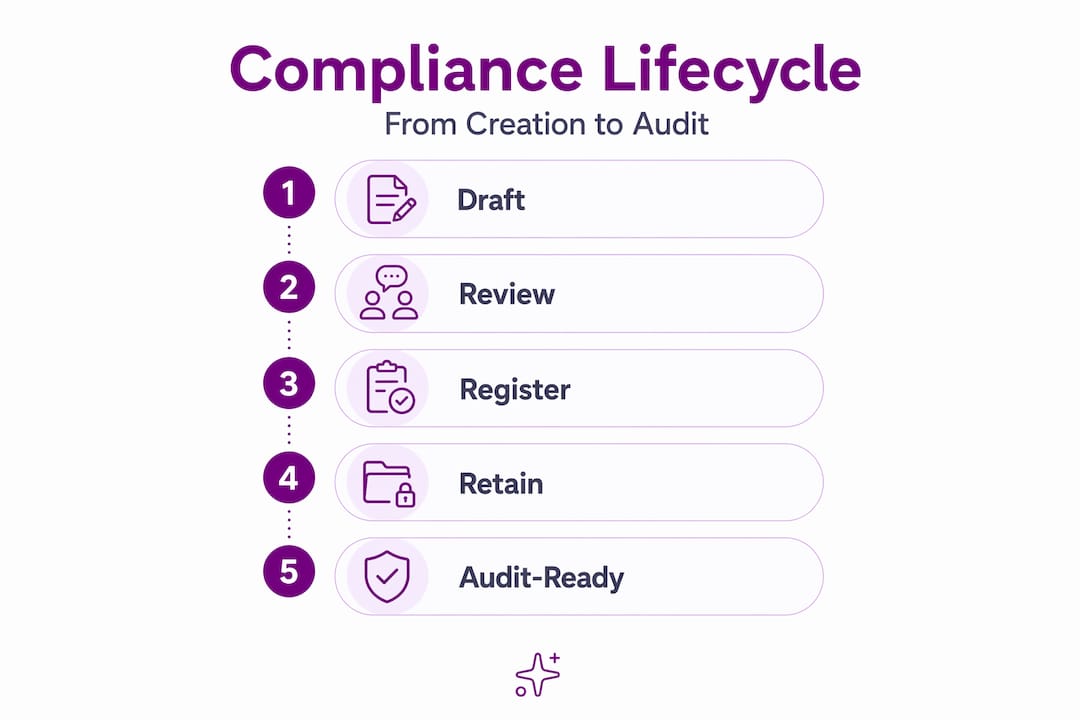
According to compliance management research, the documentation lifecycle spans authoring, versioning, validation, evidence compilation, and secure archival. Each stage builds on the previous one. Skipping a stage is not a shortcut; it is a liability.
Here is how each stage plays out in a typical small professional services firm:
- Authoring. A designated owner drafts the document, whether it is an engagement letter template, a client intake form, or an AML (anti-money laundering) checklist. The draft includes the requirement it addresses and the control it describes.
- Versioning. The document receives a version number and an effective date before anyone else sees it. Every subsequent change creates a new version. This prevents confusion about which version was in force at a given time.
- Validation. A second reviewer checks the document against its regulatory basis. This is where gaps tend to surface, where a control says "staff will be trained" but no training record is attached.
- Evidence compilation. As the control runs in practice, evidence accumulates. Signed acknowledgments, completed checklists, training completion records, and time-stamped logs all get linked to the relevant document version.
- Secure archival. Once a document is superseded or a retention period is reached, it moves to secure, tamper-evident storage. Auditors frequently ask for records from previous years, so archival is not optional.
The compliance and onboarding lifecycle functions best when these stages live in one connected system rather than across separate email threads, cloud folders, and spreadsheet trackers.
| Lifecycle stage | Common failure point | What audit-ready looks like |
|---|---|---|
| Authoring | No ownership assigned | Owner named, requirement cited |
| Versioning | Overwritten without history | Sequential versions with dates |
| Validation | No second review | Sign-off recorded, gaps closed |
| Evidence compilation | Policy exists, proof missing | Logs linked to each version |
| Secure archival | Files deleted or misplaced | Retained per schedule, retrievable |
Pro Tip: Review your ongoing compliance steps at least quarterly. Lifecycle gaps do not stay hidden for long, and small corrections now are far less painful than emergency remediation during an audit.
Critical components: Registers, retention, and sampling for onboarding
To move from concept to practice, these are the building blocks every small firm must put in place for trustworthy, scalable compliance.
The documentation register is the starting point. A register is a master list, your single source of truth, that captures every document your firm is required to maintain. According to compliance program guidance, a register should list each required document alongside its legal basis, retention period, assigned owner, and current verification status. Without a register, firms discover missing documents during an audit rather than during a routine review. That is never a comfortable moment.
A useful register entry for a professional services firm might look like this:
- Document type: Client engagement letter
- Legal basis: State bar rules or CPA licensing requirements
- Retention period: Seven years post-engagement
- Owner: Partner on file
- Last verified: Date and by whom
- Sample status: Reviewed in current quarter
Retention rules deserve serious attention. Regulators are explicit about how long records must be kept and how they must be disposed of when their time is up. Retention and secure disposal are core compliance features, and regulators actively enforce record preservation standards. A law firm that discards client files after three years when the rule requires seven is not saving storage costs. It is creating a regulatory exposure that could far exceed any storage savings.
Sample-based verification is the practical tool that keeps a register honest. Rather than reviewing every document every quarter, risk-based sampling focuses review effort on high-stakes document categories and any area that showed gaps in previous periods. Here is how a simple sampling approach works:
- Identify the three to five highest-risk document types in your register
- Pull a representative sample, often 10 to 20 percent of records in each category
- Check for completeness, version currency, and evidence linkage
- Record findings and assign corrective actions with deadlines
This approach is scalable for small firms because it concentrates attention where it matters most rather than spreading a thin team across every document at once. The centralized compliance management view makes sampling practical because records are visible in one place rather than scattered across personal drives.
Pro Tip: Mark high-risk document categories in your register with a review flag that triggers a sample check whenever a new regulation updates their legal basis. Rules change, and a register that does not reflect current law is just an organized record of outdated thinking.
The sampling and verification strategies that work best for onboarding combine routine sampling with event-triggered reviews, for example, any time a new client type is onboarded or a regulatory deadline passes.
Proof, ownership, and export: Versioning and acknowledgment mechanics
With the essentials in place, ensuring documentation is actually audit-ready requires operational mechanics that most firms overlook until a reviewer starts asking pointed questions.
Acknowledgment tracking is not just a policy statement that says "employees must read and confirm this document." Mechanically, it means every person required to review a document does so through a system that records their name, the version they reviewed, and the exact date and time of their acknowledgment. According to compliance documentation guidance, proof of acknowledgment and defensible version history are both required for audit and external diligence. A verbal confirmation or an email chain does not satisfy this standard reliably.
Here is what a sound acknowledgment and versioning process looks like step by step:
- A new or updated document is published in the compliance system with a version number and effective date.
- The system identifies which roles or individuals must acknowledge it.
- Notifications go out with a direct link to the document and a clear deadline.
- Each recipient reviews and submits their acknowledgment through the system.
- The system logs name, timestamp, and version confirmed.
- The record is immediately exportable as a PDF or CSV for audit submission.
That export capability matters more than many firms realize. When an auditor, an investor doing due diligence, or a regulatory examiner asks for proof of compliance, the ability to generate a clean, complete report in minutes separates firms that look organized from firms that scramble through folders for days.
Research on certification timelines shows that automation shortens average certification time significantly, but still requires correct mapping and human governance to be reliable. The firms that struggle are not the ones using manual processes exclusively. They are the ones who adopted automation without building the underlying mapping that tells the system which controls cover which requirements.
The beyond e-signature perspective is worth keeping in mind here. Capturing a signature confirms a document was signed. It does not automatically record which version was signed, whether the signer had the context to understand what they confirmed, or where that record lives in relation to the broader compliance register.
Handling nuances: Edge cases, risk mapping, and standardized onboarding
Once the main process is standardized, expert firms protect themselves by handling exceptions and standardizing as much as possible across their onboarding workflows.
The standard for client onboarding documentation standards in regulated industries emphasizes that edge cases often break compliance if exceptions and traceability from risk identification all the way through to controls are not explicitly documented. Consider a small advisory firm that onboards most clients through a standard engagement letter. Then a new client comes in with an unusual fee arrangement, a complex ownership structure, or a jurisdiction-specific disclosure requirement. Without a documented exception process, that client either gets squeezed into a template that does not fit or processed informally with no record of why a different approach was taken. Either outcome creates audit risk.
Effective edge case handling includes:
- A clear trigger for when a non-standard approach is needed
- A documented rationale approved by a designated owner
- A link between the exception and the relevant section of the risk analysis
- A review date to determine if the exception should become standard practice
Traceability from risk identification to controls to evidence is the thread that makes a compliance program defensible rather than just descriptive. When a regulator asks why a particular control is in place, the answer should not be "we always did it this way." It should point to a risk analysis that identified the specific threat, a control designed to address it, and evidence that the control operates consistently.
Real-world compliance examples show that standardized onboarding documentation reduces regulatory review time because examiners can follow a clear, consistent structure rather than piecing together a picture from scattered files.
"The firms that handle audits most cleanly are not the ones with the thickest binders. They are the ones whose documentation tells a coherent story from risk to control to proof, including every exception along the way."
Harmonized onboarding documentation also reduces onboarding bottlenecks. When every new client or employee follows a documented process with clear steps, required fields, and defined ownership at each stage, the firm spends less time answering "what comes next?" and more time delivering service.
What most small firms get wrong about compliance documentation
The most common mistake small firms make is treating compliance documentation as a one-time project rather than an ongoing operational discipline. A firm invests two weeks building a policy library and a documentation register, then revisits neither for eighteen months. Regulations change. Personnel changes. Client types evolve. The documentation that was accurate in January may be dangerously out of date by October.
The second mistake is assuming that policy templates, even well-written ones, are sufficient. They are not. Templates describe intent. Evidence proves execution. Auditors evaluate the latter, not the former. Firms that rely on templates without evidence linkage discover this at the most expensive possible moment.
The third mistake is misunderstanding what automation can and cannot do. Automation is genuinely useful for sending acknowledgment requests, logging timestamps, and generating export reports. It cannot decide which requirements apply to which document types. It cannot catch a mapping error between a control and the regulation it is supposed to satisfy. Human oversight at the governance level is not optional, even in highly automated workflows. The danger of incomplete compliance is rarely a technology failure. It is almost always a governance failure that technology then faithfully replicates at scale.
Finally, the compliance conversation should not stop at onboarding. Onboarding is where documentation habits form, but the systems that capture evidence during onboarding should continue capturing evidence throughout the client or employee relationship. One-time setup is not a compliance program. It is just a starting point.
Streamline compliance documentation with a purpose-built platform
If reading through the compliance documentation lifecycle feels familiar in the worst way, you are not alone. Most small professional service firms are managing registers in spreadsheets, chasing acknowledgments by email, and rebuilding audit reports from scratch every time a reviewer shows up.
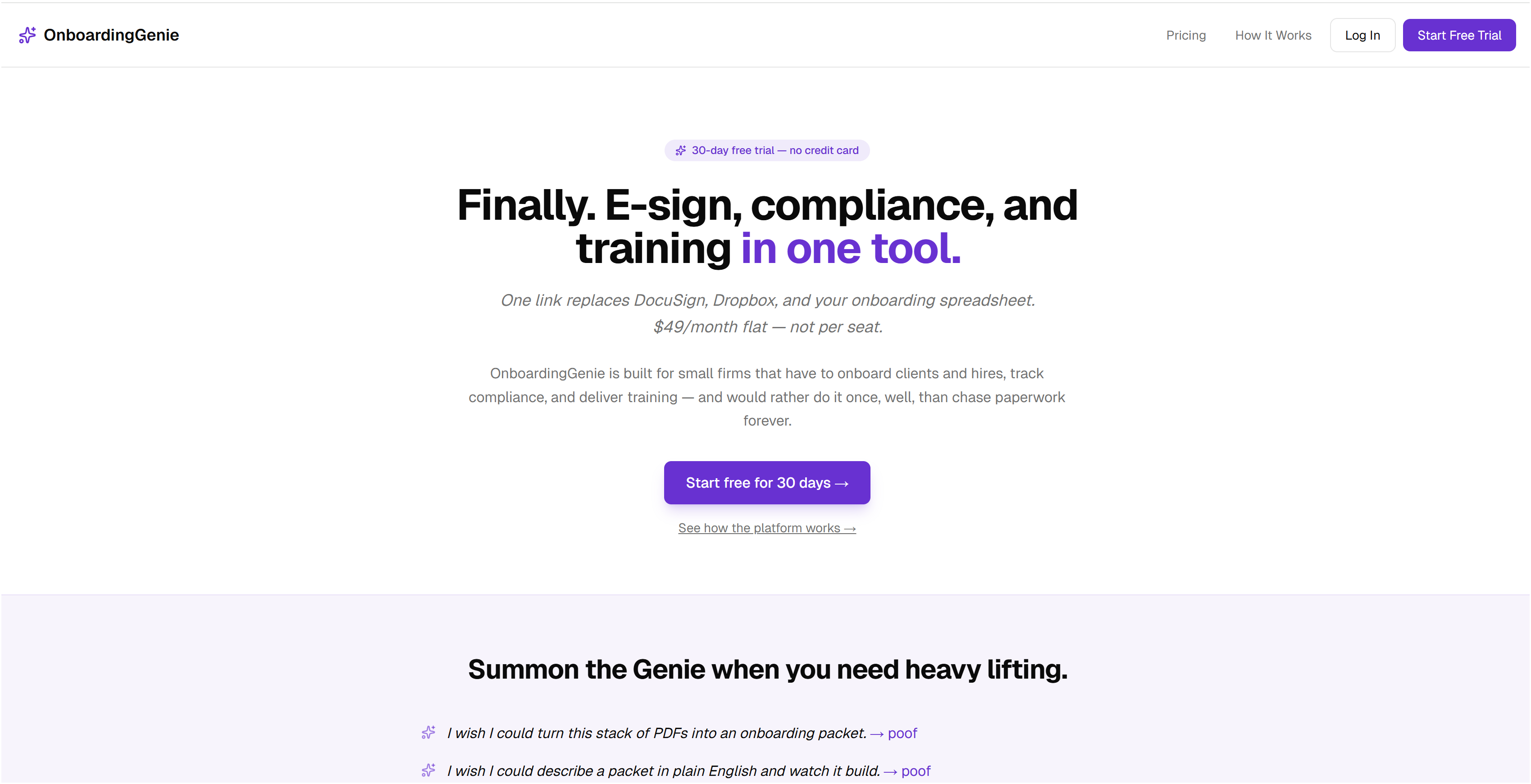
OnboardingGenie was built specifically for this problem. The platform gives small firms a single source of truth for compliance documentation, with version control, acknowledgment tracking, and exportable audit reports all connected to one branded portal. No spreadsheets scattered across inboxes. No manual PDF assembly. Just clear, organized records that are ready when a regulator asks.
Explore the compliance management tool to see how registers, retention tracking, and evidence exports work in practice. Or get started free and build your first compliance register today without the enterprise price tag.
Frequently asked questions
What counts as 'evidence' in compliance documentation?
Evidence is verifiable proof linked to your controls, such as signed acknowledgments, time-stamped records, and exportable logs an auditor can inspect. Per regulatory writing guidance, audit-ready documentation must be evidence-linked to satisfy reviewers.
How long should I retain compliance documentation?
Retention periods vary by document type and regulator. SEC audit workpapers are often retained for seven years, but always confirm the specific rule for your industry and jurisdiction.
Does automation reduce the compliance workload?
Yes, meaningfully. Average SOC 2 certification with automation takes around 3.1 months compared to 6.8 months manually, but correct mapping and human oversight remain essential.
What is a documentation register?
A documentation register lists every required document, its legal basis, retention rule, verification owner, and current status. According to compliance program guidance, onboarding compliance should always start with a well-structured register as its foundation.
How should I handle onboarding exceptions in regulated industries?
Document every exception with its rationale and connect it explicitly to your risk analysis. Edge cases and exceptions must be included in your documentation trail to avoid audit surprises and demonstrate a defensible, deliberate decision-making process.